| | | | | | | | Data is provided by |  |
*Stock data as of market close. Here's what these numbers mean. | - Stocks: Welcome to the final week of 2025! Unfortunately it looks like markets may go out not with a bang, but a whimper: The Santa Claus rally stalled today as tech stocks sank, dragging the rest of the market down with them.
- Commodities: Silver has been one of the best trades of the year, and briefly broke above $80 per ounce for the first time ever late last night. But the hot commodity staged a serious sell off, plunging nearly 8% at one point as traders took profits.
- More commodities: Oil gained ground after talks between the US and Ukraine ended without significant progress toward peace with Russia. Elsewhere, flaring tensions between Yemen and Saudi Arabia hinted at possible crude supply disruptions.
| |
|
|---|
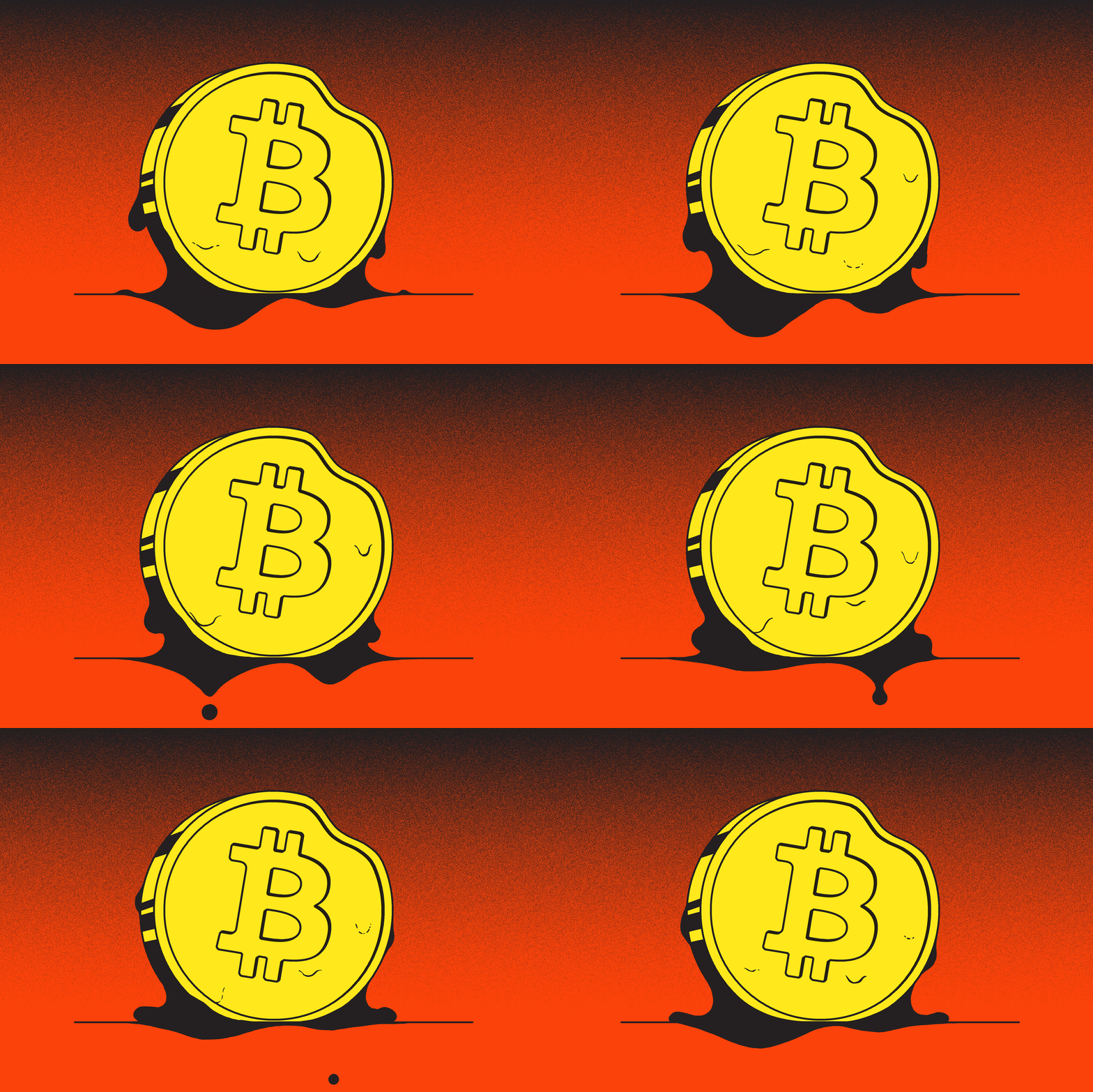
RECAP Crypto came into 2025 red hot. It’s ending the year ice cold. Digital assets began the year by riding the wave of Donald Trump’s presidential victory, with bitcoin climbing above the key price point of $100,000 for the first time on December 4, 2024. President Trump and the First Lady both debuted their own memecoins ahead of the inauguration, signaling crypto acceptance from the highest levels of government. Once President Trump was firmly ensconced in the White House, crypto advocates were sure that this would be their best year yet. At first, they seemed to be correct. In March, President Trump signed an executive order establishing a strategic bitcoin reserve. In July, Congress passed the GENIUS Act, creating regulatory guidelines for things like stablecoins, and building a framework for future crypto legislation. Regulators followed that lead, with the SEC and CFTC ending lawsuits against several major crypto exchanges, and generally becoming more lenient for crypto across the board. That gave banks the green light to begin experimenting with their own digital offerings. Wall Street embraced crypto with abandon, and digital asset treasuries like Strategy become some of the hottest stocks on the market. Then, it all came crashing down Bitcoin couldn’t sustain its momentum, tumbling to nearly $76,000 in April. The problem, of course, was tariffs: The macroeconomic uncertainty that the trade war brought with it left investors worried about risk assets like crypto, and as they pulled their money out of digital assets, bitcoin plunged. In classic fashion, the crypto king spent the year waffling above and below $100,000 as digital assets were pushed and pulled by macroeconomic worries and hopes. When the Fed cut rates, bitcoin soared—but when fears of a slowing economy reared their heads, investors took risk off the table and bitcoin fell—and where the OG crypto went, the rest of the crypto market followed. Perhaps the biggest detriment to crypto’s year was gold. Crypto proponents have long touted bitcoin as digital gold, a safe place to store their wealth while still accruing strong returns. Gold’s record-breaking year turned that wisdom on its head, and investors were all-too-happy to put their money and their faith in old school gold while watching the gains roll in. A year in review Bitcoin climbed to a new all-time high of just over $126,000 in October, and while today’s price of just over $87,000 is far below that point, don’t be fooled—it was still a very good year for crypto. Digital assets took major strides in 2025, becoming a force in markets as crypto legitimacy gained momentum. As you’ll read below, that momentum should continue into 2026—but so will the volatility.—MR | | |
|
|
Presented By CME Group If you’re currently trading the S&P 500 or Nasdaq-100, you could be missing out on a unique benefit that only futures offer. And that’s attaining greater capital efficiency. CME Group explains that with a lower performance bond requirement, equity futures offer greater margin savings compared to stocks, which can require at least a 50% margin. Get flexible contract sizes, including products like Micros, and find the futures contract that best suits your portfolio. Trade futures 23 hours a day, five days a week, which lets you access trading opportunities outside of regular market hours. Skip the potential complexities of shorting stocks or ETFs. Futures can streamline the process by having no locate requirements or borrow fees. Learn more and get started. |
|
FUND MADNESS Exchange traded funds—once known as a low-fee wrapper to track boring, slow-and-steady indexes—have strayed very far from what Jack Bogle envisioned when he created the original index fund. 2025 was a record-breaking year for the market, and brought a huge uptick in degeneracy innovation, particularly in the wild world of ETFs. With regulatory guardrails set to lower even further in 2026, don’t expect the madness to slow down anytime soon. Global assets in ETFs shattered records, climbing above $19 trillion as the bull market roared and the industry brought in new inflows for 77 consecutive months straight. Betting big A few short years ago, it felt like crypto would be forever locked out of the world of blue-chip asset management. But a lot can change in a year. Over the past 12 months, a slew of new products emerged beyond just bitcoin and ethereum ETFs. Some of those launches included spot Solana funds and the first ever memecoin ETF that tracks Dogecoin. Major asset managers, including BlackRock, are preparing to take things a step further, building the infrastructure for tokenized ETFs, which would bring funds onto the blockchain. No signs of a slowdown: Thanks to updated SEC generic standards, expect a wave of newer, volatile ETF products to hit the market in 2026. And despite bitcoin’s recent decline, don’t expect Wall Street’s embrace of digital assets to waver, either. For example, Vanguard, an asset manager that long took a strong stance against digital assets, just announced earlier this month it is going to allow crypto funds on its platform, But in a rare sign of restraint, the SEC shot down the 5x leveraged ETFs that a slew of fund issuers proposed earlier this month. At the very least, we finally know where the line in the sand is. —LB |
|
|
FORECAST After a year where bitcoin whipsawed from euphoria to existential dread, 2026 is shaping up to be the ultimate Rorschach test for analysts. Depending on who you ask, crypto is either headed for the stratosphere, slowing down for a long breather, or falling off a macroeconomic cliff. Here’s where Wall Street is placing its bets. - Standard Chartered struck a cautious tone heading into 2026, cutting its year-end bitcoin forecast to $150,000, half of its previous estimate, and trimming expectations across the rest of the decade. The bank argues that one key demand engine—buying from digital-asset-treasury companies—has largely dried up, removing a source of incremental upside. Still, Standard Chartered hasn’t abandoned its long-term conviction: it maintains that bitcoin could reach $500,000 by 2030, suggesting the current pullback is more of a reset than the end of the story.
- Bernstein remains firmly in the bull camp, raising its 2026 bitcoin target to $150,000 and projecting that the current cycle will peak closer to $200,000 in 2027. Analysts said the recent 30% drawdown barely dented long-term demand, pointing to surprisingly steady ETF flows even during heavy selling. In their view, bitcoin is no longer following the traditional four-year halving rhythm, and has entered an “elongated bull cycle” shaped by structural adoption. Bernstein continues to call for bitcoin to reach $1 million by 2033, framing the volatility as noise within a much larger upward trend.
- Ripple CEO Brad Garlinghouse is unsurprisingly optimistic, and expects bitcoin to reach $180,000 by end-2026. He points to three drivers: gradual regulatory progress, a pickup in real-world adoption, and the entry of heavyweight institutions like Vanguard and Franklin Templeton into the US crypto ETF market.
- JP Morgan takes a comparative approach, noting the widening gulf between gold’s $28.3 trillion market cap and bitcoin’s $1.9 trillion. Rather than seeing that as a limitation, the bank views it as a sign of the upside potential for bitcoin over the next 6 to 12 months. Analysts reaffirmed a $170,000 price target for 2026, arguing that bitcoin’s volatility relative to gold has been steadily declining—a shift that could justify valuations far closer to gold’s over time. In their view, bitcoin’s maturation, not just its momentum, is what supports the bullish case.
- Independent analyst “NoLimit” broke from the pack with one of the few bearish calls, warning that bitcoin could fall below $50,000 in 2026. His concern isn’t crypto-specific but macro-driven: he highlights the widening mismatch between US assets and liabilities; the latter have ballooned from roughly $30 trillion in 2016 to more than $60 trillion today. That imbalance, he argues, could trigger a broader market correction—one bitcoin wouldn’t escape.
No matter where bitcoin goes next, one thing is for sure: It’s going to be a bumpy ride.—SY | | |
|
|
Together With Hamilton Lane The largest investors put billions in the private markets, while retail investors are still on the sidelines. Access the assets that may provide superior market positions and strong pricing power—and can offer steady cash flow—by investing in Hamilton Lane Private Infrastructure Fund on Republic now for as little as $500. |
|
✳︎ A Note From Hamilton Lane Before investing, consider the funds’ investment objectives, risks, charges, and expenses. To obtain a prospectus or summary prospectus, which contains this and other information, visit here. Read it carefully. Investing involves risk. Distribution Services, LLC (fund distributor); OpenDeal Broker, LLC Member FINRA and SiPC (marketing agent). |
|
|---|
|
ADVERTISE // CAREERS // SHOP // FAQ
Update your email preferences or unsubscribe .
View our privacy policy .
Copyright © 2025 Morning Brew Inc. All rights reserved.
22 W 19th St, 4th Floor, New York, NY 10011 |
|












 President Trump is making it easier than ever to become a bank. Here’s why you may start
 No, seriously:
  The US approved spot solana ETFs in October, expanding the number of digital assets you can now find in fund form. Here’s a list of
  Thinking about investing in bitcoin? Here’s
  Here’s a trade: Interested in futures but don’t know where to start? Check out CME Group’s pro-level