 | | | Hello discoverers!At some point in your thirties, you often start carrying a particular kind of grief. You find yourself mourning the years when friends were a constant, ambient presence – when mundane moments felt significant simply because they were shared. Beneath that grief sits a layer of guilt: for the calls you never made, the messages you meant to send, and for letting it get to the point where reaching out now feels like an awkward imposition. Pranav Jain has captured all of this in a short, tender essay about how friendships fray in adulthood and how little language we have for that kind of loss. With romantic heartbreak we can usually rely on a kind of support infrastructure. The dissolving of a close friendship, however, usually goes strangely unmourned. There are no dramatic breakups. “Most friendships dissolve through unattended accumulation – postponed calls, exhausting jobs, geographic distance, emotional fatigue, (...) One day you realise the person who once knew your thoughts now only knows what you accidentally reveal on Instagram stories.” When we were younger, school and university did the work of friendship for us – proximity bred intimacy, repetition bred familiarity. Adulthood dismantles that scaffolding: “Today’s young professionals live inside systems that quietly erode friendship while pretending to celebrate connection. Work consumes emotional bandwidth. Cities stretch distances cruelly. Weekends become recovery periods rather than social spaces. Ambition transforms everyone into project managers of their own lives. (...) We are perhaps the first generation to possess uninterrupted access to each other while simultaneously becoming emotionally inaccessible. We maintain ambient awareness of one another’s existence without participating meaningfully in each other’s lives. I know what my friends eat. Which cafés they visit. Which things they complain about. I know when they get promoted because LinkedIn informs me before they do. And yet sometimes I hesitate before calling because I no longer know the emotional weather of their lives.” One of Jain’s best observations is that adult friendship has gradually absorbed the same logic we apply to everything else. We tend to weigh our relationships through a kind of invisible cost-benefit analysis: “Somewhere along the way, friendships too began absorbing the language of management. We now discuss emotional bandwidth like data plans. Even affection sometimes feels evaluated through invisible cost-benefit analysis: Who texts first? Who makes more effort? Who is emotionally available? Who drains energy? Friendship, however, has always depended on a certain irrational generosity. A willingness to waste time together magnificently. To listen to the same anxiety for the fifth time. To sit through silence. To remain available without agenda.” Like idleness (see DD392), friendship is antithetical to the economic system we live inside, because so much of it is gloriously unproductive and unpaid. Friendship doesn’t show up on any balance sheet, so it gets discounted, forgotten, filed under things that can wait. “It resists the transactional logic modern life rewards everywhere else. Because a real friend offers something profoundly rare: unoptimised presence. Family is structured by blood. Marriage by institution. Work relationships by utility. Friendship survives purely through mutual choosing. Nobody has to stay. And yet some people do.” The good news is that many of these friendships aren’t dead so much as dormant. The thread is still there; sometimes a single late-night call is enough to pull it taut again and find, briefly, an earlier and more reachable version of yourself waiting on the other end. And now to this week’s discoveries. – Kai | | Hello there, and welcome to the Lightning Yellow issue! This is Dense Discovery, your weekly dose of lovingly de-SEO’d links from an algorithmically flattened web. Writing to you and 35,881 others is Kai Brach based in Narrm. In the previous issue, this link got most of the clicks. Got thoughts on this issue? Simply hit reply – I read every email. Happy discovering! |
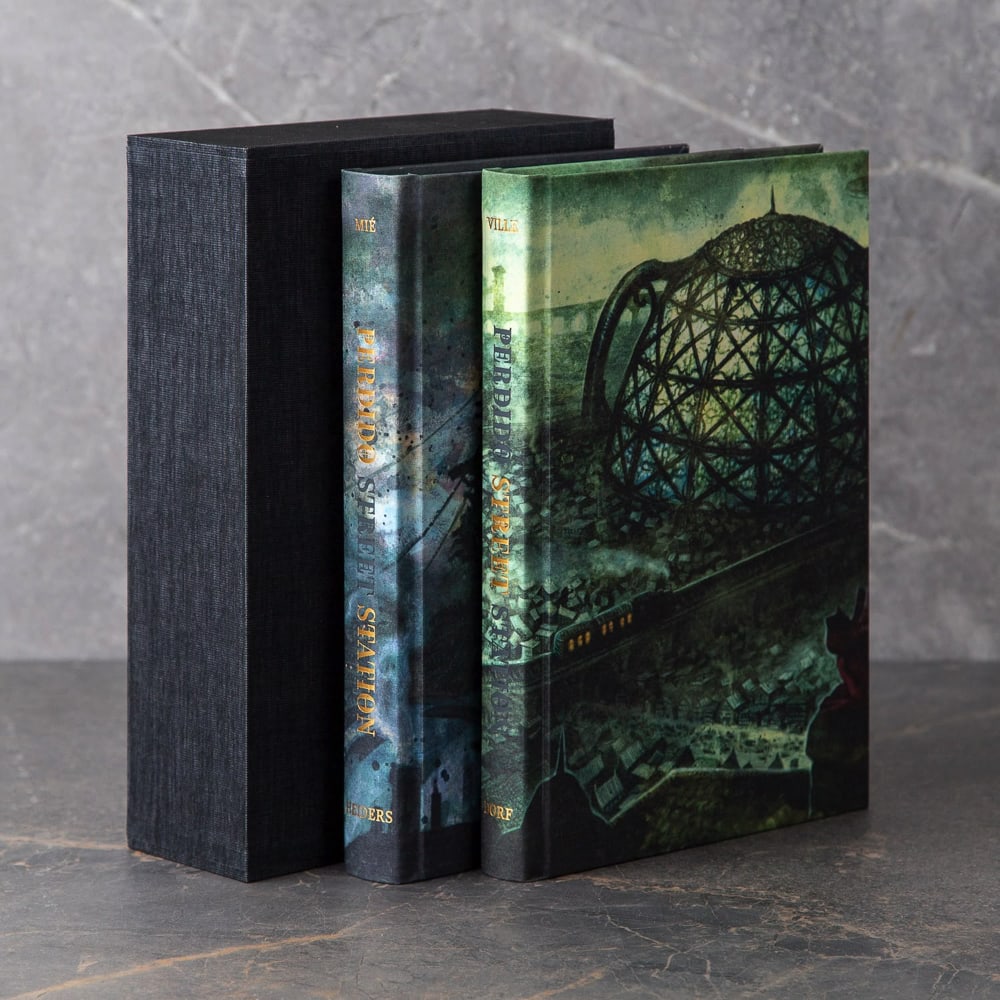
| | | Sponsor | My wife and I publish thoughtfully designed and beautifully illustrated books from here in Ontario, Canada. Our most recent edition is China Miéville’s Perdido Street Station – a genre-defining novel of industrial grime and baroque imagination, and winner of the Arthur C. Clarke and British Fantasy Awards. “I turn away from him and step into the vastness of New Crobuzon, this towering edifice of architecture and history, this complexitude of money and slum, this profane steam-powered god.” Our two-volume Collector’s Edition is slipcased and includes twenty-nine illustrations by Jana Heidersdorf, who has signed each copy. Pre-orders begin on Thursday, June 25th and the first twenty DD readers who use the code DDreader at checkout get free worldwide shipping. See the edition → |
| | | Tools | Free music radio/channels |
Earlier this year, I stopped renewing my Apple Music subscription and have been listening to music on SoundCloud and YouTube ever since. I also recently came across NTS, a radio station that’s freemium, ad-free and broadcasting 24/7 from two different channels. The programming is genre-agnostic and comes from residents and guests worldwide. You can also listen to mixes that are specific to a genre, mood or theme, or tune into one of the infinite channels. There’s a lot there to explore! |
| iOS fingerprinting exposure tool |
Loupe for iOS shows you exactly what any app can read about you/your device without ever asking for permission – from time zone and keyboard languages to paired accessory names and installed apps. It’s a free tool that shows how seemingly innocuous details combine into something that identifies you enough to follow you across the web. |
| Adaptive touch typing trainer |
A smarter-than-average typing tutor that skips the generic lessons and instead uses your keystroke data to generate phonetically plausible practice words targeting your weak spots. The tool watches how you type and adjusts the difficulty around you. |
| Browser-based generative ink painting |
What a geeky painting tool: InkField treats drawing as an event rather than an image – every stroke, pause and gesture is recorded and can be replayed stroke-by-stroke. Its ink physics mimic watercolour bleed, dry brush and salt crystallisation. You can also download someone’s recording from the gallery and paint on top of it, your work branching off theirs. |
| Wanderings | Charming discoveries from the internet’s back alleys that you don’t need but might love. |
YouTube playlists as scheduled ‘broadcasts’: tune in mid-show, just like flipping through cable TV, with everyone watching the same channel seeing the same video at the same time. A browser extension that layers a kind of social presence on top of the websites you visit. Cursor trails from real people and objects you can move create pages that show wear as others pass through. A visual library of Black hairstyles with accurate naming, alternative terms and structured filtering by texture, length and style. Built for illustrators, animators, writers and anyone tired of scattered, inconsistent references. Thousands of Chinese cigarette packs with full imagery, tar and nicotine ratings, pricing and brand histories, all searchable in English or Chinese. A lovingly maintained archive of photographs, stories, letters, sounds and film from across history. Run by one person, Paul, who has spent many hours rescuing forgotten gems from remote corners of the web and culture. |
| | | Books | 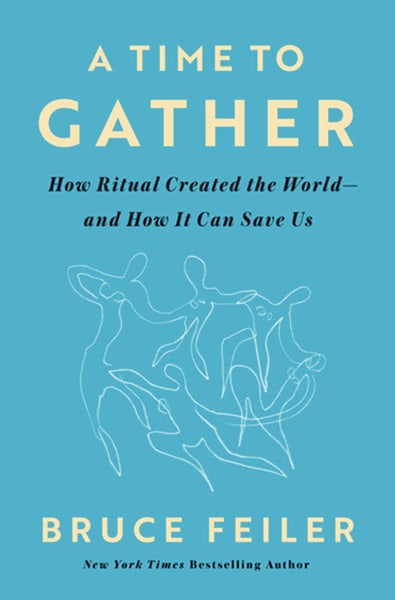 | Rediscovering the power of ritualBruce Feiler travelled across the globe attending births, weddings, funerals and coming-of-age ceremonies to understand why traditional rituals are collapsing – and what’s growing in their place. The result is a practical road map for anyone who wants to bring more meaning to the moments that matter, without waiting for tradition to show them how. |
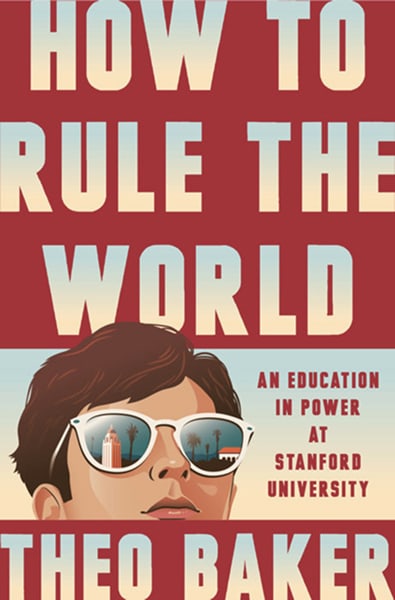 | Stanford, power and hubrisTheo Baker arrived at Stanford at seventeen and, within a month, had begun investigating his own university president. He ultimately brought him down through a student newspaper exposé that made national headlines. Part campus memoir, part investigative thriller, his book offers a maddening look at how Silicon Valley’s next ruling class gets made. |
| Socials | Hard to think of a more poignant expression of the state of affairs in the industry than the Joy of Coding conference taking a break this year. on Mastodon | | | Media | Read | A lovely, tender essay on how adult friendships tend to dissolve not through dramatic fallouts but through slow, unattended accumulation – postponed calls, exhausting jobs, distance and fatigue – and how we struggle to name the grief that comes with it. Pranav Jain poignantly describes this modern erosion of friendship: we have constant digital access to one another, yet very little real presence. |
“Somewhere along the way, friendships too began absorbing the language of management. We now discuss emotional bandwidth like data plans. Even affection sometimes feels evaluated through invisible cost-benefit analysis: Who texts first? Who makes more effort? Who is emotionally available? Who drains energy?” |
| Read | Activist and writer Mariame Kaba with a moving letter to young organisers living through crisis. Hope isn’t naïve but a discipline we practise. She urges us to focus on ‘critical connections’ over critical mass, and to keep taking small, constructive actions even when outcomes are unclear. It’s a steadying piece about how to keep going without numbing out, and why small, stubborn efforts still matter. |
“I’m with Audre Lorde, who wrote that ‘despair is a tool of our enemies’. Why do I believe this? Because despair has a way of distorting, it often pairs well with cynicism, which I see as a way of being that contracts what’s possible rather than expanding possibilities. Rather than being enabling, I have experienced it as corrosive. Are cynical people builders? I haven’t experienced them as such.” |
| Read | Yi-Ling Liu is a journalist who splits her time between the US and China. Here she cuts through the AI race narrative showing how ordinary people in both countries feel like powerless bystanders in someone else’s game. Everyone feels equally tracked, helpless and anxious. The real story isn’t who wins the race, she argues, but how both countries have abandoned the people running it. An insightful, humanising perspective on the usual geopolitics framing. |
“It’s easy to flee the friction of the real world for the comfort of our feeds and to confide in chatbots rather than friends. In doing so, we enable our leaders to leverage our fears and displace our anxieties onto the meme version of a foreign country.” |
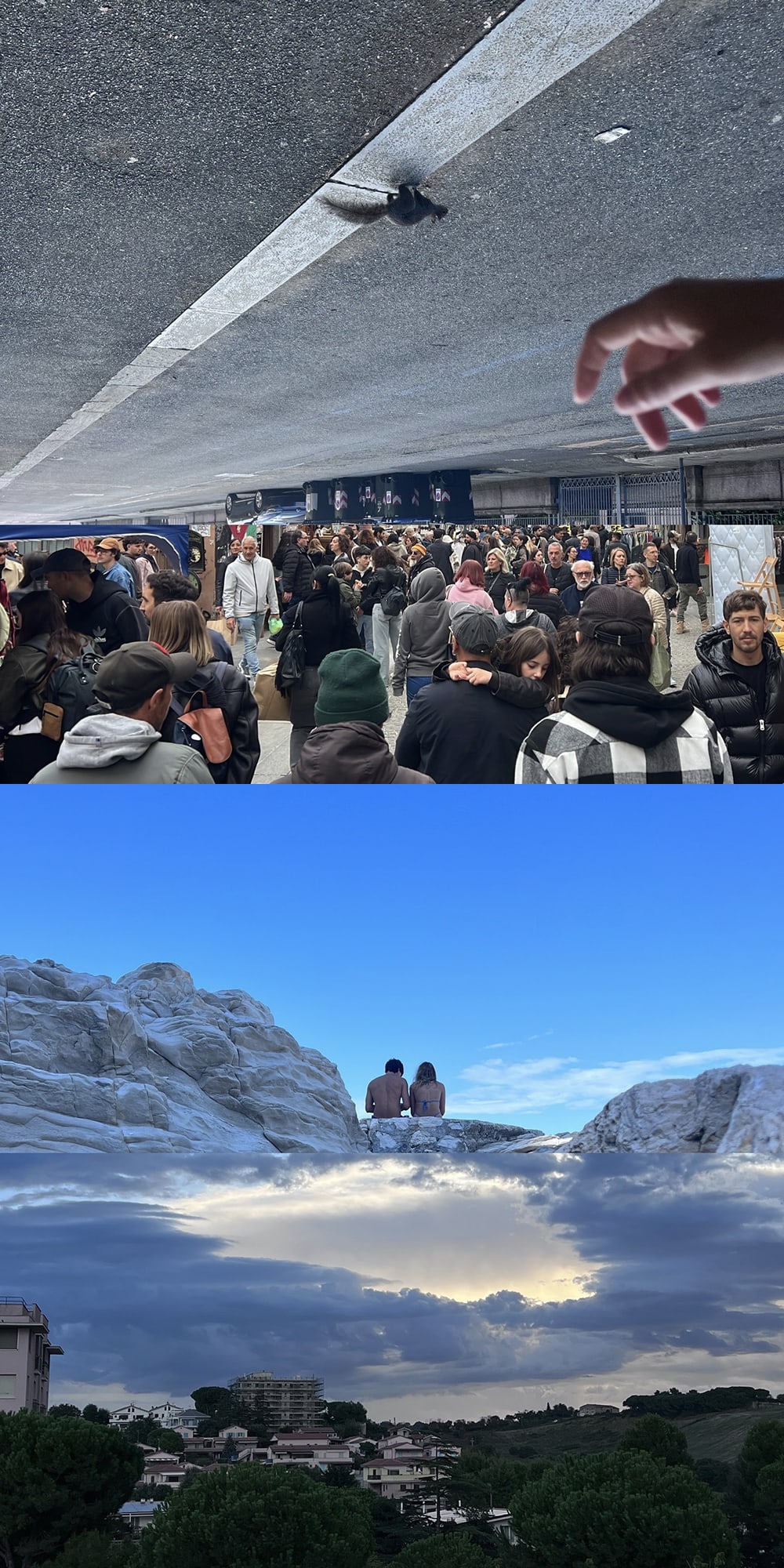
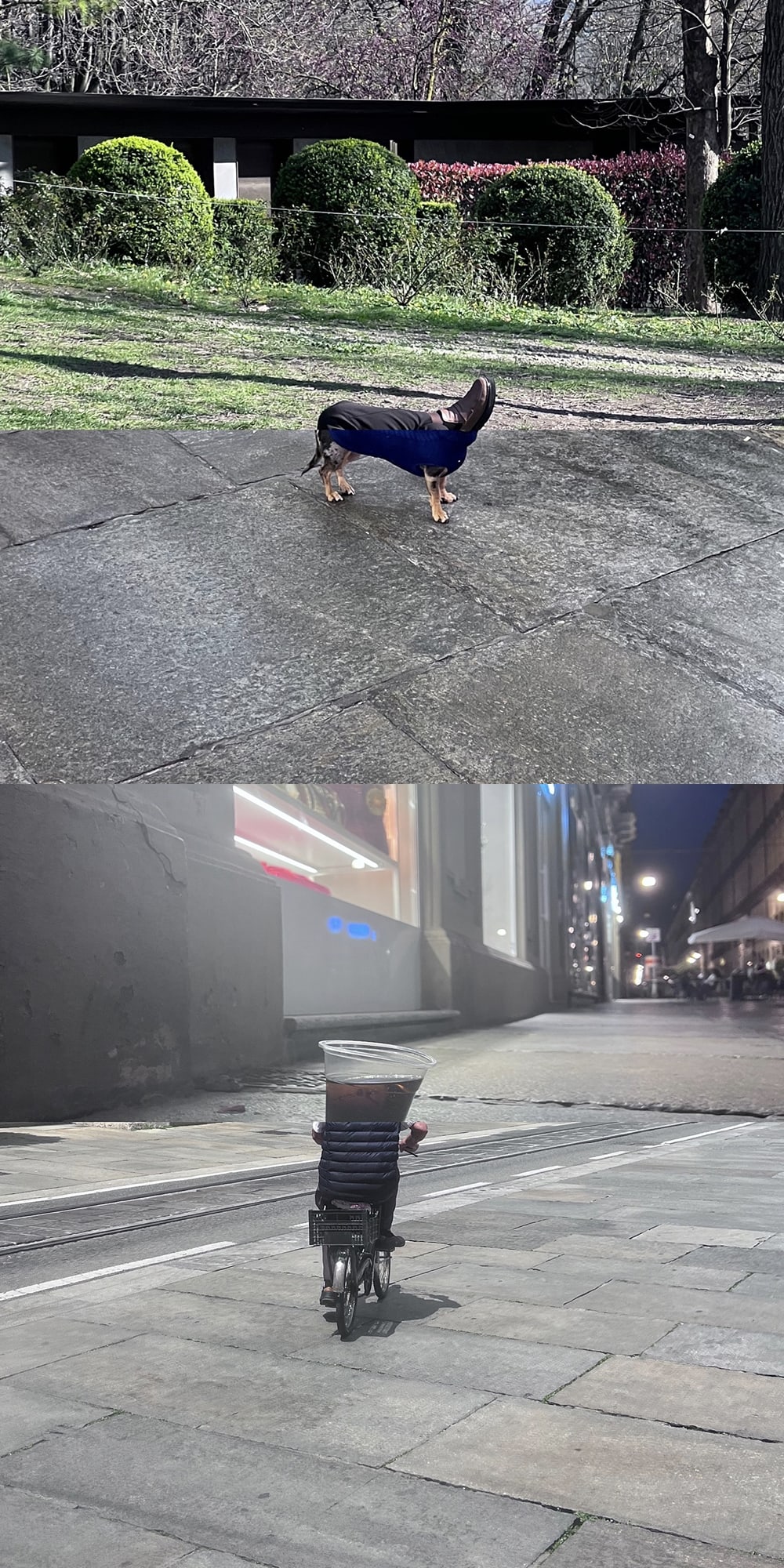
| Inspiration | Fontanesi is a popular, anonymous Insta account (possibly one person, possibly a collective?) that splits everyday photos horizontally to create surreal hybrid scenes. The results are strange and oddly hard to stop scrolling through. |
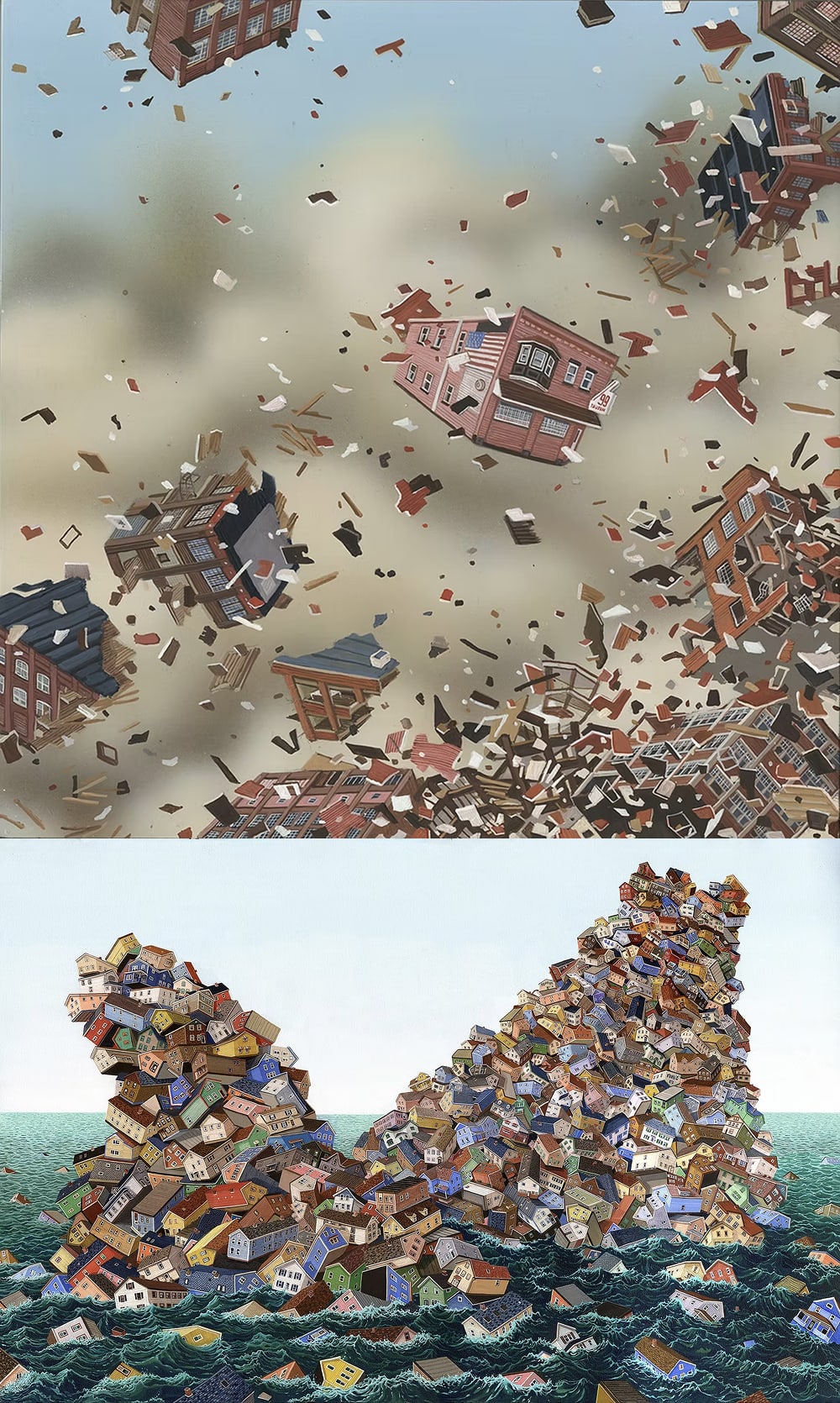
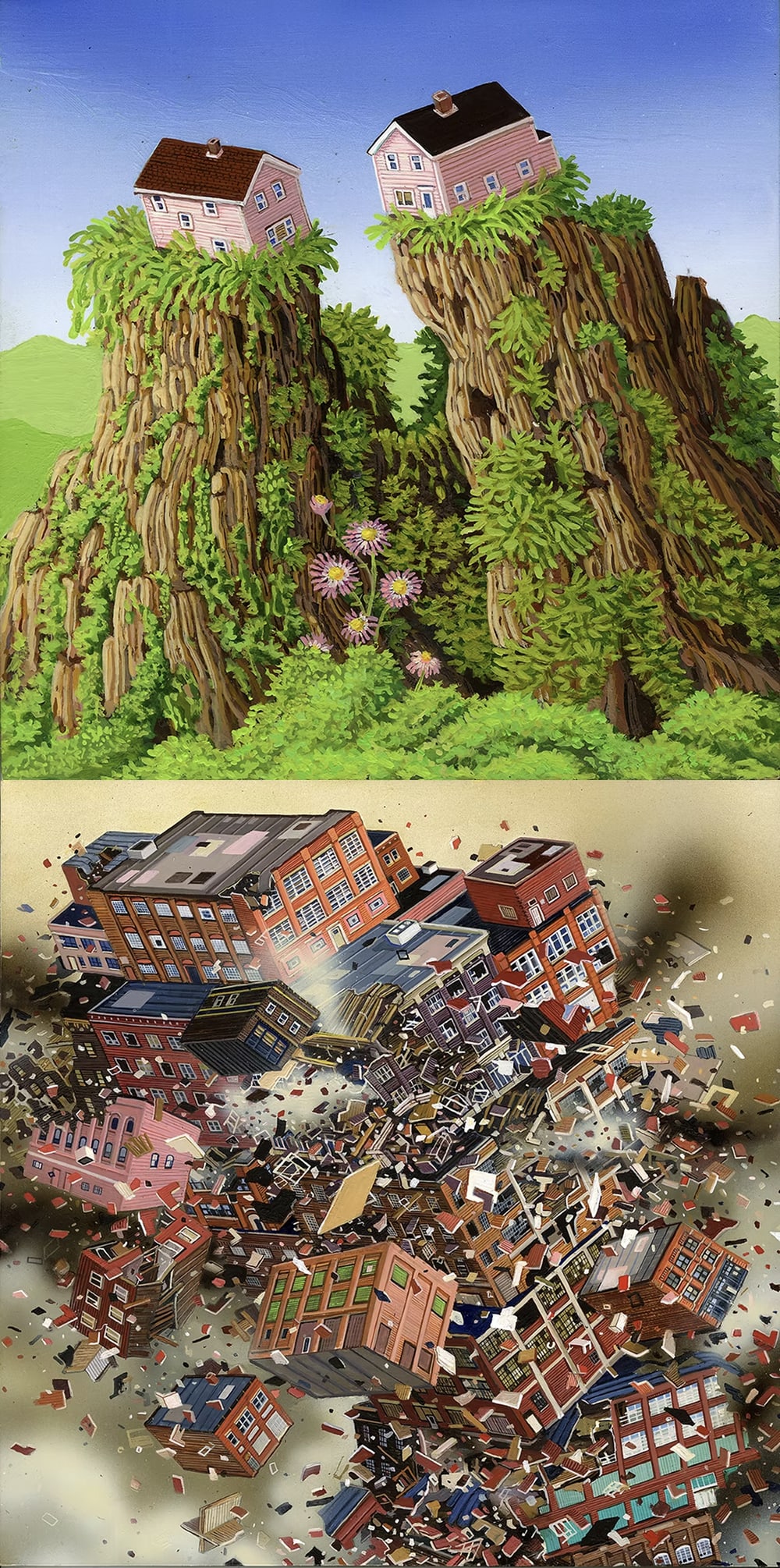
| Cleveland-based Amy Casey paints real houses and buildings from her neighbourhood – stacked in precarious ocean piles, hurled through the air, or perched on mushrooms and tree stumps. It’s her way of making sense of a world in freefall. (via) |
| Font of the week: Rothorn is a geometric, minimal typeface with bold, assertive proportions – built for branding, editorial and UI work that wants to make an impression without shouting. |
| | | Classifieds | A soldier who solved Einstein’s equations in a WWI trench, why farming made us shorter, and Everest’s faked height. A weekly newsletter for the curious – things you didn’t know you wanted to know. Utilising Claude Code, Max Quinn & Co build carefully designed software in a fraction of the time of traditional agencies. Without the AI hallmarks. Kick-off sprints deliver working screens in 5 days. Professional and woo? Leadership Tarot is a deck of beautifully illustrated metaphors to serve as your analogue oracle for planning, reframing and team building. ArtistTracker matches artists with grants, residencies and fellowships that actually fit. ArtistTracker reduces admin and returns your time to what matters: your art! |
Classifieds are paid ads that support DD and are seen by 38,000 subscribers each week. Book yours here. |
| Numbers | 31,700 Here’s one way to put a trillion dollars into perspective. A million seconds is 11 days. A billion seconds is 31 years. A trillion seconds is 31,700 years. You’d have needed to start counting when Neanderthals went extinct. |
1.4 The world has now warmed by around 1.4°C since 1850. It took 148 years for the first half of that warming to occur, and just 27 years for the second half. |
| | | Socials | I love saying ‘of course’ instead of ‘you’re welcome’. Like of course I’m helping you. That’s what I do. You were foolish to even consider an alternate dimension in which I’m not helping you. You idiot. You absolute buffoon. on Substack | | | Mood | | | |
|