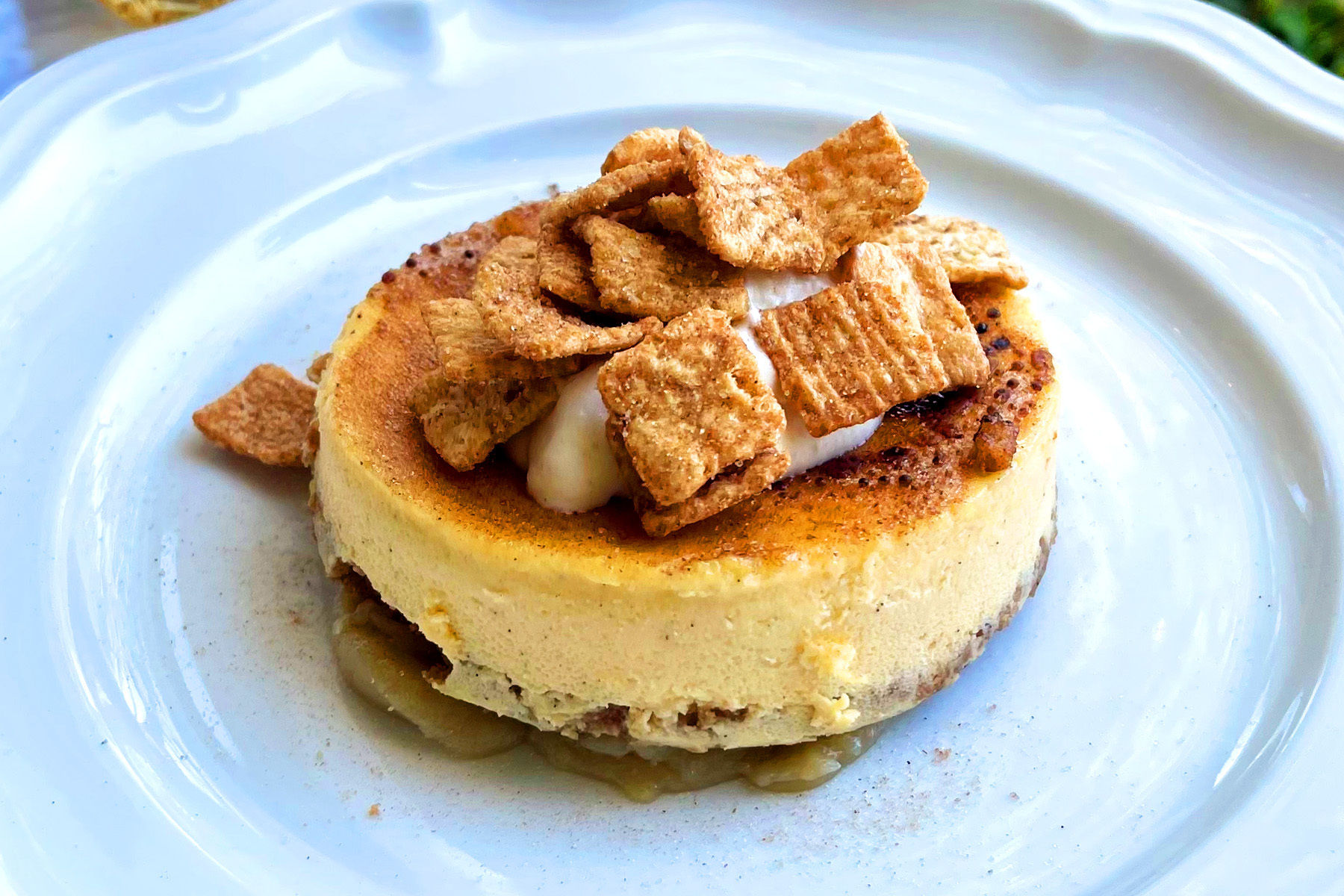
Last weekend, I sat down for lunch at Bistro Amasa in Santa Barbara, California. The newly opened sister restaurant to the Michelin-recommended Barbareño, Amasa nails the casual, coastal elegance that its setting in a Victorian-era hotel begets: Intimate marble tables dot the wraparound porch where guests dine on steak frites, shakshuka, and hot smoked salmon. It’s a classic American Riviera-style menu, but one that, on closer inspection, flashes playful Y2K snack and comfort-food twists; there’s an inventive s’mores dessert made with a cacao-avocado mousse, a Gushers-inspired cocktail, and a Cinnamon Toast Crunch cheesecake that I, as a millennial, have had bookmarked in my “must-try” list for months.
There’s novelty at work here, and also a sense of familiarity. As chef Julian Martinez told me by email, “We try to evoke a sense of nostalgia in our dishes, and Cinnamon Toast Crunch is one of the most nostalgic cereals of my childhood [...] I have eaten cereal two to three times per day for as long as I can remember [...] cereal truly is my personal comfort food.” It’s an elevated nod to Martinez’s own adolescence, and part of a wider national trend I’m observing of desserts embracing turn-of-the-millenium flair.
The millennials, once considered the “youths,” are reaching (or at least approaching) middle age, and they’re bringing back the after-school delights that have been lodged in their memories since the days of Dunkaroos. We could start with the froyo of it all: Go Greek Yogurt, whose flagship is in Beverly Hills, recently opened in Manhattan’s Noho neighborhood around the same time as Myka (originally from Spain, and with another location in Miami); New York City-born soft serve chain 16 Handles just announced that it’s opening a South Florida location; Chicago got its first-ever Greek frozen yogurt shop, Mikono, this spring; and the China-based restaurant chain Mixue, which specializes in tea beverages and soft serve, just expanded to the Bay Area. I would argue that froyo and soft serve never really left SoCal since their Y2K heyday, but it has been intriguing to watch their rise at restaurants like Budonoki, the Los Angeles izakaya whose rotating soft serve has become a menu darling with flavors such as black sesame, banana, and pandan-coconut.
We’re also mid-mania for the TikTok-viral dot cake, a cake cup topped with frosting and rainbow nonpareils that has had the internet in a chokehold, and unleashed a wave of dot cake-inspired lamingtons, lattes, and more. The admittedly hypnotic dot cakes feel spiritually aligned with the appeal of fancy cupcakes and Dippin’ Dots in the early 2000s: We seem to be resuming the ASMR appeal of consuming sweet, colorful, uniform orbs, emphasizing novelty, and almost childlike wonder.
As a millennial myself, there is a Proustian thrill to seeing teens in Ugg boots twirl a froyo spoon in the West Village — a ritual of what feels like a simpler time, if only because that time was my childhood. As the culinary personalities of millennial chefs continue to crystallize, perhaps we can expect more Y2K-era nods, especially as some of the kid-food mainstays from that time risk being discontinued. (Remember when Pasadena restaurant Agnes first paid homage to the now-retired Choco Taco with its own s'mores cocoa taco?) There is undoubtedly the appeal of The Treats of Our Youth, but there’s also a maximalism to the Y2K aesthetic that might be a welcome rebound from the millennial minimalism era that seems to have grown tired. That’s not to give all of this credit to millennials; we can’t downplay that froyo and dot cakes are surging in popularity largely courtesy of budding Gen Z tastes.
Have you spotted any 2000s-coded desserts in your city? Let me know, so I can add them to my must-try list, order another helping of the mosaic jelly cheesecake from Cento Raw Bar, and imagine that MTV still plays music videos.