
|
|
|
|
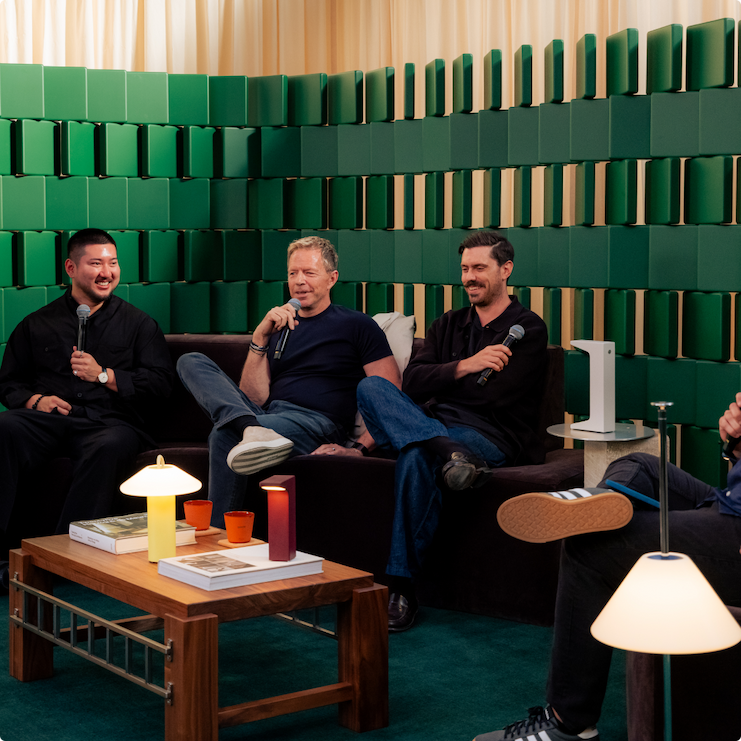
Cutting the Cord: Inside Gantri Wireless with AmmunitionWe recently sat down with Ammunition, the San Francisco studio behind the collection, to talk design, production, and the technology behind Gantri Wireless. Tyler Trykowski, a San Francisco journalist who has held editorial roles at Condé Nast’s Them, VICE, and Playboy, moderated the conversation. What follows is the transcript. |
|
|
|
|
Tyler Trykowski Alright. Hi everybody. Welcome. Thanks for being with us here today. My name is Tyler Trykowski. I am an editor and journalist here in San Francisco, and I'm honored to introduce today's conversation with Gantri and Ammunition. We're gonna be talking about Gantri Wireless, Gantri's first wireless lighting system. And we're gonna be going behind the scenes of how these two companies brought it to life. So welcome. Thanks so much for coming out. And first, I'll introduce our panelists. We have Ian Yang to the left, the founder and CEO of Gantri, which you already know as a company that makes beautiful lighting, as we can see all around us. But just as importantly, they are a pioneer in the world of digital manufacturing. Gantri runs, if you didn't know, one of the world's largest 3D print farms just across the bay in San Leandro. And they use it to sustainably manufacture all of their lamps on demand. Last year, they launched Gantri Made, a platform that allows anyone the ability to develop, make, and sell lighting on their equipment. And last month, they marked their 10-year anniversary with the launch of Gantri Wireless, which reimagines cordless lighting with a focus on user experience and high design. I had the privilege of writing a profile of Ian and Gantri for the spring issue of Ink Magazine, and I know Ian to be an insightful leader who cares as much about design as he does about the nitty-gritty of manufacturing and logistics, which we spent hours and hours and hours talking about. So trust me when I say that, but I'm excited to dive in with you today. And alongside Ian, we have Robert Brunner and Achille. Robert is the founder and creative director of the Design Studio Ammunition, and Achille is the design director of the company. You likely know Ammunition from their work designing Beats by Dre headphones or the original Square credit card reader, as well as products and branding for companies like Polaroid, Lyft, and Adobe. Before founding Ammunition in 2007, Robert was a partner at Pentagram, where he led industrial design programs for Fortune 500 companies. And before that, he was the director of Industrial Design for Apple. His work is included in the permanent collection of MoMA New York and San Francisco, and he is co-author of the book, Do You Matter? How Great Design Will Make People Love Your Company? Achille joined Ammunition in 2012 and has been a leader on a number of award-winning products, since his work includes Beats EP headphones and Powerbeats wireless headphones. He also led the design of Gantri Wireless. His portfolio has been recognized with IDEA, Spark, and iF product design awards, and he is also co-founder of two music labels. So welcome. Robert Brunner I mean, I would say what, 10 years? 10 years? Yeah. This is 10 years. That's amazing. Congratulations. Ian Yang Thank you very much. Yeah, it's, yeah, a monumental year for us. Yeah, thank you. Tyler Trykowski What a great way to market with this amazing project launch. Yeah. Anything you guys wanna add to any of that? I hope I didn't gas you up too much. Robert Brunner I think that was enough. Thank you. Tyler Trykowski That was great. Yeah, thanks. Gantri Wireless, this is your second collaboration with Ammunition. You guys did a lighting collaboration in what year? 2020. 2020. And that was huge for Gantri, I mean for both companies. Probably won a lot of awards, and it was like one of Time's 50 Best Inventions of that year and stuff, so yeah. Robert Brunner Yeah. You know how that started. I bought one of his lamps. Ian Yang Back in 2018 or… Robert Brunner 2017. Yeah, no, I heard about this thing. Gantri and building using 3D printing technology to manufacture was really curious. So I ordered one, and the next thing I get is, once you call me or email me, or I don't remember. Ian Yang Yeah, you saw him. I was like a customer in the product list. Yeah. I look at every customer, and I'm like, oh, this is an interesting person. I should talk to him. There you go. Robert Brunner Yeah. Ian Yang That's a note for all the founders out there. Read your customer lists. Yeah. Tyler Trykowski Okay, well, we'll start the conversation with Ian. You told Fast Company that you were inspired to create wireless lamps after eating out at a dimly lit restaurant, which is something I think we can all relate to. Can you tell us the story of how this collaboration came to be and how those initial conversations went? Ian Yang Yeah. Firstly, just welcome everyone to, again, the shop. This is our first year opening the shop here in SoMa — last year we had an event here, but it was more of an office studio situation. And we opened the doors to the public this year, and it's been really amazing having all the community come here and gather and hang out. So yeah. Thank you. And then welcome. The Gantri Wireless story started quite a few years ago. We were thinking about wireless because it was during the pandemic, and we saw that there were a lot of restaurants that were putting wireless lights on the dining tables, and we were like, oh, that's something that we should probably do. And then we looked at the market size. It wasn't quite at the level that we wanted to be, and we didn't pursue that project. And a couple of years ago, Gantri went from being a predominantly D2C kind of online design brand into the real world, the physical world. And we started talking to our customers and in the design industry and interior designers and specifiers, and everyone was telling us that we had to get on wireless; everyone, everything about lighting is going wireless. And we saw this really great opportunity, a lot of customer demand. And we were like, okay, we have to go and do something about wireless. And then we spent probably eight months of our time researching, building, prototyping these portable, small portable restaurant tabletop products. And after month to month to month of working, I remember we had a little table of prototypes very close to what it looks like over there. And we saw what our products could look like and could function. And it wasn't very good. It was actually quite boring. It was just like any other portable stuff that you see on the market. They were really dim. They were very small, very underpowered. I bought a portable for my own house, and I always forget to charge it. And it never has power and never can use it as a real light source. And then it's just a very terrible customer experience. And so I came away from that meeting feeling kind of simultaneously defeated, but also really excited because, when everything else was pretty bad, it means we have an opportunity. And so I went back to Robert and I was like, hey, I think there's something here, like maybe we can think about portables not just as this small restaurant tabletop thing, but maybe there's a bigger opportunity there where it's not just for restaurants, but for your home as well — like the next iteration of wall lighting could be. And so that's how the project started. Robert Brunner Yeah, I think for us, we first talked about it years ago and it was the restaurant table light. And we said, well, we'll think about that. But I think the light bulb went on for us when we started thinking about it in the context of the home. So portable lighting is not a new thing, right? Anybody's gone camping — there's a lot of rechargeable lights for outdoor, for around the pool or whatever. But I think for us, we started thinking about the notion of light inside the home, and they're tied to outlets, right? It's challenging to take the light where you want to. And so that was something really interesting — thinking about this new context combined with the idea that rechargeable things are part of our lives, right? And the idea of having things that are battery powered and you get this routine of charging. We knew we had to make that as simple and seamless and low friction as possible, but it was something we felt people could do. So it was the idea of, okay, we're gonna create these lights and they're not gonna look like flashlights. They're not gonna look like typical outdoor lighting. They're gonna look like real pieces of beauty that you have in your home, but people can take them where they want to do what they want. And I think that was what got us really excited about it. Tyler Trykowski Yeah. And these lights, they're not just portable lights — the way you describe them is they move with you. They're like a reimagination of what lighting can do. Do you want to talk about what it took to make these lights? There's the Helia wireless system and then the lamps that Ammunition designed for Gantri? Achille Biteau Yeah, of course. It's a pretty atypical project for us because this involved designing a few collections of lights. That's one thing. But then we were also asked to help design the guts, or how that whole system is gonna work. So we took a very holistic approach. There are kind of two big pieces of this. There's the Helia platform, which involves this engine, and that engine connects to components or modules, and that gets pre-certified — the same platform for a range of designs. And then there's this other piece, which is the lamp itself, and everything that lives around that engine. The charging part — you touched on how terrible that experience is. If you use USB-C cords today, they tend to fall behind furniture. You have to go grab it, find a port, and it's kind of a blind experience. All these things tend to add friction to the experience, where we are trying to really remove all of that friction. So we have this charging puck that allows you to place the lamp like you'd drop a mug on a coaster. This whole holistic approach means we had to work with the light designs and the platform in a constant dialogue. So we went through, I don't know, maybe like 150 concepts or something like that — not for the sake of it, but really more to make sure that we're stress testing this platform. We wanted to make sure that creators like us would be able to use that same platform and be able to express themselves as much as they would want to, not feel like they have a set of constraints. In a lot of products at Ammunition, there are a number of constraints, and we have to sort of comply to them — it helps us challenge our work and deliver better solutions. Here, we were literally designing the set of components. So, yeah, that whole thing by itself was rather atypical for us. Tyler Trykowski What was the design process like? I'm sure it was difficult. It sounds like there was a lot going on. Achille Biteau Yeah, there are always various stages, right? When we started together, we discussed the fundamentals, and so it always starts with rewriting the design brief together. We went through that and then work in this space we call “industrial design architectures.” That helps us define what the different components are, how we're going to approach this system, how many parts we need to design, and how they're going to work together. Only once we figured this out and feel really good about the approach we're taking, then we get into designing products. And this goes back to the dialogue I was mentioning between the platform and the products — we keep that dialogue going for a pretty long time. And the rest is just prototyping. I don't know how many prototypes for the platform itself — I'll use the example of this charging dock or charging puck, which went through numerous forms and proportions, testing that docking, making sure it registers perfectly and so forth. So yeah, it's part of our DNA to just prototype like we sketch. There was of course a lot of that involved. Robert Brunner Yeah, I'd add a couple things. There's a culture that exists at our studio. In the beginning, we're always trying to answer this question of what's worth designing, right? And so it takes a lot of effort looking not just at the idea of what the product is, but what's going on in the world around it, and what does that mean, and what is worth this investment that someone is making to actually build this product family. That's a big part of what we do, spending the time to do that and building a framework that we can develop around that will ultimately create something amazing. The other thing you mentioned, the 150 concepts — that's maybe a slight exaggeration. I think it comes from the way I was educated, which is taking a full 360-degree look at everything, right? And really exhausting every avenue that's possible. In a way, part of that's just the creative process of experimenting, but part of it's just building a case for what you want to do. We do that as a studio. I think it drives the team crazy sometimes how much work we actually create that ends up on the cutting room floor. But I think it's an important part of what we do. We have this one room in our studio that was plastered with an enormous amount of ideas for these lights. It's a really fun project, so I think our output was even supercharged a little more than normal. Achille Biteau Yeah. And one aspect to this is that all the rejects — the concepts that were like, well, this is probably not worth making — we still went back to them numerous times to make sure that a change we're doing on the platform wouldn't affect these other ideas. Sure, we're not gonna make them, but there might be other products or creations further down the road that might be similar or have challenges in common with them. So your rejects become kind of a tool in your process. Ian Yang Maybe one thing to add, at a very high level from our perspective, there are two really interesting and challenging aspects of this project. The first is, we're trying to do something no one else has done before and rethink what lighting can be without cords. That was basically the brief — when we went to you guys, we didn't have all the ideas and everything fleshed out. It was just like, oh, what if we can do this? Let's go. Very often the way a client would work with an agency or design studio is the brief is very fleshed out, there's a lot of research, but we really leaned into your expertise in helping us hone in on what this idea really was. I think we went super abstract in our first conversation — we talked about the stars, the sun, the moon, the candle. The first slide of the presentation was thinking through what light really is. And that super high-level thinking was what was really inspiring. You took that blue-sky thinking into something very concrete through a lot of discussions about user experience — where would people actually want to use a light when it's portable, the trade-offs we have to make and all kinds of stuff. So I think that's quite unusual. You took something very abstract and made it into something very concrete, and we had a really amazing time and great experience working with you because of this journey we took together. The second part that's really unique about this collection or category is that Gantri doesn't design anything — we're a manufacturer. So everything we do, we think about from a platform perspective. We have two lines of products: our own branded designs that we commission and sell, and Gantri Made, our manufacturing services product, where designers, architects, and brands can use our technologies and build their own products to sell to their customers. So when we think about a new category like Gantri Wireless, we think about it from both perspectives. We build the platform of what this thing is, and we seed the platform with a collection — in this case, three collections — of really, really good designs. Robert Brunner And it's a really effective way to do it. We did this in the first project too, when we were looking to expand your platform. Same thing here — you could go off and figure out the platform and then develop designs, but in this case, we did them concurrently both times. It's a really valuable way to flesh out a platform that's extensible and allows the level of creativity you want to give to the people who are gonna be designing your products. Ian Yang Yeah, a hundred percent. And as Achille said, the way this platform is designed is a complete departure from everything we've done in the past as a company. We've been around for 10 years, but the way our hardwired or plug-in products worked in the past was quite simple — a cord, a switch, then a light bulb. That's how lamps generally are. But with this new system, we took basically three generational leaps from this old-school 1970s architecture to the 21st century. We built this whole architecture engine that has a battery inside, all the drivers, Bluetooth and wifi connection, cap touch, LED — we went all the way to the most advanced lighting architecture that could be. And we contained all of that technology into this super small, very sleek interior module — I don't know if you can see it on the TV, the one with the light engine. It's almost a product in itself, self-contained in this one module. We call this the H1, and we have a larger version called the H1L, and every product uses the exact same architecture. It doesn't matter if it's a task light or ambient — it all uses the same architecture. So all of a sudden this advanced thing can now go into any form, because we're a digital manufacturer. Any form we can dream of, it can happen. It's a very cool unlock, from a functional standpoint as well as an ease-of-design standpoint. Achille Biteau Yeah, and I think there's something I love when I see the H1 — it's almost this plug-and-play assembly or manufacturing. It looks kind of effortless, right? It's such a simple cylinder or canister form. But we often say the simplest things are often the hardest to make. The fact that it has all the charging interface, battery indicators, all of that baked in, really challenged us: okay, what happens when a lamp has a very small diameter that's very tight around this engine versus a much larger lamp with a much bigger footprint? Is the experience still gonna be the same? How do we not compromise the seamless docking experience? So that's really what we spent a lot of time dialing in. And then there are all the different modules and components that connect to this engine — the cap-touch module, the control module, the LED modules, of which there are two types. Each component has almost a modular aspect to it, in the sense that it can break into pieces and be rearranged to fit a range of designs. So whether it's a circular area of light versus something more linear, vertical, or squat, the goal was really to make sure there's zero compromise and that same platform can be used across all of these designs. Tyler Trykowski We talked before this panel about how there would be a lot of industrial design nerds in the audience, and I hope you all got your fill. So Ian, one thing I wanted to talk about — I read an interview you did with Wired about this new collection, where you talked about thinking about these lamps almost like a candle or an accent to your lifestyle. “A mood enhancer” is a phrase you used, and mood is a word that comes to mind when thinking about a lot of Gantri lamps. The light they produce is soft and relaxing, not harsh and focused — it complements your life. How do you all think about the mood of lighting when you're thinking about design, and how did that play into the wireless collection? Ian Yang Yeah, I think that's a great question. We obviously think about light a lot in terms of how it incorporates into your lifestyle. Particularly with wireless, the lifestyle and functional piece became front and center of this whole category in a way that probably wasn't as much the case for our previous products, because they were pretty intuitive — it's a lamp, you put it on your nightstand, you plug it in, and you're done. But with this cordless category, you have the opportunity to think about what moments in your life could be lived more beautifully if you had a light next to you — like when you're having dinner, or having a party, or having a glass of wine in your backyard staring at the stars. All these moments that are so core to how we enjoy our space and our life haven't been fully lived through, partially because of the lack of lighting. That became a very central piece of the design brief that came out of our explorations. And as part of that, we realized that as a manufacturer, as a lighting company, we think about lighting not just as a design object, but as a companion for the things you want to do and the lives you want to live. Those could be relaxing moments, but there could also be moments that are a bit more productive. One of the things we hadn't done in the past was — previously all Gantri lighting comes in one color temperature, 2700K, and that's it. You can't choose; we don't let you choose. We think that's the best color temperature for relaxing, period. With this new one, we had a huge debate, almost a little pedantic, because we're so obsessed with lighting: do we want to enable another color temperature for work? And when I think about work, I think about that harsh, 4000K overhead white light, and I'm like, I don't want that. So we spent hours in a little room with product design and engineering, tweaking the color temperature up every 50K to hit the perfect temperature we think creative work should happen in. That's a big mindset shift for us — that lighting is not just for mood and relaxing, but should accompany you for all the important creative moments in your life. So all of the Gantri Wireless products now come in two temperatures: 2700K for Relax mode and 3200K for Create mode. That's a big departure from what it was before. Robert Brunner Yeah, I think the idea of mood is interesting, right? Because we all own our moods — our moods are our own, but they're affected by our surroundings and environment. And light is a big part of it. As a species, we're highly affected by light — the quality of light, the time of day, the absence of light — all these things really change how we feel. Lighting in general has always been a big part of creating, enhancing, or shifting a mood, and at best, when done well, it's almost magical how that occurs. The interesting thing about these lights, which I think is highly unique, is that much lighting is about creating something in the environment that's somewhat broad, and these are very specific to you. If you notice, the pool of light is relatively small, because these things are designed to accompany you. You can take that with you wherever you happen to be in the home — that's a unique concept. Achille and the team spent a lot of time really thinking about what this quality of light is that we're putting out, how it spreads, what it feels like, and what that's going to do to enhance, create, or define a transition of mood. Achille Biteau Yeah, a lot has been said here, but for me it always goes back to the fluidity in the ways we live. Every individual, every mood is kind of just… you. I feel like we all have different ways to navigate our living spaces. Some have more of an indoor-outdoor connection; someone might work at their dining table and then move to the kitchen temporarily, and then use the same lamp and move it to their bedroom. There's this constant movement. So the idea that light follows you, and that same mood follows you, is pretty compelling. The other thing I'll say, specific to portable lighting — beyond the two modes being more mood versus create — is the nature of being able to move the light, create a bit more distance from you as needed, or bring it closer to create more comfort or have friends gather around it. I think this really plays a big part in the mood and atmosphere you create. The form, the nature of the product, lends itself to a new type of atmosphere, and that atmosphere is never set in stone. You can decide at any time to change it, to move it, and so forth. Tyler Trykowski Yeah, I think we'll do one or two more questions, then open up to the audience. Ian, this is the first lighting collection from Gantri with the Helia wireless lighting system — it's got Bluetooth and wifi, as you mentioned. What's the future vision of that at Gantri? How do you see these lamps integrating into a smart home, and how do you want to use those capabilities? Ian Yang This idea of a fully smart, home-connected lighting system has been with me since the beginning of Gantri. And I think, over the past 10 years, I was surprised at how little this industry has moved in smart home. When I think about the way I use my devices, and the products I see on the market for smart home devices, I see this emphasis on the “smart,” but they probably forgot the fact that there are home objects, and they have to be designed in a way that fits into the home — we all have different aesthetics and different self-expressions. What really excites me about the Helia platform is that now, with this collection of 10 products and the follow-on products we'll launch on this platform, all of a sudden you'll have access to the biggest variety of smart connected devices you can get. And the way we envision people using the connectivity, or our app, is for them to not use it at all — as little screen time as possible. Even though these are smart products, I think our relationship with technology has evolved over the years, and there's a desire from us, and from our customers, to spend time with their loved ones and doing cool stuff without worrying about their phone, opening an app and turning it on and off. It's almost like the app should disappear. That's our way of thinking about it, but you still want to give people the option to integrate smart possibilities into their life. So, really excited about that. Robert Brunner Yeah, I think we saw it as just putting hooks in, right, for something that might be meaningful. I don't think we envisioned people sitting down and turning their light on and off over their phone — that doesn't feel particularly relaxing. But having the ability for the products to interconnect and possibly do something meaningful, yet to be known or fully understood, was basically the idea. Tyler Trykowski Nice. Robert and Achille, some of Ammunition's most recent projects besides Gantri Wireless include Powerbeats Fit sports headphones and Terra Kaffe's new automatic espresso machines, which I think is right behind me. What's next from you all in terms of consumer products? Robert Brunner Well, we obviously can't say. There will always be a roadmap coming from Beats, which is a wonderful relationship we enjoy and continue. I think, like a lot of us working in the industry right now, understanding AI — especially physical AI, and what that means — is really driving a lot of work in our studio, trying to find ways that are meaningful to place intelligence in products. For example, the possibility of these lights, at some point in the near future, actually understanding your mood and adapting and changing to it. These are the things we're looking at and building on. We've been doing a number of wearable things that involve intelligence, and we still, we're still working on coffee machines and appliances — we have a long history of doing things for the kitchen, so that continues as well. All fun, all great stuff. Tyler Trykowski Ian, can you tell us anything about the future of Gantri and what's next for you? Or same answer? Ian Yang We gotta sell a lot of these things, so that's what we're focused on — that's important. Generally speaking, we think about our role in the industry as an enabler. We love working with Ammunition, and we have a huge network of creators, designers, artists, and design studios that we work with. We've had a lot of conversations with them about how they can get access to Gantri Helia. This first phase, these products are pre-order right now, shipping in October, November, something like that. Next year, we're looking at leveraging the platform and developing a lot more designs from different people on it. That's really exciting for us. When we open up the possibilities of design to more people, we get all sorts of ideas of how designers and creators think wireless can fit into a new lifestyle. So I'm really excited to see that. Tyler Trykowski Awesome. Great. Now we'll open up — does anybody have any questions from the audience? Audience Member 1 I'm wondering how you guys landed on the three collections you did, in terms of form — was there a fourth one that didn't make it, and stuff like that? Ian Yang It's 147. Audience Member 1 Actually, just the three ways that they went… Achille Biteau Yeah, so the three of them are very distinct. I think there's one common thread between them — it's more where the inspiration came from. Most of our team lives here in Northern California, so we borrowed a lot from our experiences navigating the city or where we go on the weekend. The rest, as usual in any project, we proceed by elimination — there are things that just don't work, aren't that compelling. And within a family, it's about scaling it, right? Every family has different sizes of products and different use cases, so that was critical, sort of stress-testing what was promising on one or two products to a family of five or six. The other thing we wanted to ensure was that we conveyed portability in different ways, so the forms speak to different things. They're all very ergonomic, but the manifestation of what portability or a handle should be is very different between each of these three collections. If I take Drift, for example, we made sure that the post itself would fit a range of hand sizes — the diameter of that post doesn't change too much from one lamp to another, because we didn't want to break the ergonomics. Then you have another collection like Eave that has these rod handles, or this kind of post with an omnidirectional handle, that's almost like a new category of product by itself — the idea of a floor lamp that you move from place to place. In general, the handle or portability shouldn't feel dominant in our design — the idea that the handle is there when you need it, but it kind of disappears or falls into the background when you don't. The small Eave here is another example — it pops out when you need it and retracts when you don't. So they're just different ways to express how we can design a handle. Pier is a lot more sculptural, almost an architectural approach to designing a lamp. What's interesting about Pier is that it's a product that's an invitation to rearrange it constantly — you could imagine having two different ones, or different sizes, arranging them together, separating them at other times. This also conveys the idea of movement, just done in a different way. For us, it was: we're building a collection of 10 products — how can we bring a different perspective, as opposed to just having one thread applied throughout all of them? Robert Brunner Yeah, I think the answer to your question — and I don't know if this would be surprising or not — is that when we go through something like this, of course there are objectives, criteria, and constraints, and you go through all this work. But what it really comes down to, and this notion of inspiration, the way I see inspiration, is there's this collection of things you experience as an individual that end up manifesting in emotions that you carry. So ultimately, when it comes down to it, it's literally just what feels right, because you've gone through this experience of developing, creating these things, and all the experiences in your life — every movie you've seen, every building you've been in, all of it. Ultimately you look at something and it feels right. And that's only after we looked at all these things — it just came down to that simple equation. Tyler Trykowski All right, thank you. Anything else, anyone? Audience Member 2 I was curious about the LED module inside the lamps. What's the lifetime of this module, and how long is it gonna work? Also, is it easy to replace or fix if something goes wrong in a few years? Achille Biteau That's almost a question for Gantri engineering. Ian Yang 50,000 hours of LEDs. And the battery — 2,000 full charge cycles. So this should last you 10-plus years, well beyond the design lifespan of this product. We think of these products more like appliances than consumer electronics, so we designed them for a seven-plus year lifespan. It shouldn't break — you don't have to think about it. If it does, send it back to us and we'll replace it for you. Robert Brunner Get Ian's email address, yeah. Achille Biteau The good news is that designing a platform for this almost plug-and-play assembly means disassembly isn't as hard as with a lot of other products, so there's that aspect too. Audience Member 3 This is a question for Rob. I turned this off and I can't turn it back on. Achille Biteau It might just be shy, or it might be out of battery… there you go. Ian Yang It's not tuned — the touch, we have to tune it still. Achille Biteau That's what I was gonna say — some of these units are pre-production, so there's firmware that's ongoing, all kinds of things we're still debugging. The actual launch is in a few months, when they're fully released. But they're in a pretty good place for where we're at today, I'll say that. Audience Member 2 I was reading about the Gantri plant polymer, and I was wondering what priority sustainability has in the products. Ian Yang As you can see, we're in a basically all-green space. Sustainability is something so core to who we are as a company — when we started, that was never a question. Even 10 years ago, we had a choice of manufacturing our products from ABS and nylon, which are more common and frankly much cheaper materials, or a more sustainable PLA-based material set. We chose the latter, and that gave us a lot of headaches — we had to develop our own materials, because most of the PLA you find on the market wasn't produced sustainably, and it wasn't engineered for robust consumer products. Stuff you get on Amazon — PLA spools — doesn't have the heat tolerance needed for UL certification, and the light needs to diffuse beautifully with no striations. All these factors made us develop our own materials with our partners, which took about two years and had a high degree of uncertainty about whether it would ever come to fruition. Over the last few years, we've made upgrades to all our materials, gradually removing all non-bio-based component pieces of our blends. Our two blends are both 100% biodegradable, but one has 98% bio-based content, the other has 75%. So we've been removing non-bio-based content from our materials over the past few years as well. This is a super important part of who we are. Sustainability and circularity should be built in — we don't want to be in a position where it's a trade-off, because it's just foundational, like safety. No one thinks, do you want to pay extra for your car to be safe? Like, yes, I don't want my car to crash and kill somebody. That's how we think about it — very foundational. Achille Biteau Even the concept of producing on demand, not having this huge inventory — when I look at how much excess stock of products exists around the world, a lot of it never sold, so it ends up in landfill. Removing that inventory piece, producing on demand, is an important act of sustainability in my opinion. Tyler Trykowski Yeah, I think we have time for one more question. Audience Member 4 I'm curious — some people were asking about product lifecycle as well as sustainability. How do you guys balance repairability with disassembleability for recycling? How do you balance that when you're designing products? I think having done some lighting products myself, it's really hard to avoid bonding materials together in a way that you can't separate. Ian Yang Yeah, I can talk about our vision for where we want to go. You're right in highlighting a lot of issues with the way we think about end of life for many products, ours or otherwise. We've focused our attention so far on solving the problem of landfill waste, as Achille said, through on-demand manufacturing and the material itself. But the work is not done — there's a huge part left on end of life. One of the main reasons furniture products end up in landfill is assembly: products made from different materials glued together that you just can't disassemble and sort into useful afterlife parts or raw materials. Our belief is that circularity of furniture products has to start on the manufacturer side — it's our responsibility to make sure a product can be reused, recycled, or turned into something else, and it's actually our business to do so. Our plan is to introduce a circularity program in the next few years where we'd take back the products we sell and either industrially compost them or recycle them ourselves. Because we know what materials we use, we know how to dispose of them and reintroduce them into our lifecycle. There are big technical challenges — for example, materials can biodegrade, but if you re-polymerize them, they lose their strength, so we can't use them in new products; they either have to be composted away or used in non-structural parts, and we haven't gotten around to figuring that out yet. But we have the infrastructure now, given we understand how products come together and every component that goes into one, to introduce that program in a way that's a lot more effective than, say, a recycling company could. Achille Biteau We toured your factory in San Leandro — it's unlike anything. I've gone to a lot of factories for mass-produced consumer electronics, and it's unlike anything — you don't see glue. I'm used to seeing stations of people gluing things to one another, which makes for things that are very hard to disassemble. There's also an aspect of how brave you are in pushing into this space — the diffusers, for example, are kept very raw, just the substrate. And, as Ian mentioned, it's 98% bio-based, with a set of constraints in the material and process — it's 3D printed, and these things can appear slightly imperfect. Unlike something machined or tooled, which tends to be almost perfect and very well controlled, this is a whole different requirement for quality assurance and control. One thing we did on Eave, for example, is start from the constraints of manufacturing and tolerances and ask: how could we design a texture that appears much more controlled than it would if all the layers were simply visible? Sometimes it's really just about venturing into it, leaning hard into it, making a commitment, and letting designers work around the constraints. Quite often, if you think it through, it leads to a great outcome. Robert Brunner The thing I'll say is this is one of the reasons we value this relationship and value Ian so much. In design, you know there's a cost to sustainability, and what we run into a lot with manufacturers is they don't want to pass that cost onto the consumer, and they don't want to bear it themselves. Many things that started out with great intentions die because of that. But Ian is thoroughly committed to this, and it's a constant process of learning and getting better and better. That's one of the reasons we're so happy to be working with Gantri — it's fully supported. Tyler Trykowski All right. Well, thanks so much, everyone. Thanks for coming out. Really appreciate it. |
|