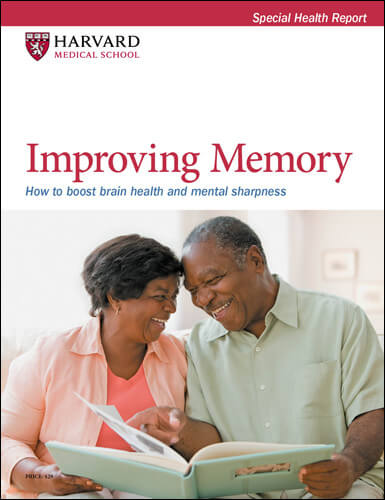
Don't miss out: Sharpen your memory and protect your mind with help from Harvard experts.
Harvard Medical School
Pre-Black Friday sale going on now! Take 25% OFF

A practical guide to keeping your memory sharp

Discover the latest strategies for fighting age-related memory loss

a puzzle of a human head with several 
missing pieces

Dear Reader,

Have you ever walked into a room and forgotten why you went in? Misplaced your keys — or struggled to recall a name that was just on the tip of your tongue?

If so, you’re not alone. And more importantly, you’re not powerless. Thanks to years of groundbreaking research into how the brain works, we now know a great deal about how memory changes with age — and, even better, what we can do about it.

The experts at Harvard Medical School have gathered the most powerful discoveries into one practical guide: Improving Memory — a Special Health Report designed to help you fight age-related memory decline and stay sharp for years to come. With it, you’ll learn how to:

  • Sharpen long-term memory with an easy “rehearsal” trick

  • Make names and faces unforgettable (Using THIS technique is like hitting the “save button” in your mind.

  • Find lost items faster with the “Look, Snap, Connect” technique

  • Memorize long lists with an ingenious reading method that “locks in” key information

  • Eat for a healthier brain with dietary discoveries that really work

  • Hidden causes of dementia Six reversible causes your doctor may not have mentioned

  • Improve cognitive performance with simple lifestyle tweaks

  • Discover which medications may affect memory — and possible substitutes

  • And more!

LEARN MORE

When is memory loss normal — and when is it not?

Improving Memory

By age 50, many of us notice changes in our powers of recall. If you’ve wondered whether memory lapses are part of aging or a possible sign of something more serious, this guide offers expert insight to help you find the answers you need. You’ll discover:

  • How to distinguish age-related memory changes from more concerning symptoms

  • What doctors look for when evaluating memory problems

  • The types of tests used and how to prepare for them

  • Key differences between Alzheimer’s disease and other forms of dementia

  • The latest treatments for memory loss—what they can and can’t do

Don’t accept memory decline as inevitable

Your brain is constantly changing. With the right support, you can give it every chance to stay strong, sharp, and resilient.

Let the doctors at Harvard Medical School be your guide. Improving Memory is filled with useful, easy-to-follow advice you can start using right away.

Order your copy now, and you’ll save 30% off the cover price!

Sincerely,

Howard E. LeWine, M.D.
Chief Medical Editor, Harvard Health Publishing

LEARN MORE & GET STARTED TODAY!
Pre-Black Friday sale going on now! Take 25% OFF
Harvard Medical School offers special reports on over 60 health topics.
Visit our website at http://www.health.harvard.edu to find reports of interest to you and your family.

PHONE ORDERS - please call our toll-free number: 1-877-649-9457.
Copyright © 2025 by Harvard University.
Harvard Health Publishing, Gordon Hall, Suite 013, 25 Shattuck Street, Boston, MA 02115, USA

* Please note, we do not provide responses to personal medical concerns, nor can we supply related medical information other than what is available in our print products or website. For specific, personalized medical advice we encourage you to contact your physician.