Bouncing back from stress
We all experience stress in our lives. Traffic. Monthly bills. Health concerns. Relationship issues. Because the mind and body are so closely linked, these constant worries can take a toll on health, contributing to a host of diseases.
While you can't erase all sources of stress, you can learn how to reduce stress and also build resilience—which is your ability to bounce back from stress.
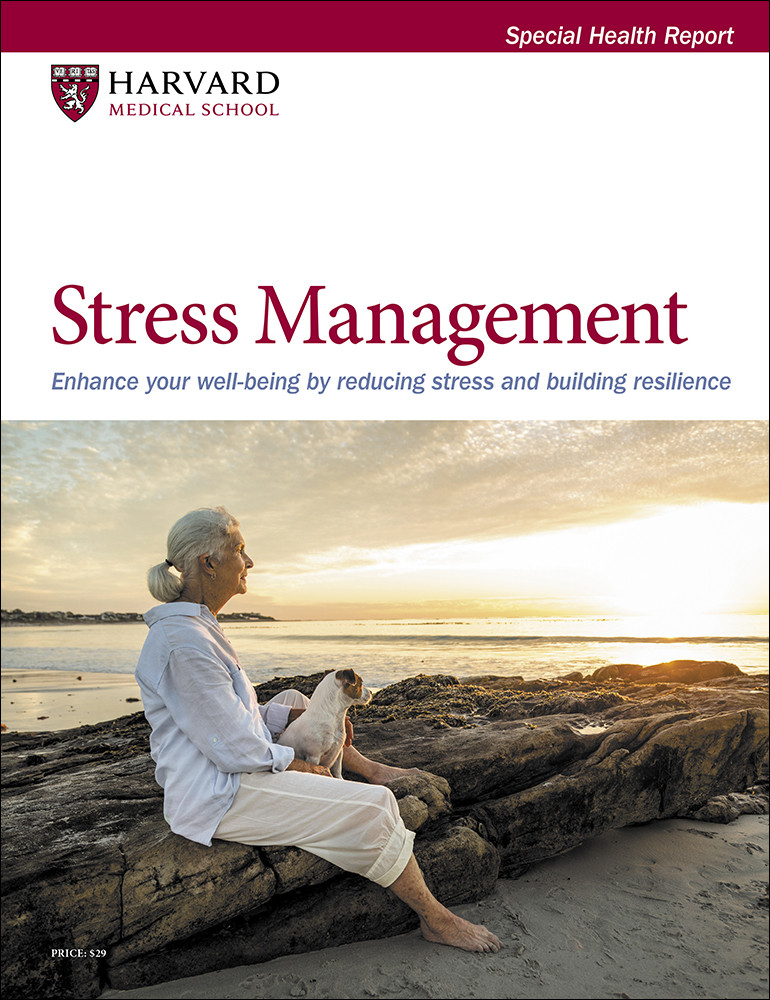
Get your copy of Stress Management
|
|
While some stress is inevitable, when your body repeatedly encounters a set of physiological changes dubbed the stress response, trouble can brew. Stress may contribute to or exacerbate various health problems. But it’s possible to dismantle negative stress cycles. This Special Health Report, Stress Management: Enhance your well-being by reducing stress and building resilience, can help you
identify your stress warning signs and learn how to better manage stressful situations.
|
|
William James was a notable Harvard philosopher-psychologist of the late 19th century and a graduate of Harvard Medical School. James was also a stressed-out melancholic. He marveled at people he called "the healthy-minded"—optimistic and positive people who appeared to live happier and healthier lives. Amid the run-of-the-mill volatility everyone must deal with, James observed that the healthy-minded seemed to turn challenges and
potential failures into grist for opportunities and successes.
The characteristics that James saw as "healthy-minded," statistician and risk-management specialist Nassim Nicholas Taleb called "antifragile." In his book Antifragile: Things That Gain from Disorder, Taleb defines fragility as the tendency to be damaged by volatility and uncertainty—the kinds of things that often create a chronic stress response.
By contrast, says Taleb, the antifragile person realizes that stress is just the price we pay for being alive. Cultivating antifragility helps us use our strengths to overcome challenges and become stronger in the process.
A prime example of antifragility is the Navy Seals. The Seals are able to manage high degrees of stress and still function admirably. Faced with life-threatening situations, they can rapidly change the focus of their attention and address the issue at hand efficiently and flexibly.
Brain scans show that Seals have altered activation in a prefrontal brain region called the insula, which is involved in managing stress signals. As a group, Navy Seals exhibit at least seven characteristics of resilient people:
- Calm, innovative, nondogmatic thinking
- The ability to act decisively
- Tenacity
- Interpersonal connectedness
- Honesty
- Self-control
- Optimism and a positive perspective on life.
Whether adopting a "healthy-minded" mindset, cultivating antifragility, or thinking like a Navy Seal, building resilience is a powerful tool against stress. People tend to think of resilience as a trait that you either have or don't have, but it's actually a capacity that you can develop with the right approach.
For additional information on the dangers of stress and ways to relieve and manage it, buy Stress Management, a Special Health Report from Harvard Medical School.
Image: © Boogich/Getty Images
|