|
"What's on the roadmap?"
After 20+ years of designing software, I’ve been asked this question countless times.
Until fairly recently I answered positively and ambitiously: “We can probably work that in.” Or, “We hope to start this fall.”
But the more specific and enthusiastic the answer, the more proportionally stressful and misaligned the delivery, it seems. Perhaps you’ve experienced something similar in your career. Even if you don’t have a formal roadmap, no doubt you have plans and others who want to know when they’re coming — be they your boss, customers, or a teacher. And the biggest problem with plans is that they never play nicely with our calendars.
Roadmaps Create Debt
We can only share future plans in terms of years, quarters, or months, so naturally we create proportionally specific obligations. Even soft roadmap commitments create small amounts of debt for our future selves and often, our team too.
Do you feel some trepidation around those future plans no one’s been able to get to yet? Held back from acting on an unexpectedly opportune moment? That’s the subconscious weight of debt accrued.
Alternatively, we might be entirely non-committal about future possibilities. While this avoids debt it's frustrating to hear (and certainly isn't inspiring). Yet time is all we have to slot future plans into. So what’s the solution?
There’s More Than One Kind of Time
A few years ago, one of our partners introduced me to an intriguing idea. Ancient Greeks had two words for time but we only have one — and that additional word makes a world of difference.
1. Chronos Time (“chronological”)
Refers to sequential time slotted into predictable categories (months, deadlines, phases). It sounds familiar because it’s the only kind of time we modern folks know. And it’s the root of our troubles with roadmaps and plans. Chronos is useful for goals, execution, sequencing, quantifying, planning, budgeting, incremental improvements, and scaling.
2. Kairos Time (“when the time is right”)
It's opportunistic, unplanned, and unpredictable. We lack a modern word for it, but we can feel it when we enter Kairos time. It happens when we lose all track of time exploring ideas only to “wake up” with an insight that colors all we planned before (if we let it). Kairos is when we get an instinctive sense that it's time to move forward or sense that things aren’t quite ready yet, regardless of what our to-do list or calendar has to say about it. Kairos is useful for discovering transformative potential and is all the things Chronos is not: unmeasurable, unpredictable, unplannable, transformative, and subjective.
In a culture that only sees one kind of time, it feels like swimming upstream to carve out space outside the bounds of our calendar or to-do list. But making space for creative, opportunistic shifts not only results in better long-term results, it helps us feel more creatively inspired in our work. (And uninspired people don’t create inspiring products.)
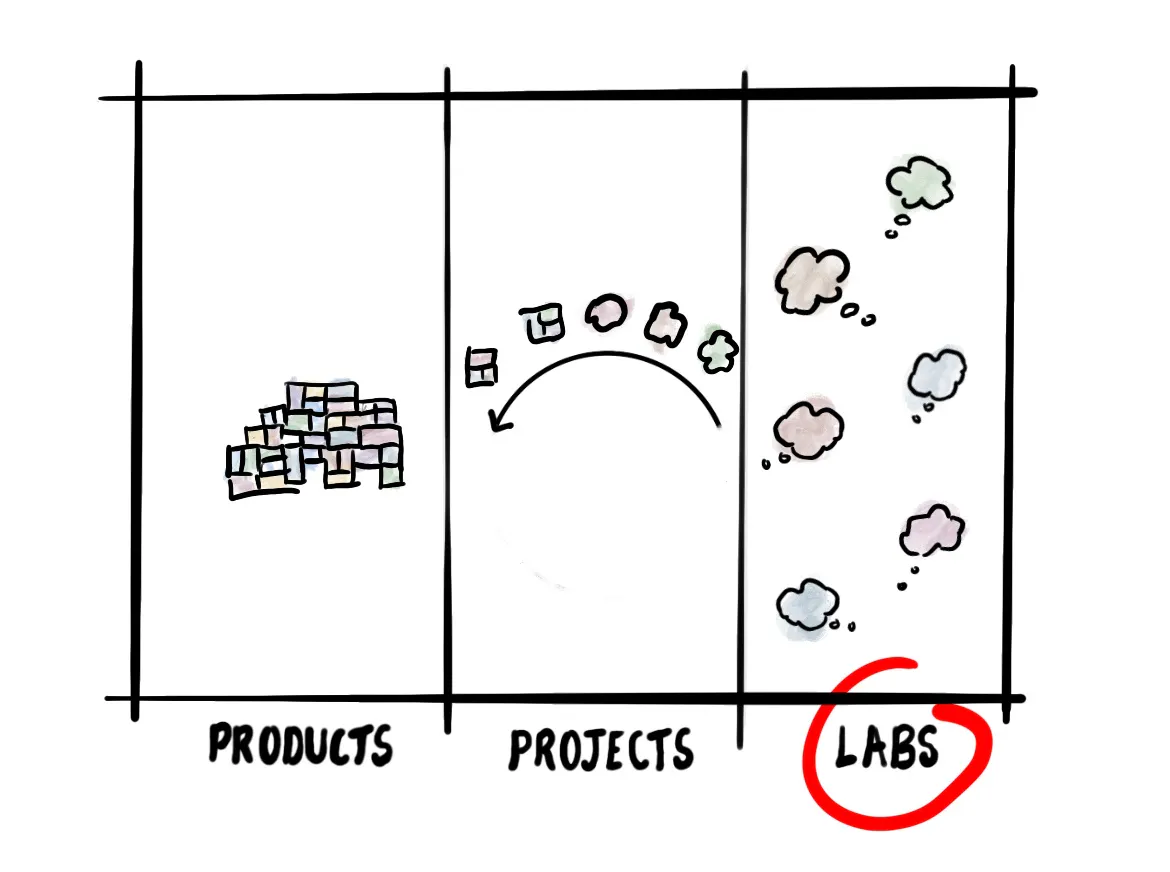
The first step to making space for Kairos time is to name it something other than a project, to.-do list, or any other Chronos tool. Our team named our space "The Labs". It totally replaced our "Roadmap."
|