Psychology and marketing: 5 important principles to use in marketing campaigns
by Phill Agnew, Creator of Nudge, the UK's No. 1 marketing podcast
I spent $67,000 on a university marketing degree, but struggled in my first marketing job. Why? The strategies I’d learned in university just weren’t helpful in my first marketing role. Learning about the 4Ps (product, price, place, and promotion for those who skipped Marketing 101) was interesting. But, that information didn’t help me write a good subject line or landing page.
Fortunately, I discovered the world of consumer psychology, which explores why people make certain purchasing decisions. Understanding buying habits allowed me to directly improve my approach to marketing. And, I wanted to share what I learned with others.
Here are the most important principles I’ve learned while running Nudge:
1. Stand out.
Zappi analyzed over 2,000 American ads and found that those that stood out were more effective. In fact:
- Ads in the top 10% for effectiveness achieved a distinctiveness score of 4.03.
- The very best 1% had a distinctiveness score of 4.15.
- The poorest performers (the bottom 5%) lagged behind with a score of only 3.6.
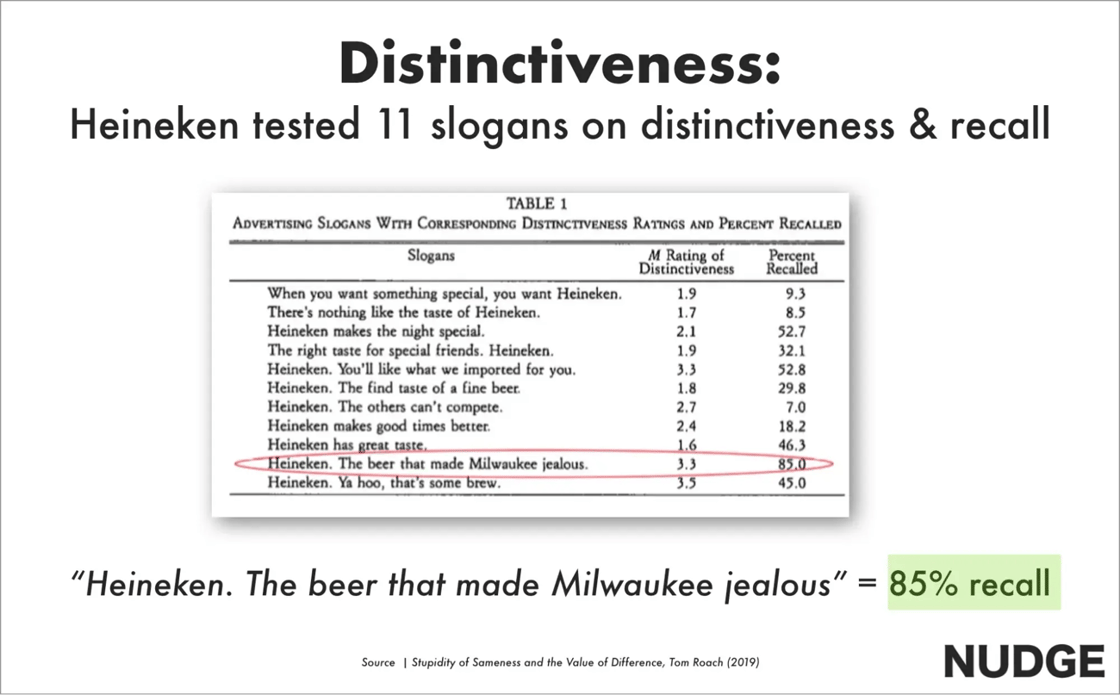
That’s an important marketing lesson: being distinct boosts recall. One study involving Heineken shows this neatly. They tested 11 different slogans with consumers. Stuff like:
- “Heineken. The others can’t compete.”
- “Heineken. Makes good times better.”
Unsurprisingly, those run-of-the-mill taglines were forgotten fast. But, one distinct and novel slogan stood out.
“Heineken. The beer that makes Milwaukee jealous” was recalled by 85% of people, more than any tagline variant.