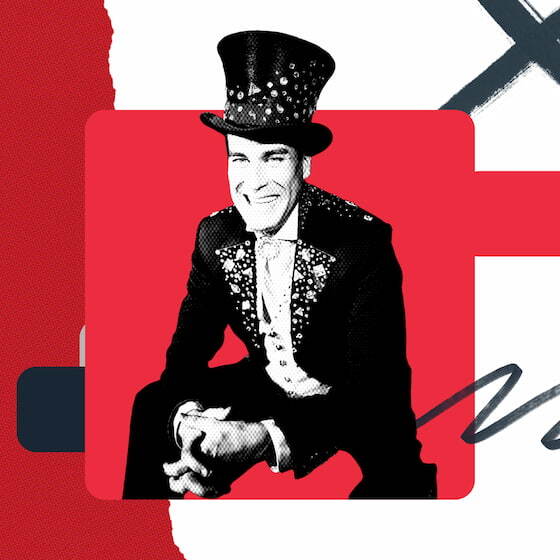
Lights dim. Sounds hush. The aerialist spins into the air. Sequins sparkle in the warm light of a followspot, and my weird little brain wonders: “What does marketing look like for a travelling circus where every other week brings a totally new market?”
When I went searching for the answer, I found, instead, one of the most genuinely profound and heartfelt conversations I’ve had in a long time.
And the reinforcement of my belief that, sometimes, the most important lessons for marketers… don’t come from marketers at all.
Fun fact: I’m sorry, what could be a more fun fact than that he owns his own circus?!
Claim to fame: Kevin grew his circus from a rented tent at a state fair to two touring shows delighting 45 locations across the U.S. and over 200,000 attendees!
Lesson 1: Use your dream to help others achieve theirs.
“All I owned was a significant amount of debt,” Venardos says, recounting the birth of his circus. “It started with a desire to keep working. To not have to rely on someone else thinking I was useful to keep around.”
But life had a lesson in store that would change his very motivation.
“I found this little [carnival] in Snohomish, WA. And I said, ‘Hey, let me put my little circus by your event, and don’t charge me a dime. And I’m gonna work my tail off putting as many butts into those hay bales as I possibly can.’”
It was only meant to be a shrewd business move, a way to stretch their thin budget, but something clicked into place for Venardos.
“The capacity we have to make an economic impact. Where we place the circus, there are businesses nearby. And when we’re successful, they benefit from that.”
That little lesson grew into the philosophy that underpins how Venardos thinks about his crew, his partnerships, and even his audience.
“How can you use your dream to help other people achieve theirs? When I’m not asking myself that question enough, I’m usually on the wrong track.”
Lesson 2: Invest in emotional connection.
“Every [interaction] has the opportunity for us to rob them of their joy or offer a reason to smile. Lift a weight from them or make our needs more important than theirs.”
This holds true with customers, coworkers, and collaborators alike. And it’s that consideration to which Venardos attributes the success of the show. To illustrate, he tells me about what could have been their lowest point.
“When 2020 hit, that investment of love is what carried us through the pandemic.” Social isolation could and did end a lot of live shows. Instead, “people showed up and bought $25 tickets [to a livestream of the circus] when they could have watched YouTube for free.”
And Venardos is quick to point out that love isn’t just for customers. “It’s about the other businesses and other parts of your community for whom the warmth that your flame generates.”
“Places where it’s simply a transactional relationship are generally not the places where we’re most successful,” he says. “When you have an army of people whose success is tied to yours in some way, that’s when things really start to grow.”
Lesson 3: Share your unique struggle.
As our conversation drew to a close, I asked Venardos what he would do differently if he could time-warp back to 2014 and do it all again.
“It might be a trap to torture oneself with such a question. Our identity as The Little Circus that Could was forged absolutely, and only, because I made so many mistakes,” he said and stared into the middle distance.
The first time I saw the Venardos Circus, the show ended as the ringmaster himself came out to thank the audience. His voice quavered as he explained how close the show had come to not making it. How he bet everything on a rented tent and a circus dream. How each one of us there was supporting a whole family of dreamers. I was hooked.
“I don’t wish pain on anyone, but pain is a spoon that carves out space in your heart for gratitude. I think that’s something that connects with people. There’s an emotional resonance.”
People come to the circus for the spectacle. But they come back because they find something deeper.
“That thing you think is your flaw, if you’re willing to get comfortable sharing, is actually your unique struggle. Someone else is out there — and you might not even know them yet — who needs to see the thing that only you can offer because of the unique challenges you’ve passed through.”
It broke my heart that I couldn't squeeze in everything I wanted into this newsletter, but, y'all... our 20 min. interview became a 60 min. communion.
So please click through for two bonus lessons that every team leader or entrepreneur should hear.
We do love to glorify the grind, but that’s exactly what it is. A grating, grueling process chock-full with blockers, failures, red tape, whack tech, and a million different reasons to give up.
Included for your sanity:
Why a Google leader almost quit her dream job
On “becoming your alter-ego” to succeed
How to curve exhaustion by obsession
Turn breaking points → breakthrough moments
Modern tech for better mental health
Personal burnout score sheet
5 ways to reset and recover
Here’s how to take a beat, assess your state, and break down common mental blockers.
“How do you see your marketing evolving as we're entering the holiday season?” — Cristina Jerome, Founder of Off Worque
THIS WEEK'S ANSWER
Venardos says: “We don't really change our marketing for the holiday season as our formula is more targeted to whether we're playing a new city or a returning city.”
Sometimes it’s just like that!
NEXT WEEK'S LINGERING QUESTION
Venardos asks: “What is your single most effective marketing tool in your arsenal?”