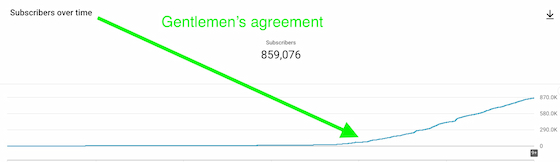
It wasn’t simply that listeners were honoring the agreement. They were sharing it.
“You’ll see it in the YouTube comments. You’ll see it on LinkedIn,” Desormeaux says. “It becomes almost inside baseball for people who know. It’s become a proper noun. And that creates an inclusion factor.”
That inclusion factor is what she attributes the tactic's success to. The very words “Gentlemen’s Agreement” have become a way for listeners to identify with each other. It has transcended engagement farming to become community building.
“‘Like and subscribe’ is such an anonymous way of communicating to people. It’s transactional. I’m talking to you like you’re only what’s on the other side of a button. It’s a signal for the brain to check out,” she explains. “[Whereas,] the Gentlemen’s Agreement is a relationship-building tactic. It’s a goodwill agreement between us and the audience.”
Creating Your Contract
Now, you shouldn’t copy this tactic word-for-word. Not only would that be ungentlemanly, it would also be ineffective. Your unique audience needs your unique language.
But Desormeaux shared some thoughts on how to find the lingua franca for your listeners.
1. Focus on the essential value exchange.
“Everyone who is creating content on the internet is doing the same value exchange with their audience. Whether it’s entertainment, tutorials, interviews, it’s all the same.” You’re exchanging your content for their attention.
But when you simply ask for likes, you’re presenting it as a one-sided equation. Instead, remind your potential audience that the exchange goes both ways.
Parr and Puri make no secret of the amount of effort they’re offering in return.
2. Stay in character.
By now, you can probably spot engagement farming just by the change in tone, without even listening to the words. So many content creators treat these moments as a chore, so that’s what listening feels like.
“It becomes part of the noise of the internet. It’s the same as, ‘Hey, let’s take a quick ad break.’ They’ve heard it so many times, it’s lost its potency.”
Instead, find the wording that matches the soul of your content.
“What is the tone that your audience responds to? My First Million is entertainment first, nerds second, and business third.”
That’s why the Gentlemen’s Agreement is presented as a funny, kinda-nerdy business proposition. It probably wouldn’t work for, say, a podcast about knitting grannies.
3. Repetition. Repetition. Repetition.
“If we had done it one time, it would have just been a novelty. Doing it consistently is what creates a movement. Bringing it back from episode to episode is what lodges it in the brain.”
And they don’t just mention it in each episode. They also use it in their social media posts, create tongue-in-cheek shareable content, and even slap it on their merch.
The result? “The audience recognizes it and uses it in situ.”
4. Don’t worry about being repetitive.
During one episode, Parr mused that the Gentlemen’s Agreement may have lost its novelty, but Desormeaux isn’t worried.
“It’s novel for whoever is hearing it for the first time, for people who haven’t subscribed yet.”
In other words, if you’ve heard it enough to tune it out, you’re probably already a subscriber. (Or you’re breaking the agreement. Tsk, tsk.)
5. Acknowledge the awkwardness.
“There’s value in the subversive. It IS cringe and unlikeable to ask for subscribers,” Desormeaux admits. “But somehow, making fun of the economics of being a content creator helps to claw away the objections of the audience.”
If you acknowledge that it’s cringey, they can’t call you cringey. Part of the success of the Gentlemen’s Agreement is that it disarms the transactional nature by acknowledging the transactional nature.
And, hey, if you’ve made it this far… do a gentleman a favor? Go click on that subscribe button.