|
Ian Crouch
Newsletter editor
|
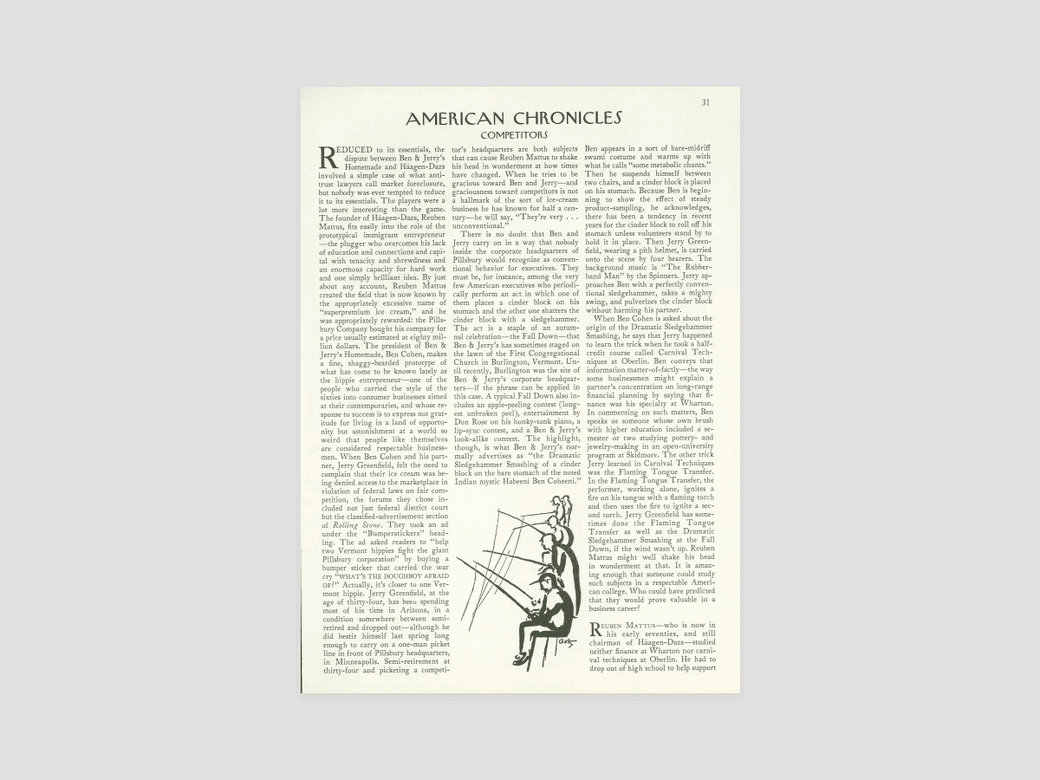
The origin stories of Häagen-Dazs and Ben & Jerry’s, two pillars of the “superpremium ice cream” revolution, have long be legendary. First, there was Häagen-Dazs, created by a Polish immigrant to Brooklyn named Reuben Mattus, an ice-cream man since childhood, who packed his product with natural ingredients and plenty of butterfat, and strung together a couple of ersatz Danish words for a touch of Continental flair. Then there were the two hippie types from Vermont, Ben Cohen and Jerry Greenfield, whose ice-cream expertise came from a few books and from a Penn State correspondence course, but who, out of a combination of delicious scoops (butterfat again!) and madcap marketing, built a minor empire.
Which brand you might have preferred in their early years was a matter of taste, not only in ice cream but in narrative flavor: Did you root for the relentless grinder from the city, who sold people on the idea that they were getting a taste of Europe in every bite (and then sold his company to Pillsbury, for an estimated eighty million dollars)? Or for the goofy college-town pair, whose sense of infectious joy led them, somewhat backwardly, into success? Either way, the stakes were low. Ice cream is fun.
But then, in the mid-eighties, the lawyers got involved. As Calvin Trillin reported at the time, Ben & Jerry’s was trying to expand its sales into southern New England, and they’d accused Pillsbury of imposing exclusive contracts on distributors, with the effect of keeping Häagen-Dazs’s competitors out of stores. The case was eventually settled out of court, but not before Ben & Jerry’s seized on the controversy to drum up a semi-grassroots pressure campaign against what Trillin observed was “the sort of huge, faceless corporation that makes a perfect foil for a company whose founders have their faces right on the pint container.” Ben & Jerry’s took out classified ads in Rolling Stone, introducing the slogan “What’s the Doughboy Afraid Of?”—calling out Pillsbury’s famous giggling mascot. The phrase soon appeared on bumper stickers, T-shirts, and bus signs in Boston. The company set up a hotline for supporters to call to learn how they could get involved, including by joining a letter-writing campaign directed at the chairman of Pillsbury. The whole thing was, like their product itself, a whole lot of fun.
Times, of course, keep changing. Häagen-Dazs is now under the corporate umbrella of an even larger parent company than before—the second-largest ice-cream producer in the world. Ben & Jerry’s, not to be outdone, is owned by the first-largest. In this private-equity, sovereign-wealth-fund modern reality, Trillin’s wry, anecdote-packed story feels like a fresh, cold rush from the past, when corporations were a little smaller, or at least a little sillier. It should give you plenty to talk about as you’re standing in line for a cone on a hot summer night.
|