Return to a story that shows how hard-working nurses created the foundation of modern U.S. medical care during the American Revolution.
Keeping you up to date with the most recent news from the University of Pennsylvania


|
June 26, 2026
|
|
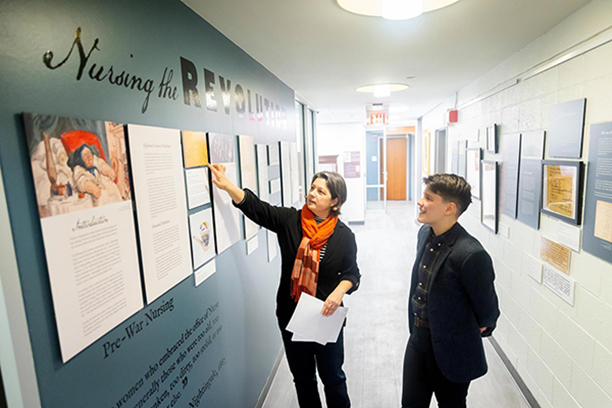
During the American Revolution, hard-working nurses created the foundation of modern U.S. medical care. But curators at the Bates Center for the Study of the History of Nursing say that these figures are largely invisible in the historical record.
“There’s so little archival evidence of nursing and women in general during this time period,” says curator Jessica Martucci (left). “How do you piece together what their contributions and roles were on the little evidence that we have?”
As part of this week’s coverage of America 250, revisit a story on “Nursing the Revolution,” an exhibit running through Nov. 20, that traces the evolution of nursing as a profession and the influence of Black and Indigenous nurses. The exhibit also documents—for the first time—the names of about 150 nurses during the Revolution.
Other pivotal aspects of early American healthcare are being highlighted at Pennsylvania Hospital—the nation’s first chartered hospital—where the Pine Building has been transformed into a museum spanning 275 years of medical history.
At the time of the hospital’s founding in 1751, the idea of having a designated place to take care of people in the colonies was groundbreaking. “It’s been here for a very long time, and there are reasons for that. A lot of it has to do with the people,” says lead archivist Stacey Peeples (not pictured). “This all started by wanting to help others. It all goes back to the idea of compassion.”
|
|

Penn Today’s coverage of American history continues as we approach July 4 and the country’s 250th anniversary. From daily life in the Revolution and the origins of the post office to “Common Sense” and colonial economies, visit the Penn Today website for more stories on our nation’s early days.
|
|
|
|
 THE ATLANTIC THE ATLANTIC
“If sports leagues and performing artists want to hold down prices for actual fans without enriching ticket speculators, they need the ability to issue discounted tickets that can’t be resold,” writes Judd Kessler of the Wharton School.
Read this story »
|
|
|
Publications may require a subscription. Penn students, faculty, and staff can access some subscriptions through the Penn Libraries.
|
JUNE 27
This new program at the Morris Arboretum & Gardens will encompass several mediums: sculpture, garden features, and selected trees and shrubs. Participants will view “garden rooms” and note how the texture, forms, colors, and movement within nature can be viewed as three-dimensional art. The 1.5-hour tour includes grassy walkways; visitors are advised to wear sturdy walking shoes. Free with Penn ID.
Explore this event »
|
|
|