|
|  |  | Monday, November 3, 2025 | | 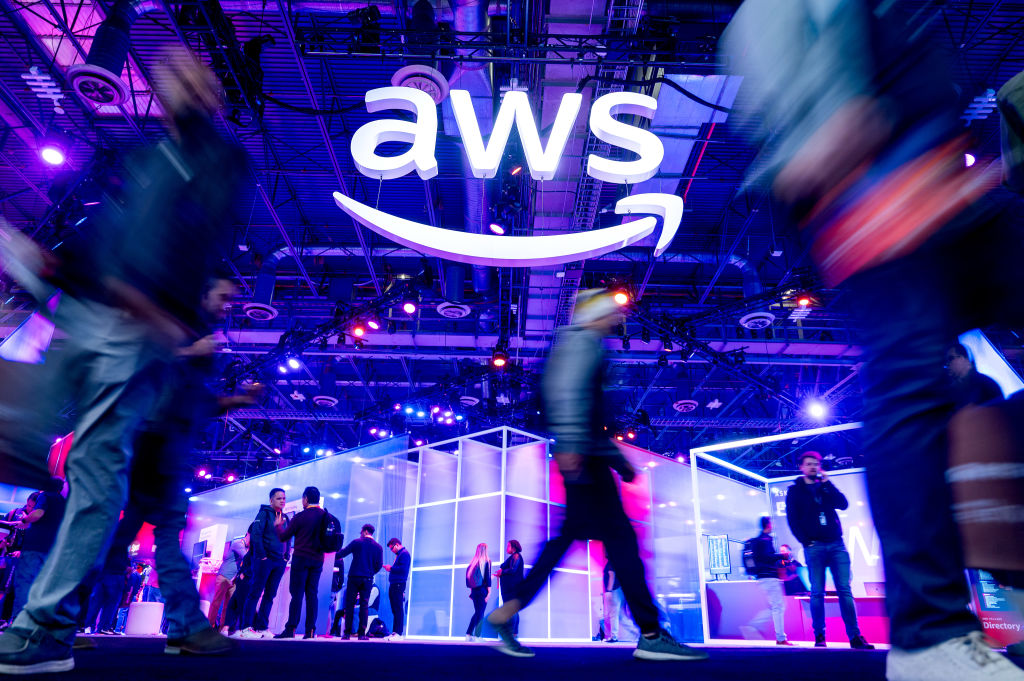 | | Noah Berger/Getty Images for Amazon Web Services | Good morning, Quartz readers! It’s Shannon Carroll with the Daily Brief. Today, Big Tech’s clouds made it rain, ex-Wall Street analysts are teaching their chatbot replacements how to pull all-nighters, dinner was on the richest guy in the
room, and the word of the year… is two numbers. | | HERE'S WHAT YOU NEED TO KNOW | The shutdown is running out of runway. With 11,000 air-traffic controllers working without pay and more than 7,000 delays in a day, carriers warned lawmakers that safety and scheduling can’t survive politics indefinitely. | Federal judges kept food aid flowing. Two rulings compelled the government to use contingency funds it
claimed were off-limits, buying time for millions of families who rely on food stamps each month. | ChatGPT is getting an NSFW
update. The company’s plan to permit “erotica for adults” drags a long-regulated industry into the algorithmic age, where consent and copyright are still unsolved problems. | Wall Street thinks Amazon has found its power source. A $180 billion quarter and re-accelerating AWS revenue showed that heavy investments
are translating into real demand — and a 10% stock jump. | | | Sponsored |  | 9 Amazon Prime Perks You Need to Be Using | Free music/podcasts, access to lightning deals, and try before you buy are just a few of the many perks that Prime has to offer. Make sure you're not missing out, and get the most out of Amazon Prime. | | |
| | CONCRETE RETURNS | If Wall Street ran a city-planning department, this was inspection week. Five tech giants — Microsoft, Alphabet, Amazon,
Meta, and Apple — lined up to prove that their projects are on schedule, and they all made the same point in different fonts. The digital economy is bumping up against physical limits. AI has turned cloud computing into a race for territory — for energy, hardware, and time — and the market has started grading like an engineer, not a dreamer.
The numbers were huge but, more tellingly, heavy. Microsoft set the tone with a quarter that paired record profit with eye-popping investment.
Alphabet followed by outlining another near-hundred-billion-dollar year of buildout. Amazon’s cloud unit has returned to double-digit growth after expanding its capacity to match rising AI demand. Meta’s costs have ballooned for the same reason, because AI at scale requires hardware at scale. Apple didn’t join in on the capex sprint, but it reminded investors that a frictionless ecosystem of devices and services can rival any server farm. Their paths differ, but the logic is shared: Being big means being
durable.
The market has caught on. Wall Street once paid for vision; now it rewards proof. Analysts no longer want promises about AI (see: Meta’s dropping stock price); they want evidence in transformers and terawatts. Taken together, the earnings didn’t crown a new winner. They showed how the game has changed. The companies that once sold weightlessness are now being judged by what they’ve built, what they’ve ordered, and how much power they can lock down. AI may be the reason, but
infrastructure has become the product. Quartz’s Shannon Carroll has more on who’s booking out the grid for the next decade. | | A MODEL STUDENT | The newest Wall Street job doesn’t require Wall Street hours. It’s remote, relaxed, and pays about $150 an hour to teach artificial intelligence how to do the work of junior bankers. OpenAI’s Project Mercury has quietly
hired more than a hundred former analysts from Goldman Sachs, Morgan Stanley, and J.P. Morgan to show its models how to build pitchbooks, run discounted cash-flow analyses, and make the kinds of judgment calls they once made on no sleep and too much caffeine. The same people who suffered through 100-hour weeks are now being paid to teach a machine how to survive them.
For those veterans, the project feels like karmic payback. The brutal early years of banking were designed to test
endurance as much as intelligence, and almost everyone eventually fled the grind. Now, the escapees are training their replacements and getting a better rate for their trouble. Bloomberg’s Matt Levine called the whole thing poetic, a tidy loop where the overworked teach the overclocked. The irony lands somewhere between catharsis and comedy, the kind only Wall Street could produce.
What comes next is less sentimental and a lot murkier. If AI handles the grunt work, there may be no
grunts left to learn the business. Finance educators warn of a missing rung in the ladder, where analysts audit a model instead of building one. The CFA Institute’s Rob Langrick says the role is shifting, not vanishing. The next generation of bankers will need to be fluent in both formulas and judgment, able to catch the flaws an AI can’t see. That may sound like progress, but it also means the human learning curve — the long, sleepless one — could soon be lost to history. Quartz’s Catherine Baab has more on the robots pulling all-nighters so humans don’t have to. | | | Sponsored | | 9 Amazon Prime Perks You Need to Be Using | Free music/podcasts, access to lightning deals, and try before you buy are just a few of the many perks that Prime has to offer. Make sure you're not missing out, and get the most out of Amazon Prime. | | |
| | MORE FROM QUARTZ | | | | | | |  | | © 2025 QUARTZ MEDIA NETWORK (US), INC. ALL RIGHTS RESERVED. | 848 N. Rainbow Blvd. 3017 Las Vegas, NV 89107 United States |
| |
|
|


