Team SaaStr has been living in AI and sales for the past 18 months, but things really accelerated started around June 2025
Since then we’ve deployed 20+ AI agents at SaaStr. Our AI SDRs now send 11-40x the volume of our human SDRs, with better results. Our AI inbound agent has closed over $1M in revenue in its first 90 days. We talk to dozens of CROs, VPs of Sales, CMOs, and founders every month about what’s working and what’s not.
Here’s what I know for sure: 2026 is going to be a rude awakening for the sales profession.
Not because sales is dying. It’s not.
But because the who and the how of closing deals is changing faster than most leaders realize. We’re already seeing $4M+ deals close without a traditional AE ever touching them. We’re seeing AI SDRs outperform humans on volume AND quality. We’re seeing buyers trust chatbots more than salespeople.
And yet... some things haven’t changed at all.
In-person still closes at 3x. You still can’t coach an inbound rep into doing outbound. The best reps still work harder and are genuinely curious.
Below are 15 ways sales have fundamentally changed in the age of AI, plus 5 things that haven’t budged. Whether you’re a founder, CRO, or individual contributor trying to figure out where this is all heading, this is what I’m seeing on the ground right now.
|
|
|
SF Bay Area, May 12-14, 2026 |
The Biggest SaaS + AI Event of the Year.
|
|
|
If you wanted to pick the most dramatic turnaround in B2B software in 2025, MongoDB would be it. Mongo has always been a great company, but growth dramatically slowed in 2024 (fiscal 2025):
The stock was down for most of the year. Analysts were skeptical. Growth was decelerating. The CEO announced his retirement. And then… everything changed.
MongoDB is up 70%+ YTD. From a low around $214 in late August to over $400 today. Two consecutive blowout quarters. A new CEO. And suddenly, everyone believes the AI thesis again.
Here’s what happened — and what it means for B2B software.
The Setup: A Tough First Half
MongoDB entered 2025 in a difficult position.
The stock had been crushed in 2024, falling from its 2021 highs of $585 to the low $200s. Growth was decelerating — revenue growth had slowed from 40%+ in the hypergrowth days to the low 20s. Enterprise software spending was weak across the board.
The narrative was simple: MongoDB was a great company in a tough market.
- Atlas (their cloud database) was growing, but consumption trends were softening
- Enterprise deals were taking longer to close
- The “AI tailwind” everyone talked about wasn’t showing up in the numbers
- Competition from hyperscaler databases (AWS DocumentDB, Azure Cosmos DB) was intensifying
By late August 2025, the stock bottomed around $214. Down for the year. Sentiment was terrible.
And then the turnaround began.
|
|
|
This edition of the SaaStr Daily is sponsored in part by Wistia
|
Your audience's time is scarce, and keeping them engaged takes intention. This series will teach you how to craft webinar experiences that capitalize on every minute.
Learn techniques from an expert so you can capture attention, influence decision makers, move deals faster, and reinforce your brand's authority.
|
|
|
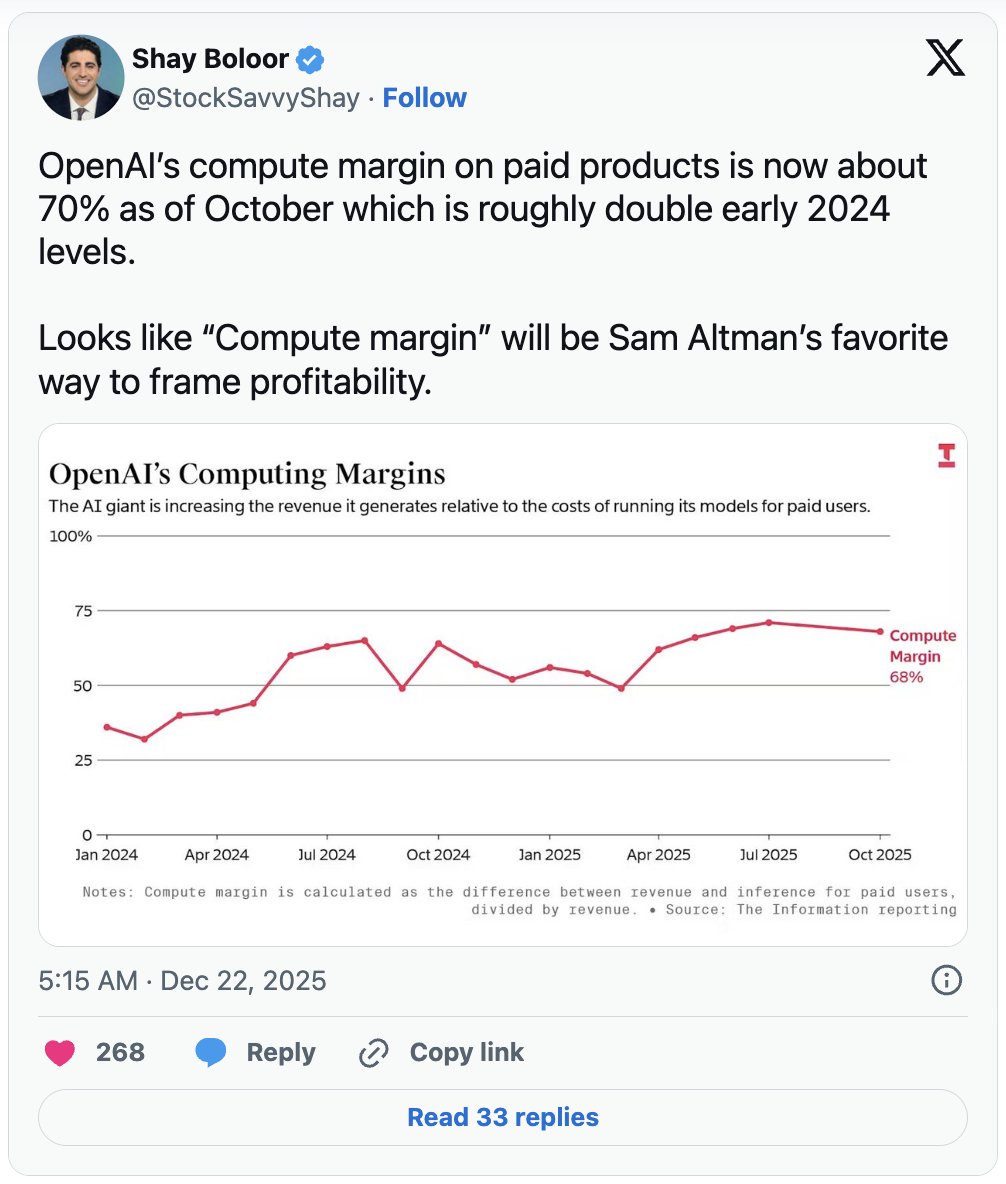
OpenAI (or at least, The Information reporting on OpenAI) just dropped a bombshell: their “compute margin” — the share of revenue left after paying for the massive server costs to run ChatGPT — hit 70% in October 2025.
In January 2024, that number was 35%. They’ve essentially doubled their margin efficiency in less than two years.
|
If you’re a B2B founder or investor, you know exactly why this matters. A 35% gross margin is a services business. A 70% gross margin is starting to look like… software.
So the question everyone’s asking: Have AI gross margins actually turned the corner? Or is this just creative accounting on a burning pile of cash?
And the harder question for B2B founders: Does any of this actually help you?
The honest answer: probably not as much as you’d hope.
Let’s dig in.
|
|
|
This edition of the SaaStr Daily is sponsored in part by Seamless.AI
|
|
|
This is a tough one.
- Wait too long, you run out of time and money in many cases.
- Launch too quickly, you burn your earliest and often most passionate users and fans.
I made this mistake with Adobe Sign / EchoSign. While we were lucky to raise a $2.6m seed round (now it would be called a pre-seed), I was worried wouldn’t have enough time to hit our Series A milestones, so I pushed the team to launch when the product looked cool but wasn’t ready.
But I also launched too early for a practical reason. I thought the team was moving too slowly in general. I thought the pressure of being up on TechCrunch and public would push us to go faster. That part I was right about. We moved faster. But at the cost of a lot of stress.
The product really didn’t quite work yet when we launched. It was slick, but some of the tech just wasn’t ready, and one truly core feature wasn’t available yet. So many of those early users … just went away.
Looking back, we should have launched just 1 release later. I pushed about 60 days too soon, because I didn’t quite know enough about SaaS then.
But much more than that, we would have run out of time.
|
|
|
So this post isn’t meant to be a sub-tweet, or a sub-post — it’s just a general learning over the years. So please, no one take this personally. It’s not about you.
But I’m still going to make one simple suggestion when you go to hire your first set of VPs, your second, or even your third: Beware The Mediocre Recycled
What does that mean? Well, there is a certain type of VP candidate that worked somewhere good once, twice, sometimes even three times. And they seem to know the talk and walk the walk. So they just … keep getting hired. As a VP of Marketing, again and again. A CMO role, again and again. A VP of Sales role. But they actually aren’t that good. They didn’t really do it. They just worked there. And sometimes, even oftentimes, left the place worse than when they got there.
A few tells:
- No CEO-level reference. Any great VP-level candidate should have at least 1 CEO willing to sing their praises. Maybe not everywhere. Maybe a role or two didn’t work out. But someone to say they were great.
- Too many short job hops as a VP / Director. We can debate if this is OK or not early in your career, but someone who never seems to make it a year as a VP … well … they probably won’t at your shop either.
- No one great wants to come with them. This is especially rough in a VP of Sales candidate, but it goes for any leader. And great leader should have 1-2 great folks that want to follow them.
But the thing is, the Mediocre Recycled often talks the talk. Your employees, board members, and more, often will give them a pass and even a thumbs up. They won’t go the extra yard to dig deeper. The Mediocre Recycled are often quite likable.
But I see them all the time. I see very mediocre executives that came into startups I’ve invested in and really get nothing accomplished in 6-9 months or more … then trade that experience for another VP role. Again and again.
|
|
|
© SaaStr 2025
644 Emerson St. Suite 200, Palo Alto, CA, 94301
If you'd like to stop receiving the SaaStr Daily, click here
|
|
|
|