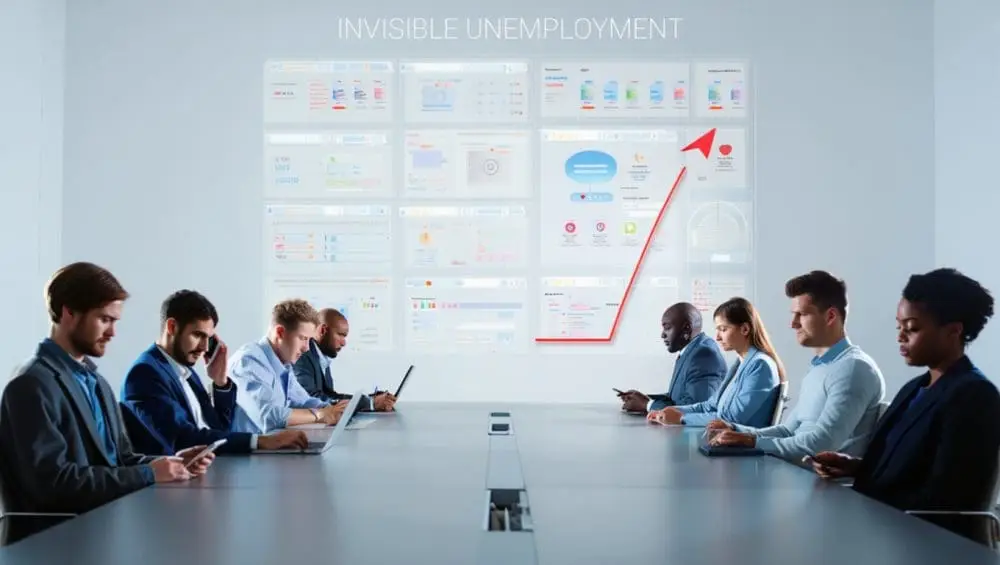
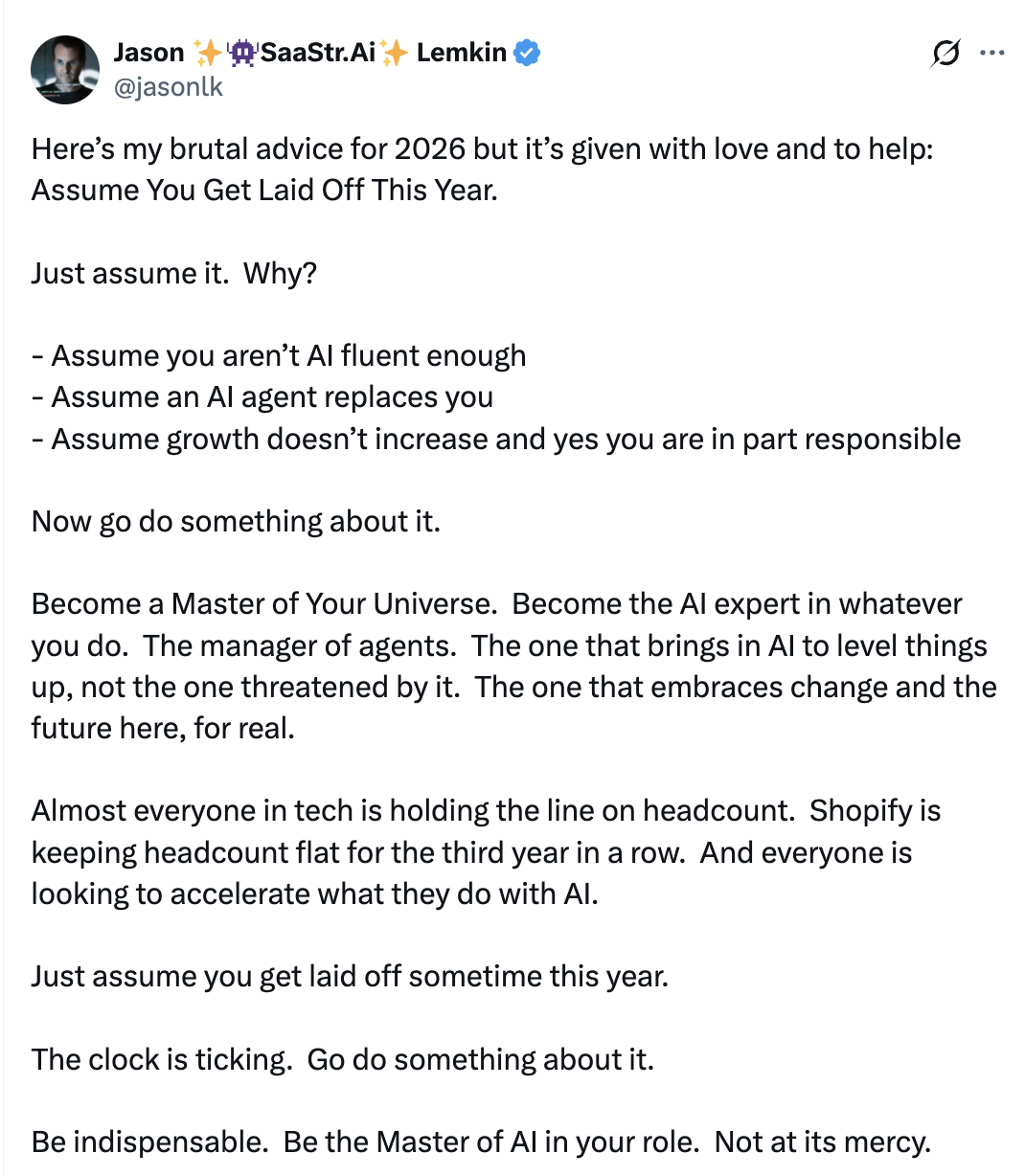
Invisible Unemployment is going to really pick up in tech in 2026.
It’s already here. It just doesn’t show up in the numbers yet. And yes, it’s fueled by AI—but not in the way most people think.
The unemployment rate in tech looks fine on paper. Layoff announcements have slowed down from the bloodbath of 2023. VCs are deploying record capital again. But beneath the surface, something fundamental is shifting. And if you’re a founder, a leader, or someone trying to navigate their career in tech right now, you need to understand what’s actually happening.
At a recent gathering of CEOs, 66% of leaders surveyed said they planned to either fire workers or maintain the size of their teams in 2026. Only one-third indicated they planned to hire. The unemployment rate has already risen to 4.6%—the highest in four years. Economists at Indeed expect it to hover there throughout 2026.
This isn’t a blip. This is a regime change.
The root cause is multi-layered. Let me break it down.
|
|
|
This edition of the SaaStr Daily is sponsored in part by Seamless.AI
|
|
|
The vibe coding hype cycle has a narrative problem.
Every week, someone posts “I built a SaaS in 4 hours!” And technically, they’re not lying. You can absolutely scaffold something that looks like a product in an afternoon.
But there’s a canyon-sized gap between a demo and something people will actually use. I just learned exactly how wide that canyon is. I’ve vibe coded a dozen apps now used 800,000+ times.
My latest? A complex game. A start-up simulator, Founderscape.ai. OK it’s not a B2B app. But how long it took to truly get it into production is instructive.
The Project: Founderscape.ai
I set out to build something I’d never attempted before: a full startup simulator game. Not a landing page. Not a prototype. A real game where you:
- Go from founding to YC to Series A to IPO
- Raise from Sequoia, Benchmark, Founders Fund — with realistic dilution math
- Build a team and poach from your AI rivals
- Manage burn rate, runway, NRR, and churn
- Race to a trillion-dollar valuation before you run out of cash
Think of it as “what if someone turned 15 years of SaaStr content into a game you could actually play.”
The result? Founderscape.ai — a cyberpunk-styled founder simulation with real VCs, real accelerators, real mentors, and an AI competitor that scales with you.
|
|
|
Here’s something almost nobody tells you when you deploy your first AI agent: you’re not eliminating management overhead. You’re trading one type of work for another.
It’s different work. But it requires about as much time for oversight, review, and training as managing humans did.
We’ve deployed 20+ AI agents at SaaStr over the past year. Our team is now about 60% AI. The productivity gains are real. Our AI SDR built $500,000 in pipeline in its first few weeks—better than any human SDR ever did for us. Our AI mentor has done 100,000+ chats with founders. Our AI reviewed 1,000+ speaker submissions on its own.
But here’s what we didn’t expect: we spend roughly the same amount of time managing these agents as I used to spend managing humans. The work is completely different. But the time commitment? Almost identical.
|
|
|
This edition of the SaaStr Daily is sponsored in part by Wistia
|
Repurpose your videos and webinars into high-impact content with insights from marketing, content, and video production experts. Plus, learn how to produce content faster with AI, from clip creation for your social channels to dubbed content for your global audiences.
|
|
|
The B2B market in 2025/2026 is experiencing a paradox that every founder, CEO, and investor needs to understand: there’s more capital, more budget, and more opportunity than ever before.
But the thing is .. that incremental B2B budget it’s not evenly distributed. Not even close.
If you’re not grabbing AI budget, you’re swimming against a brutal current. Let’s break down exactly what’s happening and what you need to do about it.
The VC Paradox Today: Capital and Growth Are Back — But Only for the Select Few
Here’s what’s actually happening in the market right now:
Venture Capital is back to 2021 levels – but 50% of that capital is going into just 4 deals. We’re seeing massive concentration at the top.
Software spend is up a record percentage – but half of that increase is going to price increases from existing vendors, and 30%+ is specifically allocated to AI. The rest? Flat or shrinking.
Unicorns are being minted at a 3-year record pace – but they’re far more concentrated than in 2021. The winners are winning bigger, and there are fewer of them.
|
|
|
We’re all hearing about AI-native companies crushing it. Replit, Gamma, Harvey.
But what if you’re running a real B2B company? One with 400 salespeople, 15,000 customers, and years of accumulated process debt?
That’s exactly where Personio was in May 2024 when their CEO kicked off an “AI Surge Week” — and what happened next is one of the most practical AI transformation stories I’ve heard.
In just six months, they went from “90% of our team uses LLMs weekly” (which sounds good but isn’t transformation) to building 400+ AI assistants, cutting research time from 2 hours to 15 minutes per rep, and booking 140 meetings in 7 days through their AI SDR.
Here’s what Philip learned — the stuff that actually worked, and the mistakes you should avoid.
|
|
|
The Official SaaStr Podcast |
|
|
- SaaStr 836: The Step-By-Step Playbook for Building AI-Powered GTM Teams with Personio's CRO
- SaaStr 835: AI + B2B in 2026: Find the Tailwinds or Get Left Behind with SaaStr CEO and Founder Jason Lemkin
- SaaStr 834: Why OpenAI Doesn't Pay Sales Commission (And Why It Works) with OpenAI GTM Leader Maggie Hott, and Harry Stebbings, Founder of 20VC
Listen on Apple Podcast, Spotify or Google Podcasts
|
|
|
© SaaStr 2026
644 Emerson St. Suite 200, Palo Alto, CA, 94301
If you'd like to stop receiving the SaaStr Weekly, click here
|
|
|
|