In this edition: The increase in forward deployed engineers, the promise of enterprise digital twins, and the rise of the agentic government.
| |
|
The Rise of the Forward Deployed Engineer | |
Job postings for forward deployed engineers shot up 800% between January and September 2025. That demand is driven by a gap that nobody quite anticipated: companies are adopting AI agents at breakneck speed, but most need outside expertise to actually deploy them.
They need someone who can code, consult, translate "agentic AI" into a working solution — and deliver hard truths to C-suite stakeholders without burning the relationship.
Sarah Khalid didn't plan on becoming an FDE. Three years into her career as a Success Architect at Salesforce, her team restructured and she found herself in a role she hadn’t planned on and couldn't fully define. Now she's an FDE Director. The path wasn't a straight line so much as a cumulative one — "my developer side taught me depth, and the architect side taught me perspective," she said. "The FDE role combines both."
Human judgment and communications skills are key for FDEs: When an insurance company's AI deployment nearly went sideways, the fix wasn't a technical breakthrough. Instead, Khalid needed to rebuild the client’s confidence in Agentforce.
As Ruth Hickin, VP of Agentic Workforce Strategy at Salesforce, puts it: "Human jobs become more human." The FDE role won't be a specialty forever. But right now it's a leading indicator of where technical work is heading — closer to the customer, more dependent on judgment, and more human than the job title implies.
Read the full story on the Salesforce Newsroom. | |
 |
|
|
|
The Promise of Enterprise Digital Twins |
Every quarter, finance teams run the same thought experiment: What if we lost our biggest customer? What if a competitor slashed prices overnight? These exercises are useful — but they're still abstract, still guesswork. Now imagine being able to actually simulate those scenarios, with real organizational behavior, real ripple effects, real stakes — without any of the actual risk. That's the promise of the enterprise digital twin.
Formula One teams have used digital twins for years to test thousands of pit stop and tire decisions before a single lap is run. Powered by agentic AI, that same logic is coming to knowledge work — and the companies that start laying the groundwork now will have a serious head start.
Read the full story. |
|
| | |
 |
 |
|
|
|
8 Design Principles for the Agentic Enterprise |
|
When AI deployments fail, it might be tempting to blame the model, the use case, or the humans who won't get on board. But the real culprit is usually hiding one layer deeper: the architecture. As Salesforce SVP Shibani Ahuja writes, "simply plastering an agent on top of an existing but inadequate architecture won't work." Not because models are outdated or lacking but because classic architectures aren’t designed for agent workloads.
So what does a sound framework actually look like? Leaders across the Salesforce product and architecture teams have distilled it into eight design pillars — from building for modularity to instilling the right level of human oversight. The through-line: "Agents need guardrails. So bake governance and trust principles into the very DNA of the Agentic Enterprise architecture."
Read the full story. |
|
| | | | |
|
|
|
Salesforce AI Research Launches AI Foundry to Accelerate System-Level Enterprise AI |
This initiative is focused on developing transformative AI innovation for the enterprise. AI Foundry brings together AI research, strategic customers, and academic partners to develop, test, and validate new AI capabilities designed to move from foundational research to product innovation faster than ever before.
Read the announcement. |
|
| | | | |
|
|
|
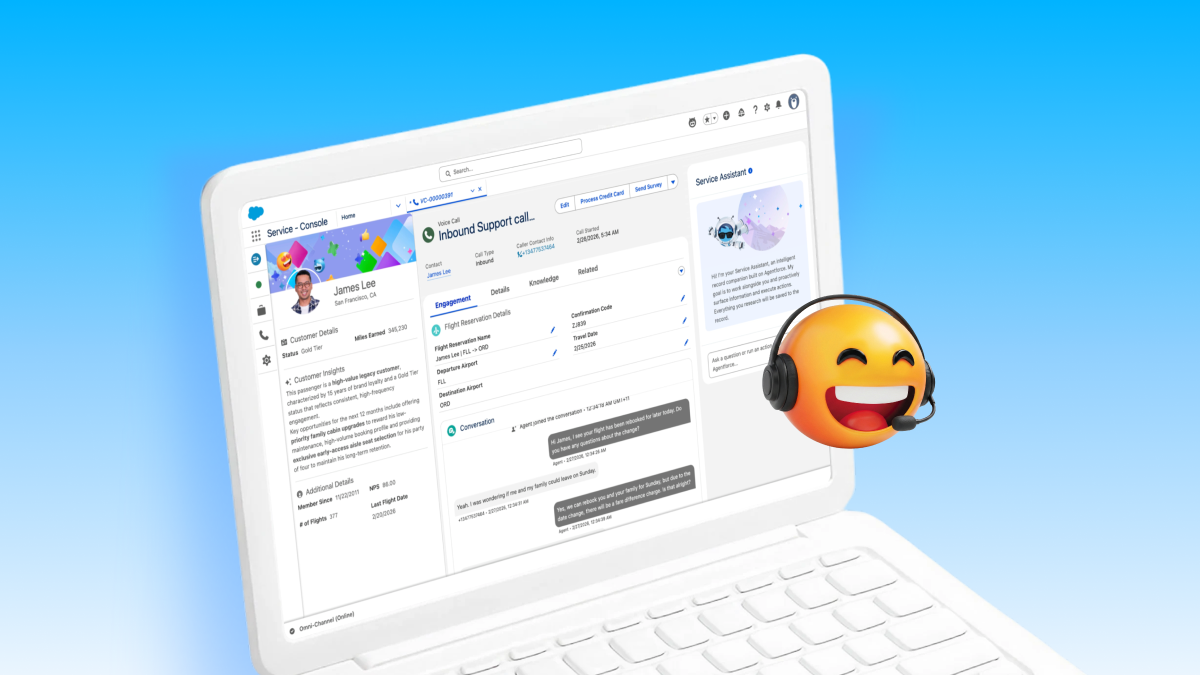
Introducing the Agentic Contact Center: AI, Channels, CRM All in One |
“Managing support across professional installers, retail partners, and direct consumers requires a contact center solution that understands context. Agentforce Contact Center’s ability to intelligently route customers and provide our agents with the right information for each interaction — whether it’s a luxury home installer or a DIY smart home enthusiast — ensures we deliver premium service across every touchpoint of our business.” — Beth LeClerc, VP of Business Systems Architecture & Web Services at Savant Systems.
Read the announcement. |
|
| | | | |
|
|
|
Salesforce Teams With NVIDIA to Bring High-Performance, Cost-Efficient AI Agents Into the Flow of Enterprise Work |
For regulated enterprises operating at massive scale, agents must do more than generate answers. They must run securely, integrate with governed data, control cost, and execute actions inside business workflows.
Salesforce and NVIDIA are addressing this challenge for enterprises by bringing high-performance, cost-efficient AI agents into the flow of work. Powered by Agentforce, Slack, and NVIDIA Nemotron models — part of the NVIDIA Agent Toolkit — organizations can now deploy governed agents across regulated and on-premises environments.
Read the announcement. |
|
| | | | |
|
|
|
|
|
|
|
|
|
|