GREEN TECH Hospitals are inherently risk-averse—and these days, relying on the grid can be risky. That’s why a majority of hospitals and medical centers have backup generators powered by diesel or natural gas that can fuel critical infrastructure in the event of a power outage. But as energy costs rise and larger health systems report their emissions, many hospitals are turning to microgrids as a way to provide electrical resilience and generate on-site energy. A microgrid is a small energy network made up of energy-generating technologies, like solar panels or hydrogen-powered fuel cells, and energy storage technologies, such as batteries. Most microgrids supply power to specific buildings or areas, and some can provide power to the electrical grid if needed. In the case of hospitals, some medical systems can run entirely on their microgrid for a specific interval of time, while others use one to supplement backup power from generators. But no matter how the microgrid functions, it requires an immense amount of planning to tailor it to a hospital’s needs and cover the cost—which can range from hundreds of thousands to millions of dollars. “You have to be really specific about what you want to serve, and then how are you curtailing those loads?” Matt Jones, a principal at construction engineering company PAE Consulting Engineers, told Tech Brew. “You might not put it in charge of the most sensitive areas, like operating rooms.” That’s because a microgrid is less energy dense than a diesel generator. But unlike a diesel generator, microgrids fueled by renewables can produce their own power without needing fuel deliveries. “[A diesel generator is] not covering everything in the hospital. It’s going to cover a select part, a selection of critical loads in the hospital,” Jones said. “The idea of supplementing that with a microgrid is pretty appealing just from a standpoint of resilience.” Keep reading here.—TC | | |
|
|
Presented By Wistia Take off your cape and set down your wand (things you regularly carry, of course). You won’t need those to create webinar magic. But you will want to take a look at Wistia’s Webinar Guidebook. It’ll explore how to conjure better webinars and deliver real magic for your audience through: - crystal-clear audio, enchanting lighting, and an absolutely magical recording space
- promotional emails that work better than spells
- evergreen content that keeps working its magic long after the webinar is over
Want to hear your audience ooh and ahh at your next utterly bewitching webinar? Grab your copy of Wistia’s Webinar Guidebook to learn how to wield webinar wizardry like a pro. Wave your webinar wand. |
|
AI Businesses are increasingly testing the waters with AI agents, but trust issues persist. A survey by integration platform Workato and Harvard Business Review of more than 600 tech leaders found that most respondents find agents more trustworthy outside of core business areas, while just 6% said they fully trust agents with essential end-to-end business processes. But that hasn’t curbed interest: 86% said their companies plan to invest more in agentic AI over the next two years. More than two in five respondents (43%) said they only trust agents with routine operational tasks, while 39% said they delegate agents to “supervised use cases or complex, noncore processes,” and 8% said they don’t trust agents with business operations at all. “This report is almost exactly the conversation I had with [CEO friends],” Workato Chief Information Officer Carter Busse told us. “When I read it, I’m like, ‘Oh my gosh, this actually is real data [for] the conversations I’m having where, ‘Yeah, we bought all these Chats and Claudes and Geminis and people can summarize their emails and look up stuff in their calendar and help me write a nice letter.’ But is that real work? It’s not.” Keep reading here.—PK | | |
|
|
Together With Bland AI Let’s chat. Meet Bland AI, the company making voice agents that sound human, run 24/7, and improve themselves on autopilot. Call it yourself to experience human-sounding AI and role-play with your ideal business use case live. Give Bland a call or book a demo today. |
|
AI Every generation throws a hero up the charts—and in the 2020s, that hero is AI. Spending on AI has dominated the earnings season. Amazon reported that demand from large corporate AWS clients has driven the company to put money into all aspects of AI, including energy to power compute, CEO Andrew Jassy told investors on a recent earnings call. “We need to have the requisite capacity, and we’ve been focused on accelerating capacity the last several months, adding more than 3.8 gigawatts of power in the past 12 months, more than any other cloud provider,” Jassy said. “To put that into perspective, we’re now double the power capacity that AWS was in 2022, and we’re on track to double again by 2027. In the last quarter of this year alone, we expect to add at least another 1 gigawatt of power.” Big changes. As Melissa Ruzzi, AppOmni director of AI, told IT Brew, the potential of AI has opened a world of possibilities for tech companies. Expansion of opportunity for vendors could mean there’s less danger of a bubble, Ruzzi said, and it’s encouraging to see different aspects of the technology taking precedent. “It’s not a bubble in the sense of fear that everyone has, it’s more we’re going to see those companies maturing and shaping and changing what they’re offering,” Ruzzi said. “The buzz from generative AI is going to change—that’s what I’m hoping to see, that we see more generative AI on top of other things, and not as the one solution that’s going to fix all your problems.” Keep reading here.—EH | | |
|
|
Together With Fidelity Private Shares℠ 409-hey what now? Most founders and finance teams treat 409A valuations as just another task to check off. Fidelity Private Shares’ guide walks you through the potential risks, requirements, and misconceptions that could cost you more than just time. Get it here. |
|
BITS AND BYTES Stat: 61%. When Salesforce surveyed 200 CIOs from across the globe, that’s how many said they “[improved] their leadership skills in preparation for agentic AI,” IT Brew reported. Quote: “By teaching young children about privacy, we can help them understand that their boundaries matter and give them the vocabulary to talk about their privacy needs.”—Lorrie Cranor, director of the CyLab Security and Privacy Institute at Carnegie Mellon University, about her book for preschoolers that illustrates the importance of digital privacy Read: Why does AI write like…that? (The New York Times) One tool, big transformation: Atlassian’s AI teammate, Rovo, offers the trifecta of AI-powered search, chat, and agents. It’s powered by your team’s existing knowledge and integrates natively with Jira, Confluence, and more. Take a look.* *A message from our sponsor. |
|
|
Who said desk calendars have to be boring? Introducing the Morning Brew 2026 Daily Games Desk Calendar. It’s perfect for desks, nightstands, and kitchen counters, so give yourself (or others) the gift of entertaining coffee breaks. Check it out |
|
|
JOBS More focus, less fluff. CollabWORK filters out the noise and delivers jobs that actually match what Tech Brew readers are looking for. Click here to see the full board of curated roles. |
|
|
SHARE THE BREW Share Tech Brew with your coworkers, acquire free Brew swag, and then make new friends as a result of your fresh Brew swag. We’re saying we’ll give you free stuff and more friends if you share a link. One link. 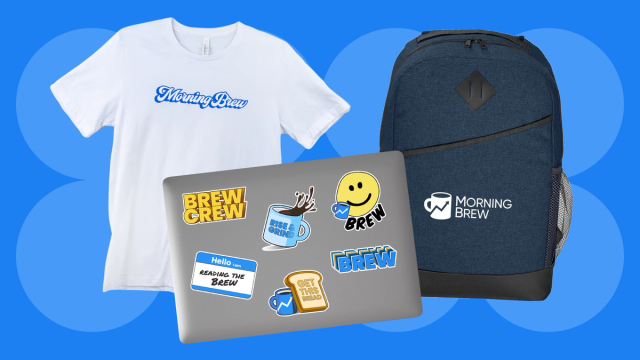
Your referral count: 0 Click to Share Or copy & paste your referral link to others:
emergingtechbrew.com/r/?kid=2eb0f6f5 |
|
|
|
ADVERTISE // CAREERS // SHOP // FAQ
Update your email preferences or unsubscribe .
View our privacy policy .
Copyright © 2025 Morning Brew Inc. All rights reserved.
22 W 19th St, 4th Floor, New York, NY 10011 |
|






(1).png)






 Guide →
  Guide →