|
Manipur is sometimes called the “Switzerland of India” owing to its picturesque landscapes and green rolling hills. After visiting last month, I can attest to its beauty. But the north-eastern state, home to just 3.3m people, is no haven. In fact, it is one of the most conflict-prone pockets of India.
For decades Manipur has suffered from insurgencies. Once an independent kingdom, it only merged with India in 1949, two years after independence, in an agreement many Manipuris believe was forced upon their king. That grievance fuelled several militant groups who took up arms against the Indian state. Much of that violence has ebbed, yet Manipur has not found peace.
As I write this week,
life in the state today is shaped by a second conflict: between the Hindu-majority Meiteis and the chiefly Christian Kukis.
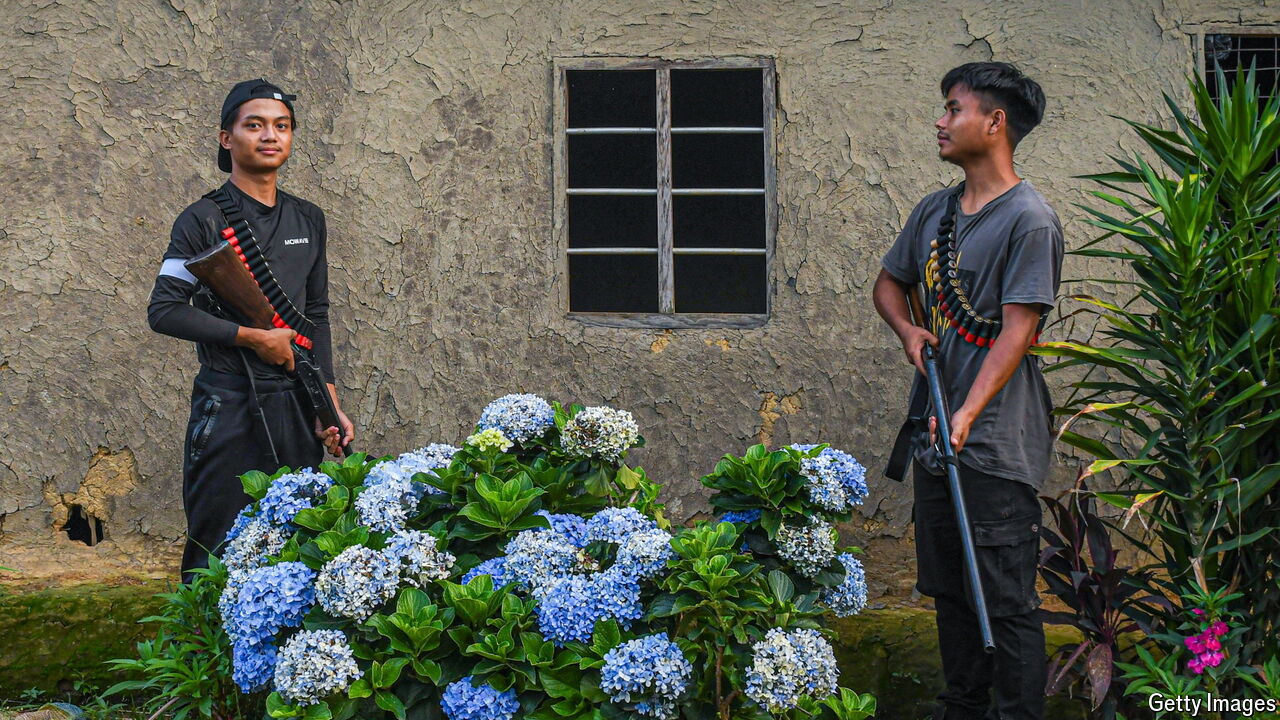
Like many disputes in India, this one is rooted in a competition over rights and resources. Many Meiteis, who live mostly in valley areas, view the Kukis in the hills with suspicion. The Kukis complain that the Meiteis dominate the economy, and that they are victims of discrimination. While tensions have long simmered between the groups, they boiled over in May 2023, when a court recommended handing Meiteis “scheduled-tribe” status (which grants preferential access to government jobs, among other benefits). Incidents of violence at protest marches spiralled into state-wide riots. Hundreds were killed and thousands of homes were destroyed.
India is no stranger to riots—but few have had such a lasting impact. Nearly three years on, bitterness and unease pervade the state. In Moreh, a town on the border with Myanmar, I saw streets lined with burned-out shells of houses. All across the state, movement is restricted. Meiteis and Kukis live apart, divided by buffer zones. To travel from Imphal, the capital and Meitei stronghold, to Churachandpur, a largely Kuki city, used to take an hour. Now, because of military checkpoints, it takes much longer than that. As a non-Manipuri, I was waved through after some questioning. My taxi driver, a local Muslim, could also pass. A Meitei or a Kuki, however, would not have been able to. Worst of all, tens of thousands of them remain stranded in refugee camps, cut off
from homes they cannot return to.
These camps are squalid places, but it was their mood rather than the conditions that struck me most. Few residents were optimistic about the future. Resentment is running high. In Meitei camps, people insisted that Kukis were being backed by armed groups that would never disarm. In Kuki camps, they said the army and the state itself were siding with the Meiteis. Both agreed on one thing though: that living together again was going to be very difficult.
So what now? No one really knows. Civil-society leaders and officials are trying to broker some form of dialogue, but nothing concrete has emerged. Meanwhile the state remains under “president’s rule”—a constitutional provision that allows it to be run by the federal government. It is a controversial arrangement but a familiar one for Manipuris, who have lived through it several times before. For all the lip service that is paid to its beauty, a sense prevails that Manipur, tucked away in a corner of India, is not important enough to command attention in Delhi. Last month a Manipuri MP bemoaned that parliament had barely spent any time discussing the state’s travails.
But Manipur plainly does matter—and not only for humanitarian reasons. The state has long been billed as India’s gateway to South-East Asia, and the linchpin of greater regional trade and connectivity. That was always an ambitious vision; now it has all but collapsed (thanks also to the conflict in Myanmar). More worrying, though, is the risk that the longer this limbo persists, the more it will deepen divides and destabilise the region. Other groups, such as the Nagas, who have their own history of militancy, may grow frustrated and mobilised. So too could the remnants of the insurgency groups. In Manipur, as elsewhere, conflict could just beget more conflict.
What can be done to end the crisis in Manipur? Please write to us with your thoughts:
[email protected].
|