For more than a century, the Conshohocken steel mill in suburban Philadelphia employed thousands of people and anchored a booming industrial economy. But the original owner went bankrupt in the 1970s, after which the facility limped on with a succession of new owners. Last summer, it was idled indefinitely and put up for sale.
It’s a familiar story of decline. But in Conshohocken at least, the remnants of America’s industrial age are a perfect fit for what’s powering its economy now — artificial intelligence. A local developer quickly moved to convert the old steel mill into a massive new data center.
“What I'm proposing is to enable AI to progress while replacing 19th-century manufacturing with 21st-century manufacturing,” developer Brian O’Neill told the Plymouth Township Planning Agency meeting in October.
There are billions of dollars of data center projects currently underway in the United States, with hundreds of billions of dollars more planned. President Donald Trump loves them. So do prominent Democrats. On the local level, they’re sold to officials as all upside: Be part of the economy of the future, rake in tons of tax revenue, and do it all without having to provide many new services.
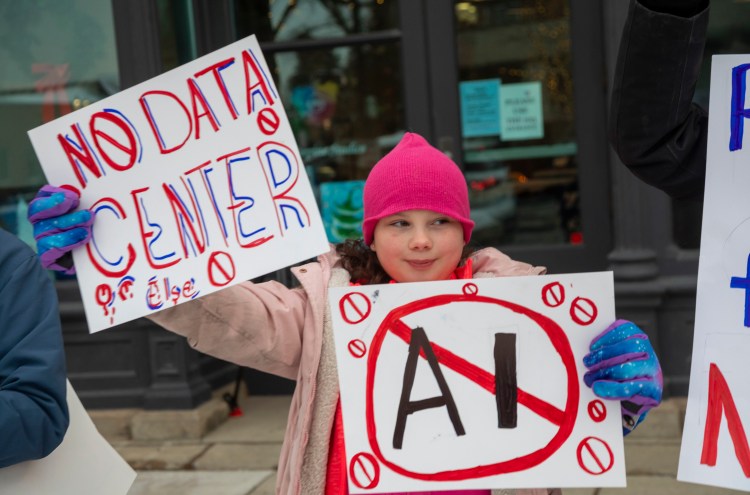
This pitch is going over great with many politicians — but it’s falling flat with a large and growing coalition of regular people.
“For residents around data centers, there's just no positive,” said Genevieve Boland, who lives just a few blocks from the old steel mill.
That backlash has been steadily growing in communities throughout the country as the AI economy has boomed — and it may very well shape the future of our politics and economy.
The populist backlash to data centers
Soon after finding out about the planned data center, Boland and her roommate Patti Smith began rallying neighbors in opposition, posting flyers and “hitting the town Facebook page like we’ve never hit it before.”
Their appeals resonated. Neighbors shared their concerns about noise and light, possible environmental pollution, and what the center could mean for the cost of power — concerns that have been echoed in other communities where data centers are springing up.
“Obviously, our utilities are going to skyrocket, and I don't want to see that happen,” said Mark Musial, who also lives near the mill.
Pennsylvania is part of a regional electricity grid that has seen a huge amount of new data centers added in the last few years, and a corresponding increase in electric costs. Electric bills spiked about 20 percent in New Jersey last year, becoming a flashpoint in that state’s governor’s race.
The backlash to data centers is just starting to bubble up in the news, but it’s already been consequential: In the second quarter of this year, 20 data center projects worth nearly $100 billion were canceled or delayed by community opposition, according to a report from Data Center Watch, a project that’s been tracking the opposition to data center development.
How data center opposition is scrambling politics
The data center backlash doesn’t really have an obvious ideological valence.
“One striking finding is that the pushback against data centers was bipartisan,” said Miquel Villa, an analyst at 10a labs, an AI safety company that produces Data Center Watch. “You could find it in red and blue states alike.”
Democratic candidates for governor in New Jersey and Virginia in this year’s elections made criticism of some aspects of the data center buildout part of their winning campaign message, but the races that have been dominated by data center backlash so far have been local.
In Georgia, two Democrats won big upsets to land seats on that state’s Public Service Commission, which helps regulate climate and energy policy. The race was dominated by rising power bills amid the data center boom there.
And a number of local races in Virginia — home to the largest cluster of data centers in the world — were fought out over data centers. Democrat John McAuliff, who ran to flip a conservative state assembly district in Northern Virginia, built his campaign around opposition to the state’s generous data center policies.
“We would knock 80 to 100 doors [a day] and in that process have 15 conversations; more than 10 of them would be about data centers in this context,” McAuliff said. “Which is remarkable.”
In suburban Philadelphia, the Conshohocken steel mill will likely remain vacant a while longer: Last month, the developer seeking to turn it into a data center abruptly yanked the application when the project ran into a legal issue.
Boland and Smith, the roommates turned organizers, told me they’re relieved, but they’re not done. They plan to keep organizing against data centers with other activists from around the country whom they’ve connected with in the last few weeks. Boland recently launched a website to coordinate statewide pushback.
“Data centers everywhere, data centers in your backyard — it's not inevitable,” she said. “You can change it.”
This story is based on a recent episode of Vox's Today, Explained podcast; you can listen to the full episode here.