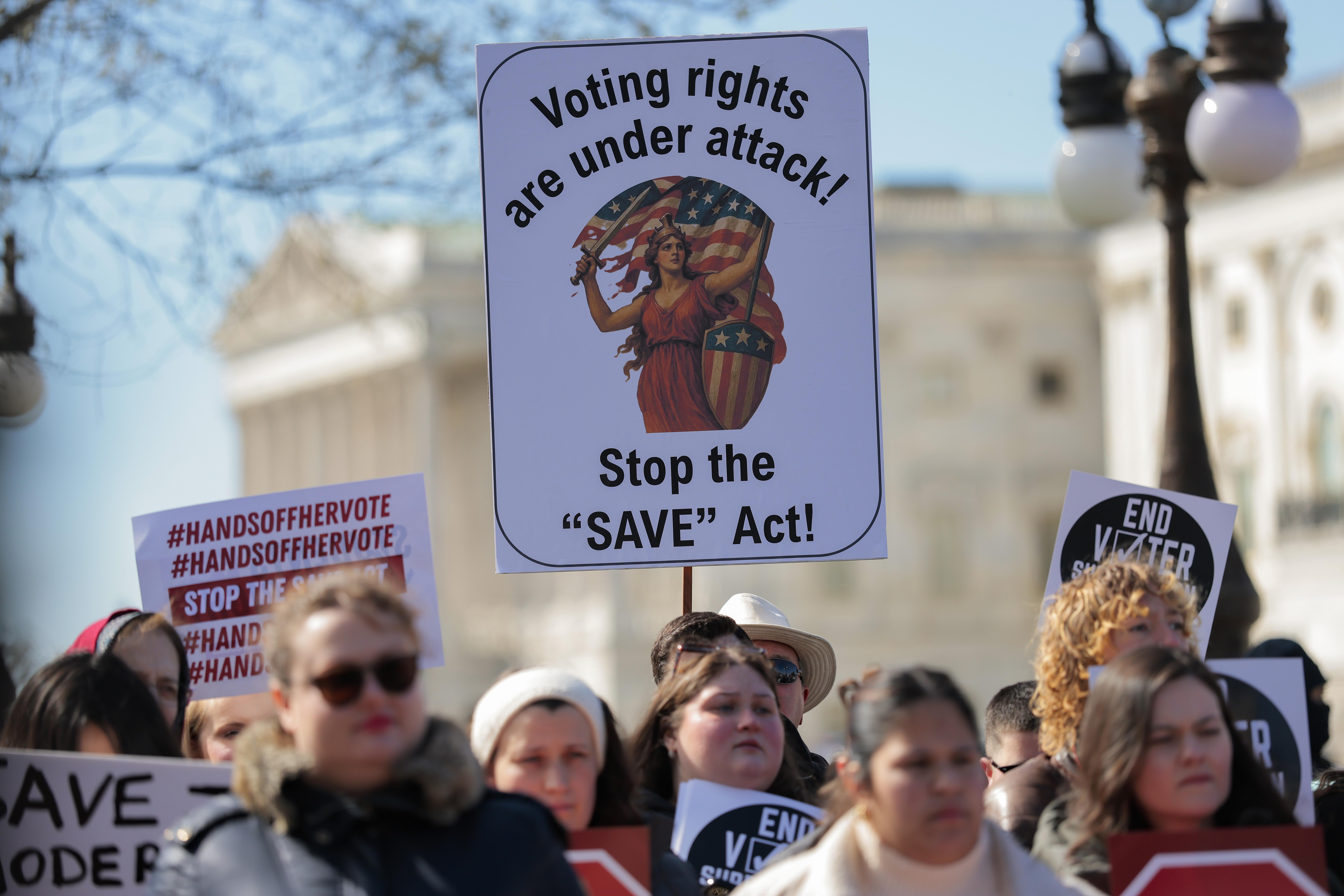
The SAVE America Act is one of several so-called election reform bills that congressional Republicans have introduced since the start of Trump’s second term, to the alarm of civil rights advocates and state election officials.
You might’ve heard of the more modest SAVE Act, for instance, or the more extreme MEGA Act — as in, you guessed it: “Make Elections Great Again.” (SAVE stands for “Safeguard American Voter Eligibility.”) But all three bills would actually make voting harder for many Americans.
The SAVE America Act, explained. Voting requirements vary by state. But generally speaking, most states require voters to provide their Social Security number or driver’s license to register to vote, and 36 states also require some form of ID — ranging from a driver’s license or passport to a student ID card, concealed-carry permit or utility bill — at the polls.
The SAVE America Act would introduce far stricter requirements across the board. To register to vote or change your registration, you’d need to show "documentary proof of citizenship,” like a passport. (In most cases, a driver’s license or birth certificate alone wouldn’t cut it.) By some estimates, more than 20 million voting-age adults don’t have access to these documents.
Then, once you get to your voting place, the SAVE America Act would also require you to show a state or federal photo ID that indicates you’re a US citizen. Notably, this means that most states’ driver’s licenses wouldn’t be enough on their own — you’d also need to carry additional proof of citizenship. And documents like university ID cards would no longer qualify you to cast a ballot.
Republicans have said the law is needed to prevent noncitizens from voting — which sounds reasonable enough, but… there’s no evidence that noncitizens are voting in any appreciable numbers. The Trump administration itself came to that conclusion when it commissioned an analysis of noncitizen voting earlier this year: Of the nearly 50 million voter registrations that the Department of Homeland Security audited, only 10,000 — or roughly 0.02% — were even referred for further investigation.
Noncitizens do occasionally vote in American elections, but the numbers are microscopic. Consider the case of Haoxiang Gao, a University of Michigan student and Chinese citizen who allegedly voted in the 2024 presidential election after lying about his citizenship on voter registration forms. The incident provoked a national outcry and fueled broader claims of fraud in Michigan’s voter rolls.
But when the Michigan Department of State audited voting records from the 2024 general election, it found only 15 “credible cases” of noncitizen voting, in addition to Gao’s. That’s 16 bad votes in a state that cast 5.7 million ballots.
But Trump isn’t one to let a good bogeyman go to waste. The president has continued to insist that noncitizen voting and voter fraud are widespread problems requiring drastic intervention. In his Truth Social post Wednesday, the president called the situation a “national emergency.” And earlier this year, during his State of the Union address, Trump claimed that only stricter voter ID laws could prevent Democrats from “cheating” to win elections.
“Their policy is so bad that the only way they can get elected is to cheat,” Trump said, while discussing voter ID requirements. “We’re going to stop it. We have to stop it.”
That pretty extraordinary claim — that any and all Democratic wins are inherently illegitimate — reveals the president’s real project, my colleague Zack Beauchamp wrote back in February.
“We’re all so used to wading through Trump’s sea of hyperbole that it’s easy to push past a bald-faced declaration of authoritarian intent,” Zack wrote. But “taken literally, that is the president announcing that the stated policy of his administration is preventing the opposition from winning any future election.” And Trump believes laws like the SAVE America Act will help him do that.
Ironically, whether the law would actually advantage Republicans isn’t clear. A March analysis by the Bipartisan Policy Center concluded that Republican voters may actually be “more heavily impacted by documentary proof requirements” because they’re less likely to have passports than Democrats.
We’ll likely never find out either way: There’s currently no path for the SAVE America Act to pass the Senate.