

On this page · 15 min read
People usually search for an HTML email builder for one reason: they need clean HTML their ESP will accept, without hand-coding tables. Maybe your ESP’s editor outputs heavy markup that breaks when you edit it. Maybe a developer built your templates two years ago and has since left. Or maybe you want control over the HTML without writing it yourself.
I have been building email HTML by hand for over 20 years, and I have shipped campaigns with every tool on this list. We built one of them, so I will point out that bias when we get there. Prices below are what each vendor published at the time of writing (September 2026); check their pricing pages for current numbers. And because opinions are cheap, we also analyzed the raw HTML of 5,000 recent production emails from the Email Love archive for this piece, so when the article says what email code does in the real world, there is a number attached.
One more thing before the list: HTML email builders are not all solving the same problem. Some replace coding with a visual editor. Some give developers better tools for writing the code themselves. Some start from a library of pre-tested modules. And some, including ours, turn an existing Figma design system into production-ready email. The difference that actually matters is not how many templates a tool ships; it is where the email gets designed, who builds it day to day, and how it becomes HTML. The ranking below reflects that: each tool is ranked for the workflow it is best at, judged on the criteria further down, with our own bias disclosed where it applies.
A note on scope: there are dozens of HTML email builders. I picked these five because each represents a distinct way real teams produce email. The enterprise creation platforms (Knak, Stensul, Taxi for Email) are a different conversation, covered in our comparison hub.
The short version
- Best HTML email builder overall for teams that design in Figma: Email Love Builder (disclosure: our product). Figma stays the source of truth, components sync instead of being rebuilt, and exports are MJML-backed HTML for any major ESP.
- Best for visual editing with code access: Stripo. A real HTML/CSS editor and a drag-and-drop builder on the same template.
- Best straightforward standalone editor: RGE Studio (formerly Beefree). The most approachable editor in the category, with brand controls and approvals as you scale.
- Best for polished results without a designer: Postcards. 100+ pre-tested modules and an AI Suite.
- Best for developer-owned email: Parcel. A code editor built specifically for email, with live preview and client-support data inline.
The five workflows at a glance
| Tool | The workflow | Existing Figma designs | Design system | Who builds | Code required |
|---|---|---|---|---|---|
| Email Love | Figma to Builder to ESP | Native: components sync | Synced from Figma | Marketers and designers | No |
| Stripo | Build in Stripo, push to ESP | Rebuild in the editor | Modules and styles | Marketers, optional developer | Optional |
| RGE Studio | Build in RGE, push to ESP | Rebuild in the editor | Brand controls | Marketers | No |
| Postcards | Modules, customize, export | Rebuild from modules | Designmodo presets | Marketers | No |
| Parcel | Code, test, export | No | Code components | Developers | Yes |
Why the HTML quality matters
Email HTML still is not web HTML. Legacy desktop Outlook renders with Microsoft Word’s engine, Gmail clips messages past roughly 102KB, dark mode recolors emails differently in every client, and CSS support is inconsistent everywhere. A visual editor is only as good as the HTML it produces, which is why MJML keeps coming up in this space: it is an open-source markup language that compiles into well-tested, responsive email HTML, and it is what we built the Email Love plugin on. The analysis below measures how real production email handles all of this.
What 5,000 real emails told us about HTML email in 2026
Rather than repeat the usual folklore, we measured it. Email Love archives the raw HTML of every email in our library, so for this piece we analyzed the source code of the 5,000 most recent marketing emails in the archive: real production sends from real brands, not templates or demos. Here is what production HTML email actually looks like in 2026.
Responsive is solved. Dark mode is not. 97.5% of the emails carry responsive media queries; mobile-friendly output is simply table stakes now. But only 14.3% carry any dark-mode handling at all (a color-scheme declaration or a prefers-color-scheme query). Apple and Gmail environments dominate opens, both recolor unprepared emails, and each does it differently, so five out of six production emails are letting the inbox improvise their dark-mode design. This is the widest gap we found between what inboxes do and what senders handle, and it makes for the sharpest question you can ask of any HTML email builder: show me the dark-mode controls.
One in fifteen emails ships pre-broken in Gmail. 6.6% of the emails exceed roughly 100KB of HTML, the point where Gmail clips the message and hides the rest (including the unsubscribe link) behind a “View entire message” click. Another 9% sit in the 80 to 100KB danger zone, one added section away from clipping. The median production email is 51.7KB, so there is plenty of headroom for a normal campaign; the emails that clip are usually just too long (too many sections stacked into one send) or older templates that have accumulated years of bloat.
Nearly half of production email is compiled, not written. 42.5% of the emails carry MJML fingerprints in their markup, meaning the HTML was generated from a framework rather than written or dragged together directly. The output is still nested tables underneath (the median email contains 63 of them), but almost nobody is maintaining that markup by hand anymore. The industry has quietly standardized on generated HTML, which is precisely why the generator you choose matters more than it ever has.
Everyone still pays the Outlook tax. 95.5% of the emails contain Outlook conditional comments (the <!--[if mso]> blocks that feed Word-engine Outlook its own markup) and 83.8% ship VML, even though Litmus’s market-share data puts desktop Outlook in the single digits of opens. The tax persists because the opens Outlook does get skew toward exactly the corporate buyers B2B senders care about. The practical test when evaluating a builder: search its export for [if mso, and treat its absence as disqualifying.
The unglamorous details are where senders actually differ. Only 27.4% of the emails define explicit preheader text, one of the highest-leverage lines in any send, while 87.6% do get the accessibility scaffolding right with role="presentation" on layout tables. The spread between the best and worst production email is not taste; it is whether the tool, or the team, sweats details the subscriber never consciously sees.
Methodology: raw HTML source of the 5,000 most recently archived marketing emails on Email Love, measured September 2026. Size figures are the HTML part only, which is what Gmail’s clip threshold applies to. MJML detection uses markup fingerprints, so it understates tools that strip build comments.
How I judged these tools
I looked at these tools as production workflows rather than feature checklists. The questions that separate them: Can a marketer actually build an email without touching code? How does an existing design system get into the tool: synced, imported, or rebuilt by hand? What does the exported HTML look like against the production benchmarks above? How do you test before sending? How does the finished email reach your ESP? And the question almost nobody asks in a demo: what happens when a shared component changes six months from now, does every template update, or does someone update every template?
That last one matters most, because the expensive part of email production is never the first email. It is the two-hundredth, and the rebrand after that.
1. Email Love Builder: best for teams that design in Figma
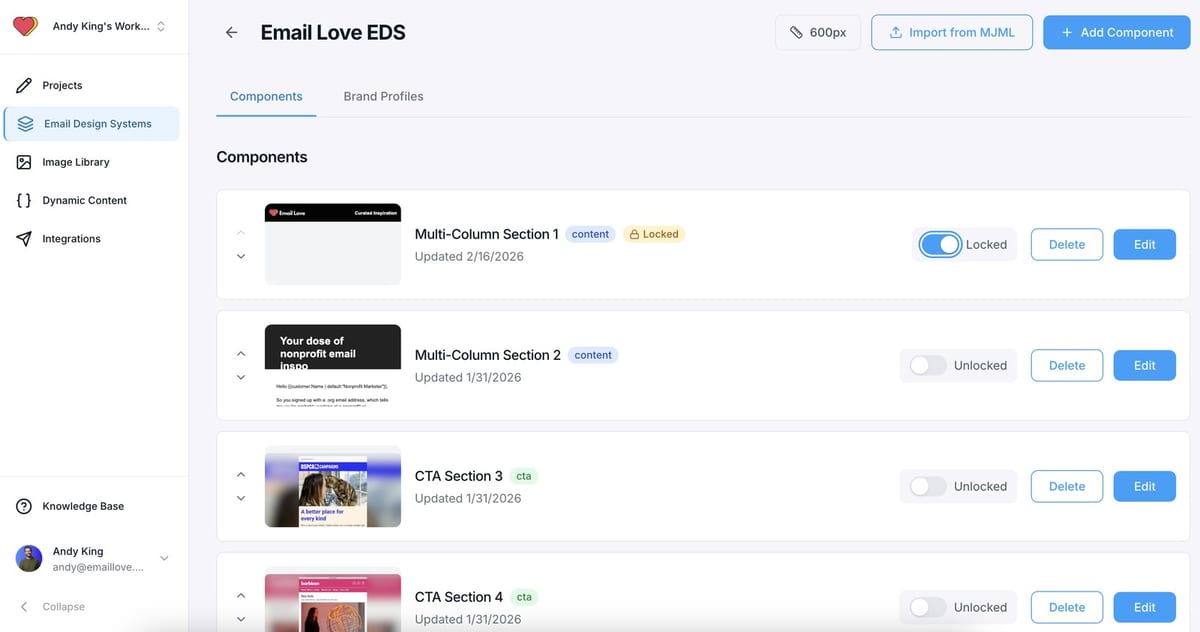
Full disclosure: this is our product. Here is the reasoning, and you can judge it against the alternatives below.
The important difference: you do not rebuild your email design system in Email Love. Your components already live in Figma, and the Email Love plugin turns them (Auto Layout, Variants, and nested components included) into reusable email building blocks. Figma stays the source of truth.
The consequence is the economics of change. A design update happens once, in Figma, instead of being maintained there and again inside a separate builder. Change a footer component, re-sync, and every template that uses it updates. Campaigns stop drifting away from the brand between rebrands.
Everything else about Email Love Builder is supporting evidence for that idea: marketers assemble campaigns visually with no code, exports are clean MJML-backed HTML for Braze, Iterable, Salesforce Marketing Cloud, Klaviyo, HubSpot, Customer.io, and most other platforms with your personalization syntax intact, every email is previewed across 90+ clients before it ships, and AI can assemble campaigns from your approved components in Claude, ChatGPT, or Cursor. (If compiling from MJML sounds exotic, it is not: 42.5% of the production emails in our analysis carry MJML fingerprints.) Jake Leffler, Email Development Specialist at StreetEasy, says the workflow cut their dev time by more than 90 percent.
Pricing: the Figma plugin has published pricing, with a free plan (5 HTML exports a month) and paid plans from $19 per user a month. Email Love Builder, with migration done for you, is a custom quote and comes with Enterprise.
- Best for: enterprise teams whose designs live in Figma and ship lifecycle volume across one or more ESPs.
- Skip if: your team does not use Figma. The main advantage does not apply, and one of the editors below will fit better.
2. Stripo: best for visual editing with code access
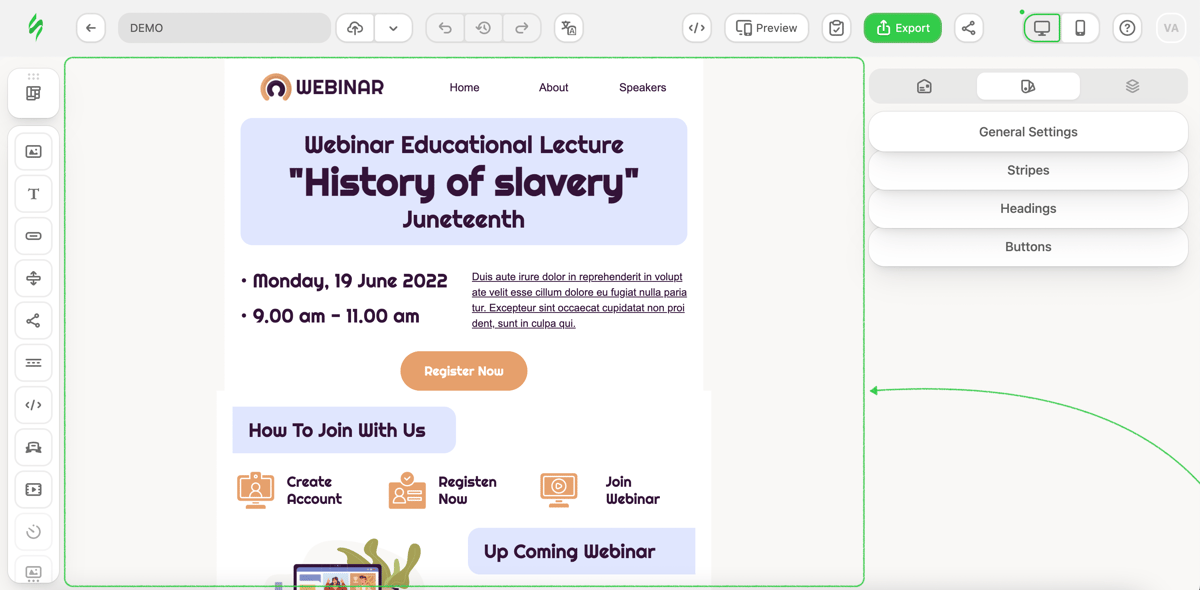
Stripo’s main feature is its dual view: a drag-and-drop builder and an HTML and CSS editor open on the same template, with no mode switching. For a marketing team with one technical member who sometimes edits code, it is one of the best standalone editors. The template gallery is large (they advertise 1,650+ free templates), AMP for Email is supported, and the platform includes a broad set of features around the editor: built-in email client testing, spam testing, an accessibility checker, AI for copy and subject lines, modular design with reusable content blocks, and an MCP integration for AI workflows.
Pricing: Free at $0 (2 members, 4 exports a month), Basic at $20 a month (50 exports), Medium at $45 (3 members, 300 exports, 5 projects), Pro at $125 (10 members, 4,000 exports). Watch the export limits: high-volume teams move up tiers faster than they expect.
- Best for: teams that want one self-contained editor with real code access and built-in testing.
- Skip if: your emails need to match your design files exactly. You will rebuild your designs in Stripo and keep them matched by hand.
For a detailed comparison, read Email Love Builder vs Stripo.
3. RGE Studio (formerly Beefree): best straightforward standalone editor
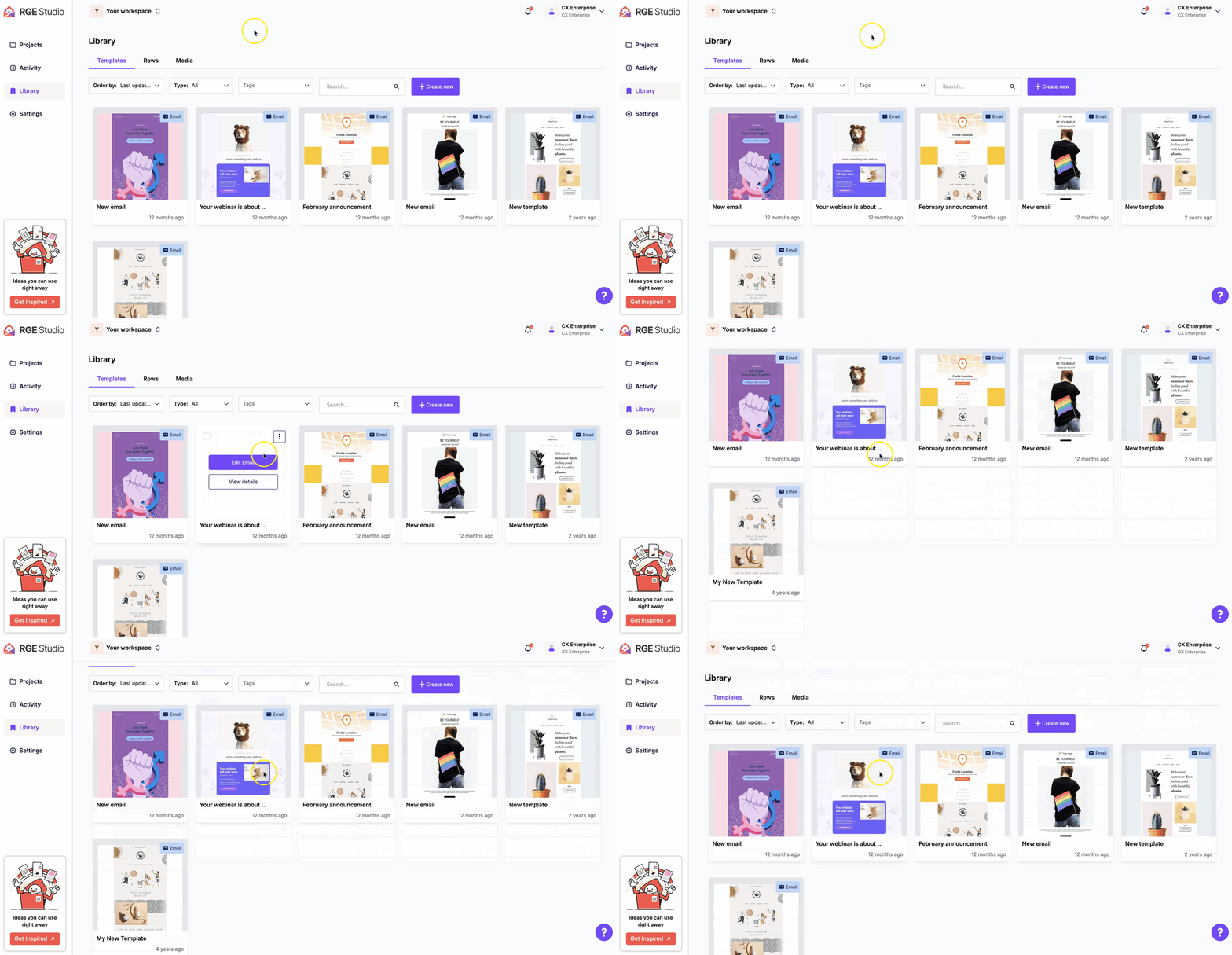
If you knew this tool as Beefree, the main 2026 news is the rebrand: Beefree is now RGE Studio, part of the Really Good Emails brand, and describes itself as the creation layer that sits above your ESP. The editor is the same one that appears in most roundups: an easy learning curve, reasonably clean HTML export, and one-click push connectors into Salesforce Marketing Cloud, HubSpot, and others.
The current feature set goes further than the old free-editor reputation suggests: reusable synced content blocks, dark mode preview, brand style kits with color permissions, multi-step approval workflows on higher tiers, an AI Co-Pilot for drafting, and design-specific commenting. Worth knowing: ESP-native dynamic content (Salesforce personalization strings, for example) does not render live in the builder; you build the logic and it resolves in the ESP.
Pricing: Starter is free (10 designs, 6 exports a month), Professional is $25 a month billed yearly ($30 monthly), Business is $134 a month billed yearly, Enterprise is custom with SSO and advanced restrictions.
- Best for: small-to-mid teams that want a genuinely approachable editor, and mid-size teams that need approvals without enterprise procurement.
- Skip if: you plan to stay on the free plan. At 6 exports a month it suits genuinely small programs; higher-volume teams will need a paid tier.
For a detailed comparison, read Email Love Builder vs RGE Studio.
4. Postcards by Designmodo: best for starting from polished modules
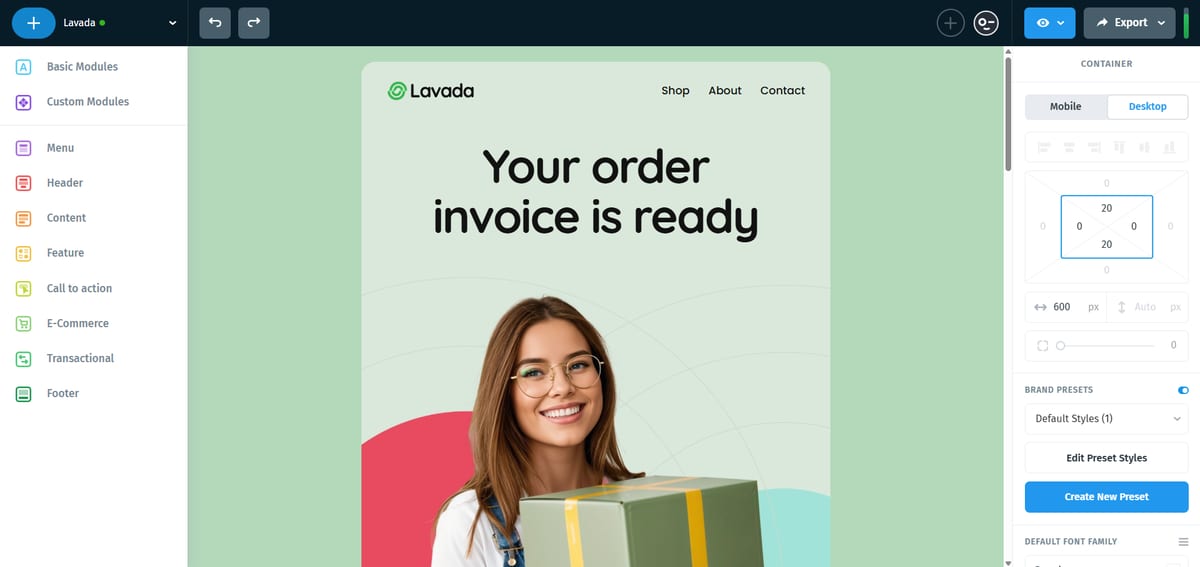
Postcards focuses on polish. Its 100+ modules look professionally designed, every module is tested in dark mode (they call the tested set Night Shift), and the modules are validated with Litmus and Email on Acid across email clients. The 2026 additions are substantial: an AI Suite that builds a full template from a prompt in a back-and-forth chat, brand import that pulls your logo, colors, and fonts from your website, and an MCP server so AI agents like Claude or Cursor can open projects and export the HTML. The editor opens with no signup, which makes it the quickest tool on this list to try.
Pricing: the editor is free to use; paid plans gate exports, team workspaces, and the AI features. Check their pricing page for current tiers.
- Best for: solo marketers and small teams without a designer who still want emails that look designed.
- Skip if: you have a strong existing brand system. You would be working within Designmodo’s design language, so put a few modules next to your brand guidelines before committing.
5. Parcel: best for developer-owned email production
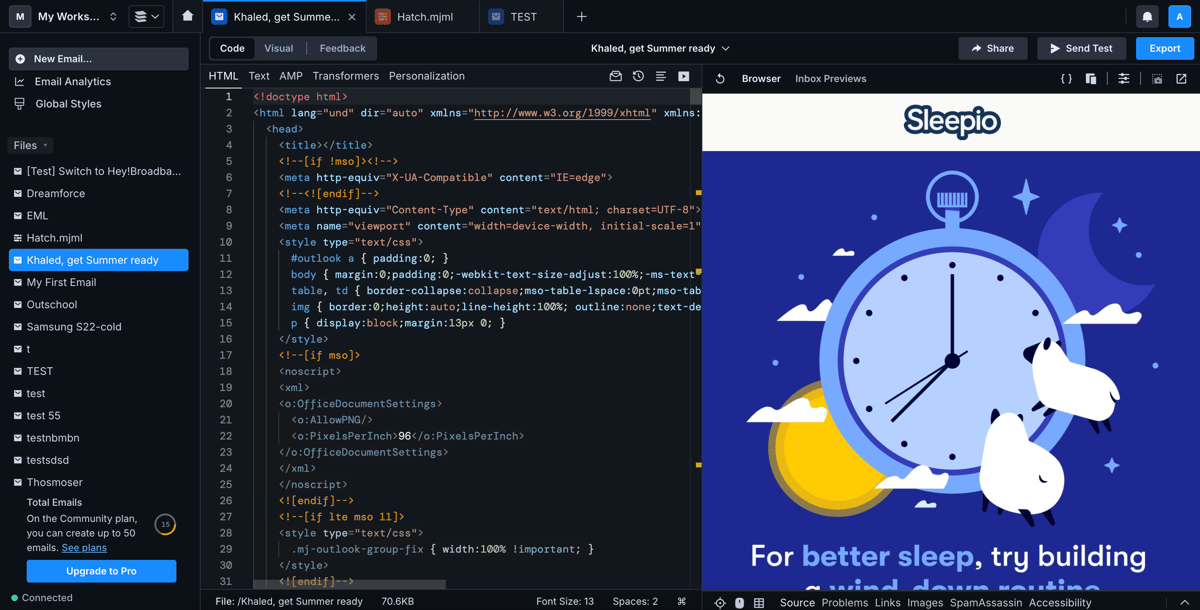
This list is for marketers, but most email programs have one person who works in the code, and Parcel is built for them. It is a code editor made for email: live preview as you type, dark mode and image-blocking simulation, client-support data from Can I Email shown inline, an accessibility checker, CSS inlining and minification, and reusable components. The Business tier adds SpamAssassin scanning and approval workflows, and a pay-as-you-go add-on renders your email in 80+ real inboxes.
Pricing: Community is free (50 emails, solo), Pro is $29 per user a month, Business is $56 per user a month. Inbox previews are an addon from $49 for 500 renders.
- Best for: the developer or technical marketer who owns your templates.
- Skip if: nobody on your team wants to work in code. It is a professional code tool, and marketers will not be able to use it on their own.
For a detailed comparison, read Email Love Builder vs Parcel.
How to audit any builder’s HTML in five minutes
Every tool on this list has a free tier or trial. Build one email, export it, open the file, and check it against what production email actually does (the percentages are from our 5,000-email analysis above):
- Weight: a single-purpose marketing email should land well under 80KB of HTML. If a simple two-section test email already exports heavy, a real campaign with ten sections will hit Gmail’s clip.
- Outlook code: search the file for
[if mso. Production reality is 95.5% of emails carry it; an export with none will fall apart for every corporate reader on desktop Outlook. - Dark mode: search for
color-schemeandprefers-color-scheme. Only 1 in 7 production emails handles this today, which means it is also the easiest place to look better than your competitors’ emails. - Accessibility: layout tables should carry
role="presentation"(87.6% of production emails do this) and images should keep the alt text you entered. - Preheader control: the builder should give you an explicit preview-text field that survives export. Only 27.4% of production emails define one; the rest let the inbox grab whatever text comes first.
- Portability: paste the exported HTML into a different ESP’s raw-HTML block and send a test. If it only renders correctly inside the vendor’s own integration, you are not buying a builder, you are buying a cage.
The lock-in question nobody asks until it hurts
Every builder demo shows you how easy it is to get email in. The question that determines what the tool costs you over five years is how your templates get out. Templates built in a proprietary editor exist in that editor’s internal format; the HTML export is a one-way artifact you cannot edit back. Switch ESPs, get acquired, or just outgrow the tool, and the rebuild you bought the builder to avoid comes back with interest, multiplied by every template in the library.
There are only three genuinely portable sources of truth: raw HTML a developer owns (Parcel’s model), an open framework like MJML that any tool can compile, or a design file your team already maintains, which is the bet we made with Figma. When we migrate teams off other builders, the template library is always the sticking point, and it is why we publish direct comparisons against the tools on this list: the honest differences are mostly about where your source of truth lives, not whose drag-and-drop feels nicer.
Which workflow sounds like yours?
- Your designs exist in Figma: generate the HTML from those designs instead of recreating them in an editor. That is what Email Love is built for.
- You want one standalone editor: Stripo if someone on the team will use the code view, RGE Studio if nobody will, Postcards if you want the templates to carry the design for you.
- A developer owns email: Parcel, plus MJML directly if they prefer a framework to an editor.
Frequently asked questions
How do you create an HTML email template without coding?
Use a builder that generates the HTML from a visual layout: every tool above except Parcel does this. The quality difference is in what the generator knows about email clients. MJML-based output and pre-tested modules hold up in Outlook and dark mode. Simpler generators can produce HTML that looks right in the editor and breaks in inboxes.
Is MJML better than writing raw HTML?
For most marketing teams, yes. MJML compiles a simple markup into the tables, conditional comments, and fallbacks email clients need, and its output is maintained against client changes. Hand-written HTML is only better when you need something MJML cannot express, which is rare in marketing email.
Will the HTML from these tools work in Outlook?
All five generate or support the fallbacks legacy desktop Outlook needs. The more useful question is whether you will see problems before sending: look for real client previews (Email Love covers 90+ clients, Parcel’s addon renders 80+ real inboxes, Stripo has client testing built in) rather than a single preview pane.
Do people still build emails with tables in 2026?
Yes, almost universally: 99.5% of the 5,000 production emails we analyzed are table-based, with a median of 63 table tags per email. The difference in 2026 is that almost nobody writes those tables by hand; builders and frameworks generate them, which is the whole reason this category of tool exists.
How big should an HTML email be?
Keep the HTML under about 80KB. Gmail clips messages at roughly 102KB, and our analysis found 6.6% of real production emails already ship over that line, with another 9% within one content block of it. The median well-built email is around 52KB, so a clean generator leaves you plenty of headroom; images live on a CDN and do not count toward this limit.
For the full tool-by-tool comparison including the enterprise platforms like Knak and Stensul, see our comparison pages. And if you want to see your own Figma file become sendable HTML today, the Email Love plugin has a free tier to try on a real design.
Much love,
Andy

Andy has spent two decades building email programs for brands and agencies, and now co-runs Email Love: the inspiration gallery of 532,000+ emails and the Figma plugin that lets teams design, build, and export production-ready email without leaving their design file. He writes about email design systems, production workflow, and where the industry is heading.

Customer.io delivers more impact from every message–unifying data, messaging, and AI into one platform so every customer interaction gets smarter over time. We help teams build personalized campaigns across email, SMS, push, in-app, and webhooks, using their own first-party data to reach the right people with the right message at the right moment. AI is built into the platform to remove the grunt work, letting marketers focus on strategy, not setup. Over 9,000 brands trust us to power their messaging.
 Oct 1, 2026 · 9 min read
10 Halloween emails from last year to inspire your campaigns
Read article →
Oct 1, 2026 · 9 min read
10 Halloween emails from last year to inspire your campaigns
Read article →
 Sep 30, 2026 · 12 min read
How we built an email design system for Movember with AI
Read article →
Sep 30, 2026 · 12 min read
How we built an email design system for Movember with AI
Read article →
 Sep 17, 2026 · 5 min read
What Is Headless Email Design? Build in Figma, Send Through Your ESP
Read article →
Sep 17, 2026 · 5 min read
What Is Headless Email Design? Build in Figma, Send Through Your ESP
Read article →

