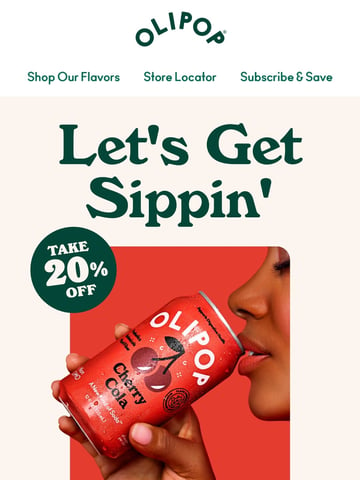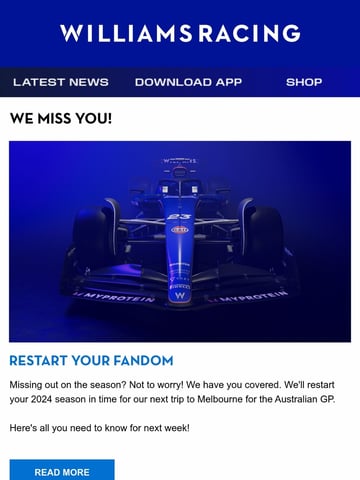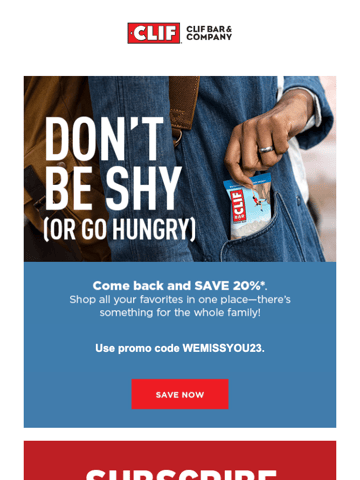
A re-engagement email tries to win back subscribers who have gone quiet, typically triggered after 60 to 120 days of no opens or clicks. The best ones lead with a clear reason to return (a discount, a “we miss you” note, or a preference reset) and use plain, honest subject lines. Give one obvious action, and make opting down feel as welcome as staying.

Re-engagement (or winback) emails go after the hardest audience in email: subscribers who stopped opening or customers who stopped buying. Done well, they recover real revenue from people you already paid to acquire; done lazily, they are a we-miss-you template that confirms the relationship is over. This hub collects curated winback sends from brands like '47, eBay, Cuisinart and Rumpl.
The strongest examples in the grid pick a specific angle rather than generic nostalgia: what changed since you left (new products, fixed problems), a concrete incentive with a real deadline, an honest ask (do you still want these emails), or personality big enough to earn a second look. The structural rule is one decision per send: come back, or choose what happens next. Sends that ask for both at once get neither.
Winback also has an unglamorous but critical job: list hygiene. The final email in a good sequence is a sunset send that removes non-responders, which protects deliverability for everyone else. Study the sequencing here, then pull real re-engagement subject lines, and see the adjacent lifecycle moments in cart abandonment and browse abandonment.
Ranked by real reader views on Email Love over the last 90 days.
Pulled verbatim from sends in this collection. Every line links to the actual email it opened.
What the sends in this collection actually do, measured from our own archive.
Subject stats from 22 curated emails in this collection.
A send targeted at subscribers or customers who have gone quiet: no opens, no clicks, or no purchases over a defined window. Its job is to restart the relationship with a reason to return, or to let the recipient gracefully choose less email before the list sunsets them.
Define lapsed from your own purchase or engagement cycle, not a universal number. Common triggers in our archive run 60 to 120 days without engagement for frequent-purchase brands and longer for durable goods. The key is acting before the address goes fully cold, when recovery odds collapse.
They are the most reliable lever, but lead with what changed and make any offer feel like an exception with a deadline. A discount alone recovers bargain hunters; new products, fixed pain points, or an honest ask recover customers worth keeping.
The final send in a re-engagement sequence that tells non-responders they will stop receiving email unless they act. Removing the silent segment feels like shrinking the list, but it improves deliverability and engagement rates for everyone who remains, which is usually a net revenue gain.
Designing your re-engagement email?
Design it in Figma and export production-ready HTML straight to your ESP with the Email Love plugin. Build it in Figma →