
On this page · 8 min read
If you spend any time on LinkedIn you’ve seen the feed we all see: launches, milestones, ARR charts pointing up and to the right. Matt and I have posted our share of those. But anyone building a business knows the other column of the ledger is just as long, and nobody posts that one. So here’s ours. Five things that went sideways building Email Love, what we were thinking at the time, what they cost us, and what each one forced us to do differently.
Our first enterprise payment almost arrived too late
In January 2025, I thought our first enterprise deal was done. The customer wanted the product, we had a yes, and in my head the remaining steps were administrative details. I had the payment date circled on the calendar, and I needed it circled, because our credit card bill and estimated taxes were due right behind it.
As we got close to the date, I found out no money was coming, because we’d never submitted an invoice and a payment request to their finance team. The procurement process had started, but nobody told us that step was ours to take, and we didn’t know to ask. And once we did get into the process, we learned they paid on net 70 terms, which, for a small startup that needed the money, is a long time to wait. I’d spent my energy on the work of getting someone to buy, and I hadn’t understood everything that needed to happen after the yes. Nobody was misleading us. I’d just assumed the deal closing meant payment was in motion, and I hadn’t asked enough questions to find out otherwise.
To their credit, once they realized what was happening, they rushed it through, and the money landed just in time to pay our bills. That was a huge relief, and it was also closer than I ever want to get again. Turns out at a big company, the person who wants to buy your product and the person who cuts the check work in different buildings.
We’ve onboarded a bunch of enterprise customers since then, and I’m much more familiar with how buying and procurement actually work. The process turns out to be pretty similar across large companies, so now I know the right questions to ask up front: who else needs to be involved, what vendor onboarding looks like, and what the payment terms are, before the verbal yes. We’ve also been careful to keep a good cash buffer so we never end up in that position again.
We spent seven months building a paid tier, then made it free
Email Love Pro was a longer education. We spent January through July building it, with thousands of dollars in development costs along the way. The idea was a $19/month membership for deeper insights, trend reports, and expert analysis. It seemed reasonable. Tons of sites do this, and we had the audience: tens of thousands of people visiting Email Love every month.
The conversion rate was 0.24%.
Worse, Pro was confusing the thing that was actually working. We understood the difference between the membership and our Figma plugin because we’d spent months thinking about it. People landing on the site hadn’t, and they’d hit the paywall and mix the two up. The hardest part was that I could still see a version where we kept grinding, marketed it harder, and got it to $10K MRR after a few years. But that wasn’t the business we wanted to build, and every hour on Pro was an hour not spent on the plugin or the site.
So we killed Pro and made all of Email Love free. And that’s where the flop turned into one of our best decisions. Making everything free gave something back to the email community, drove more people to the site, and set us apart from the other inspiration sites that charge. Most importantly, it put more people in front of the products we actually sell, the Figma plugin and the Email Builder. The failed paid tier taught us what the business really was, and it wasn’t a paywall. I’m happy with the decision. I’d have been happier reaching it several months and several thousand dollars earlier.
Our traffic record was mostly bots
In late August 2025 our traffic took off. By September we hit 52,900 unique visitors and 258,000 pageviews in a month, more than double our baseline. When you’re spending your nights and weekends trying to grow a website, a chart like that feels great.
Then we looked closer. These visitors were hitting one page, spending a couple of seconds on it, and bouncing, and a lot of the traffic was coming from countries we don’t typically serve. Real people browsing an inspiration site don’t behave like that at scale. Bots do. A big share of our record month wasn’t human, and the crawling kept inflating our numbers for two more months even as it tapered off. Instead of improving the site, we were suddenly spending time investigating our own analytics.
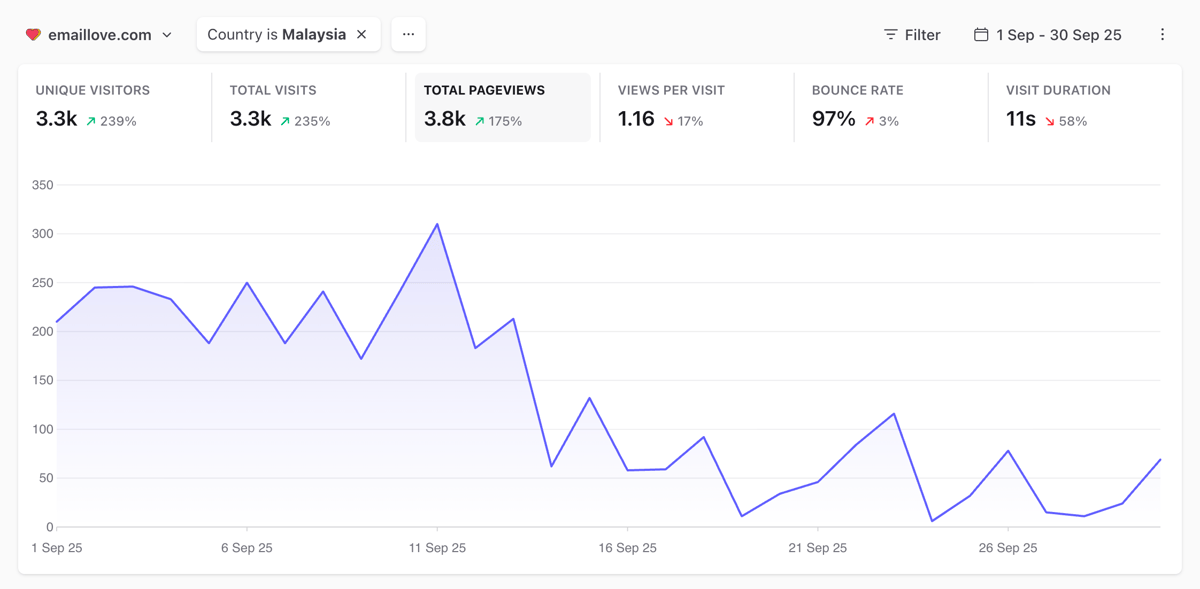
(Bot traffic from Malaysia)
We set up Cloudflare rules to block the junk traffic, and here’s the honest part: we’ll never know if those rules turned away real people too. There’s no dashboard for the visitor who got challenged and left. We traded fake traffic for an unknown amount of lost real traffic. Eventually the numbers settled back down to boring and true, which is how I like them now. A spike isn’t a win until you know who’s actually visiting.
We launched a second brand, then shut it down
In February 2026 we launched Composa as its own brand, with its own site. The thinking was that our email builder deserved its own name and identity. Email Love was known for inspiration, and we wanted the builder to stand on its own. It made sense to us at the time, and we spent real effort driving traffic to it. Some came. Then it flatlined, and within a few months we deprecated the brand and folded the product into what’s now the Email Love Builder.
What we learned is that building a new brand from scratch is way harder than we thought, especially when we already had a recognizable brand sitting right there in Email Love. Emaillove.com had years of built-up audience, and instead of putting the new product in front of those people, we put it on a separate site under a name nobody knew and started building awareness from zero. The good news is the fix wasn’t too painful. We brought the product home, and the people who needed an email builder were already on our site every day.
People told me calling it the Email Love Builder was a bad idea, that a product deserves its own name. But in my opinion, the name doesn’t matter. I thought Beehiiv was a freakin stupid name when I first heard it, and now they’re massive. What matters is your ability to get your product in front of the right people and show them why they should care. It doesn’t matter what it’s called if nobody ever sees it.
The lesson stuck: the audience is the moat. Don’t build anything a long walk away from it.
We messed up our own email program
And yes, we’ve flopped at email itself. Twice in one year, publicly enough that we wrote both up.
In late January 2026, during our migration from MailerLite to Customer.io, I was fixing some mislabeled data late at night and re-uploaded it. That re-upload made the system treat existing subscribers as brand new signups, and it fired welcome emails at people who’d already gotten them. Rookie mistake, from the guy running an email inspiration site. A few people unsubscribed, a few wrote in asking what was going on, and I decided against sending an apology email, because a correction that isn’t necessary just adds a second annoying email on top of the first. I wrote up the whole thing here.
Then in August, a subscriber replied to tell us we’d sent them three different lifecycle emails at once. Not duplicates, three separate automations that all triggered at the same time and collided in one inbox. The part that stuck with me is that every dashboard said everything was fine. Each automation was firing correctly on its own. The subscriber’s inbox was where the experience actually broke, and the only reason we found out is that someone took the time to reply. That one’s written up here.
Both came down to the same root cause: a very small team trying to do a lot of big things, and letting the unglamorous parts of our own lifecycle program slip. The fixes were the boring ones we’d tell any customer: don’t run migrations solo late at night, test your journeys before they go live, and treat subscriber replies as a diagnostic layer, because they’re bug reports written in much clearer language than your dashboards.
What all of this taught us
None of these felt like learning experiences at the time. They felt like wasted money, wasted months, and one very stressful week watching a bank balance. But every one of them forced a better decision. The procurement scare made us better at enterprise sales, which is now the core of the business. Pro dying gave us a clear model: Email Love is free for the community, and the plugin and builder are the products. The bot mess made us honest about our own metrics. Composa taught us to build on the audience we own. And our own email mistakes made us tighten the exact practices we preach to everyone else.
Today we’re focused on making emaillove.com the best email inspiration site on the internet and building the future of email production with our Figma plugin and Email Builder. Those two things fit together. People come to Email Love to find ideas, and we build the tools that turn those ideas into emails. For the first time in a long time it feels like we’ve got real momentum, and I’m sure we’re doing something right now that’ll seem obvious in hindsight.
If you’re building something and you’ve got your own list like this, that doesn’t mean you’re bad at business. It means you’re in it. Learn from it, adjust, and move on.
Much love,
Andy

Andy has spent two decades building email programs for brands and agencies, and now co-runs Email Love: the inspiration gallery of 485,000+ emails and the Figma plugin that lets teams design, build, and export production-ready email without leaving their design file. He writes about email design systems, production workflow, and where the industry is heading.

Customer.io delivers more impact from every message–unifying data, messaging, and AI into one platform so every customer interaction gets smarter over time. We help teams build personalized campaigns across email, SMS, push, in-app, and webhooks, using their own first-party data to reach the right people with the right message at the right moment. AI is built into the platform to remove the grunt work, letting marketers focus on strategy, not setup. Over 9,000 brands trust us to power their messaging.