

On this page · 9 min read
I’m about to share the least creative email marketing tactic I’ve ever used. It took zero effort, zero new copy, and zero design work. And it actually outperformed the original send.
I re-sent the exact same email. To my entire list. Five days later.
That’s it. That’s the tactic.
Here’s what happened
A couple weeks ago I sent a newsletter to our 14,700+ subscribers announcing Composa, our new drag-and-drop email builder. It’s a big deal for us (we’ve been working on it for a while), so I wanted the email to land.
The first send did well. A 34% open rate and 7.4% click-through rate. For a product announcement to a newsletter audience, I was pretty happy with those numbers.
But here’s the thing about email: even a 34% open rate means two-thirds of your list didn’t see it. That’s roughly 10,000 people who never opened a pretty important announcement. Not because they weren’t interested. Because they were busy, or it landed at the wrong time, or it got buried under 47 other emails that morning.
So five days later, I hit send again. Same subject line. Same copy. Same everything. No tweaks, no A/B test, no clever “in case you missed it” preheader. Just the same email, same list, second time around.
The result? A 34.4% open rate and 7.9% click-through rate.
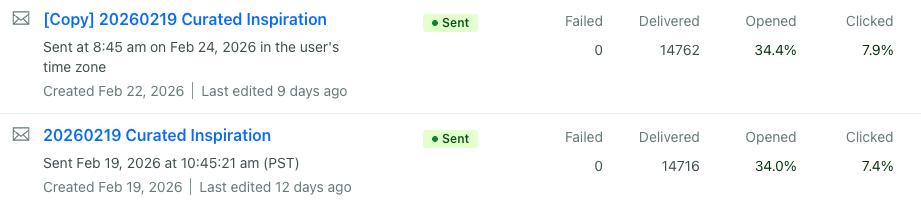
Read that again. The resend didn’t just hold up. It outperformed the original. Higher open rate. Higher click rate. On a list that had already received the identical email five days earlier.
The original send generated roughly 1,089 clicks (14,716 delivered x 7.4%). The re-send generated ~1,166 clicks (14,762 delivered x 7.9%). That’s about 2,255 total clicks from a single piece of content. I more than doubled my total click volume by pressing send one more time.
Why most marketers don’t do this
I get it. It feels weird. You worry about annoying your subscribers. You think people will notice they got the same email twice. You assume it’ll hurt your sender reputation or spike unsubscribes.
But here’s what actually happens: most people don’t notice. They weren’t paying attention the first time. Their inbox is a warzone, and your email was collateral damage on a busy Wednesday morning. Sending it again on a Monday gives it a second chance to land when they’re actually scrolling.
And even the people who do see it twice? They mostly don’t care. If the content is relevant and valuable, seeing it a second time is a gentle reminder, not an annoyance. Think about how many times you see the same ad on Instagram before you even register it. Email subscribers are far more forgiving than we give them credit for.
Five ways to resend an email
What I did (sending the identical email to my full list) is just one approach. There are actually several ways to squeeze more value out of an email that’s already performing. Each one has a different risk profile and a different level of effort.
Here are five tactics, ordered from laziest to most involved.
1. The full re-send (what I did)
Same email, same list, same everything. Zero effort, maximum laziness. You’re betting that your content is strong enough to stand on its own twice, and that the people who missed it the first time will catch it now.
The risk is technically higher because you’re sending to everyone, including people who already engaged. But the upside is that you’re not just catching non-openers. You’re also reaching people who opened but didn’t click the first time around. Maybe they were interested but got distracted. A second touch gives them another shot.
This works best for high-stakes content: product launches, major announcements, or your best-performing sends where you know the content delivers.
2. Re-send to non-openers only
This is the “safe” version. Filter your list to people who didn’t open the first send and hit them again. Most ESPs make this a one-click segment, so the effort level is almost as low as a full re-send.
The advantage is obvious. You’re only reaching people who didn’t see it, so there’s virtually zero annoyance risk. The downside is twofold. First, you miss the people who opened but didn’t click, and those are often your warmest prospects who just need a nudge. Second, open tracking isn’t perfectly reliable anymore. Thanks to Apple’s Mail Privacy Protection, a chunk of your “openers” may not have actually opened at all, and some real non-openers may be hiding in your “opened” segment. Your non-opener list is fuzzier than it used to be.
Still, this is the tactic most marketers should start with if re-sending feels uncomfortable. It’s low risk and you’ll see immediate results.
3. New subject line, same content
Keep the body of the email identical, but give it a fresh first impression in the inbox. This is a smart move when you suspect the content was solid but the subject line undersold it.
Here’s a quick way to diagnose this: look at your click-to-open rate (CTOR) from the first send. If CTOR was high but your overall open rate was low, the content was converting. It just didn’t get enough eyeballs. A new subject line solves that specific problem without requiring you to touch anything else.
This tactic also works well combined with the non-opener segment from tactic two. New subject line to people who didn’t open is about as targeted as you can get without any real effort.
4. New subject line + tweaked content
Now we’re getting into territory that requires actual work (I know, I know). Update the subject line and adjust the opening paragraph. Maybe freshen the CTA, add some urgency, or include a “since we last shared this” angle that acknowledges time has passed.
This approach feels less like a re-send and more like a natural follow-up. It’s a good fit when you’re sending to your full list and want to avoid the perception of repetition. The people who saw the first email will register that it’s related but different, and the people who missed it get the full value of the original content with a fresh wrapper.
The effort is moderate, maybe 15-20 minutes of editing, but it gives you a legitimate reason to reach out again. I’d use this for campaigns tied to a specific outcome, like driving signups or registrations, where you want to build momentum over multiple touches.
5. The “in case you missed it” send
Instead of pretending the resend isn’t a resend, lean all the way into it. Frame it as a deliberate ICYMI and use the performance of the original as social proof. Something like “This was our most-clicked email last month, here it is if you missed it.”
This is a surprisingly effective tactic because it flips the narrative. You’re not pestering people. You’re curating your best content for them. It signals confidence (this email was good enough to send twice) and gives subscribers a reason to pay attention (if everyone else clicked, maybe I should too).
I’d reserve this for genuinely high-performing content where the social proof angle adds real value. Don’t ICYMI a mediocre email. That just highlights that you’re running out of things to say.
How to pick the right tactic
If you’re staring at your email performance data trying to decide which approach fits, here’s a quick way to think about it.
Look at the original email’s open rate and click-to-open rate. If open rate was low but CTOR was high, the content resonated with everyone who saw it. It just didn’t reach enough people. A new subject line (tactic 3) or a non-opener re-send (tactic 2) is your best bet.
If both open rate and CTOR were strong, you’ve got a winner. Do a full re-send (tactic 1) or an ICYMI (tactic 5) and let the numbers speak for themselves.
If open rate was fine but CTOR was low, the subject line did its job but the content didn’t convert. Re-sending won’t fix that. Tweak the content first, then re-send with a new angle (tactic 4).
Also factor in your send frequency. If you’re already emailing three times a week, an additional re-send carries more weight than if you send once a week. Know your audience.
Take it further: turn your best emails into an automated series
Everything I’ve talked about so far is about getting more from a single send. But there’s a bigger play here that most marketers completely overlook.
Go pull your top 5-10 highest-performing emails from the past year. Sort by click-to-open rate, not open rate. CTOR tells you which content actually resonated with the people who saw it. Those emails represent your proven best work. Content your audience has already told you they love.
Now ask yourself: why is that content sitting in your archive doing nothing?
Every week, new people subscribe to your list. They never saw your best email from March. They missed that killer product breakdown from September. They have no idea about the trend analysis you published in June that got more clicks than anything else you sent all year.
Instead of letting that content die, build it into an automated welcome or nurture sequence. New subscribers get your greatest hits delivered on autopilot. A curated “best of” experience that introduces them to your brand through content you already know works.
How to build it
Start by pulling your email performance data for the past 12 months and sorting by CTOR. Grab your top 10 emails. Read through them and strip out anything time-sensitive or that would feel stale. References to specific dates, events that have passed, trends that have already played out. Most of your best content will be evergreen enough that a light edit is all it needs.
Sequence them in a logical order. It doesn’t have to be chronological. Think about the subscriber journey. What do new people need to know first? What builds on what? Lead with your most helpful content and let the sequence gradually deepen the relationship.
Set it up as an automated drip in your ESP. One email every 3-5 days works well for most audiences. Make sure new subscribers who join your regular newsletter also get fed into this sequence so they’re receiving both your current content and your greatest hits simultaneously.
Congratulations. You just built an onboarding experience out of content that already exists. No new writing required.
The bigger lesson
Email marketers (myself included) spend so much time chasing the next send. The next campaign, the next subject line test, the next design refresh. And those things matter. But sometimes the biggest lever is the simplest one: do more with what you’ve already built.
Not everyone sees your email the first time. That’s not a failure of your strategy. It’s just how inboxes work. Re-sending gives your best content a second chance. Automating it gives your best content an infinite number of chances.
I left over 1,100 clicks on the table before I hit send again. How many are you leaving?
Try it this week
Here’s your homework. Pick your best-performing email from the last month and re-send it using one of the five tactics above. Don’t overthink it. Even the laziest approach (tactic 1, the full identical resend) will surprise you.
Then take the bigger step. Pull your top 10 emails from the past year, strip out the time-sensitive stuff, and start building that automated series. Your best content deserves to work harder than a single send.
If you’re curious about the email builder we’ve been working on, check it out here. And if you aren’t subscribed to our newsletter yet, get on it!
Much love,
Andy

Andy has spent two decades building email programs for brands and agencies, and now co-runs Email Love: the inspiration gallery of 474,000+ emails and the Figma plugin that lets teams design, build, and export production-ready email without leaving their design file. He writes about email design systems, production workflow, and where the industry is heading.

Customer.io is an AI-powered customer engagement platform designed for organizations to create personalized customer journeys that engage, convert, and scale. Orchestrate messages across all channels, including email, in-app, SMS, push, and webhooks. Over 8,000+ companies, including Notion, LESMILLS+, and Angi, rely on Customer.io to power their messaging needs.
 Sep 23, 2026 · 9 min read
The 5 Best HTML Email Builders in 2026 (For Marketers, Not Developers)
Read article →
Sep 23, 2026 · 9 min read
The 5 Best HTML Email Builders in 2026 (For Marketers, Not Developers)
Read article →
 Sep 17, 2026 · 5 min read
What Is Headless Email Design? Build in Figma, Send Through Your ESP
Read article →
Sep 17, 2026 · 5 min read
What Is Headless Email Design? Build in Figma, Send Through Your ESP
Read article →
 Sep 16, 2026 · 8 min read
Competitor Email Monitoring: What to Track and How to Do It
Read article →
Sep 16, 2026 · 8 min read
Competitor Email Monitoring: What to Track and How to Do It
Read article →

