
Supported by

Build your email marketing calendar with Claude and the Email Love MCP
Every September the same thing happens: Q4 email planning starts with someone trying to remember what worked last year. A few screenshots, a couple of subject lines someone saved, and the calendar gets built from memory.
This year we tried starting from evidence instead. We pulled 84 emails that nine beverage brands sent over the last twelve months, Athletic Brewing, poppi, Recess, Health-Ade, Ritual Zero Proof and others, and asked a simple question: what does their actual calendar look like?
The thing we keep coming back to is that your competitors’ email history is a dataset. Every send carries a date, an offer, and a discount depth. Read enough of them together and the strategy behind them is sitting right there. Here’s what we found, and how to build your own email marketing calendar the same way.
Our friend Luke Kline at Hightouch wrote This Claude skill builds your entire campaign calendar in minutes for the Lifecycle Leaders community, and that post is what got us thinking about all of this. His skill builds the calendar scaffold in minutes. What we’re doing here extends his idea with the Email Love MCP, filling that calendar with what your competitors actually send.
What the market actually does
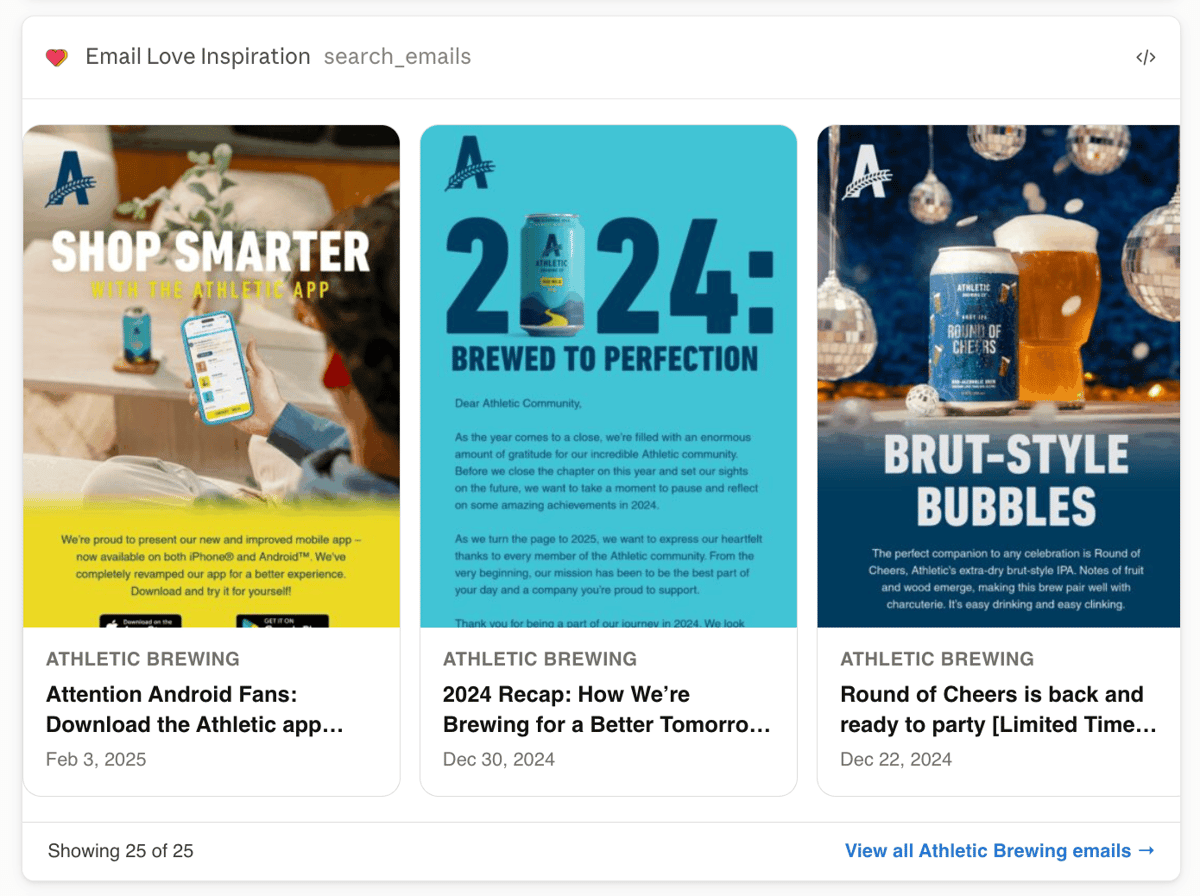
Start with one brand, because this is where it clicked for us. We pulled Athletic Brewing’s sends from last season, with dates and offers: Oktoberfest on Sep 30, the Dark & Gourdy pumpkin brew on Oct 6, a Halloween loyalty push on Oct 24, a Veterans Day limited edition on Nov 11, 30 percent off with free shipping on Cyber Weekend, a holiday limited product on Dec 22, and a year-in-review on Dec 30.
The pattern is pretty clear: Athletic starts seasonal pushes early, uses limited products to create the moment, saves its deepest discount for Cyber Weekend, and switches back to brand storytelling before the year ends. That’s their whole strategy, reconstructed in a minute, and every line links to the actual email.
Across all nine beverage brands, six patterns showed up:
- Seasonal products come before discounts. Athletic, poppi, Health-Ade, and Liquid Death all lead seasonal moments with limited-time products, not price cuts.
- Holiday starts earlier than you think. Health-Ade launched its holiday flavor on October 7. poppi dropped Cranberry Fizz on November 3, before Black Friday.
- BFCM is the one big discount window. Standard promos run 15 to 21 percent all year. Black Friday week jumps to 30 to 40, and Health-Ade’s 40 percent was the deepest we found.
- Early access opens it. Recess opened early access on November 19, a full week before Black Friday. Olipop used early access to grow its SMS list.
- Content fills the space between promotions. Recess sends recipes, gift guides, and holiday-stress content between offers. Nobody sends offer after offer.
- For NA brands, Dry January behaves like Black Friday. Ritual runs it as a month-long arc: sale opens January 3, urgency on the 9th, an extension on the 12th, encouragement mid-month, last chance on the 31st.
The send-time data backs the same picture. Promos go out midday, Tuesday through Friday. Sunday is a real content day in this category. Product drops land early in the week. And subject lines follow brand voice, not category rules: Ghia averages 21 characters and almost no emoji, poppi averages 34 characters with 1.8 emojis per line, in the same market.
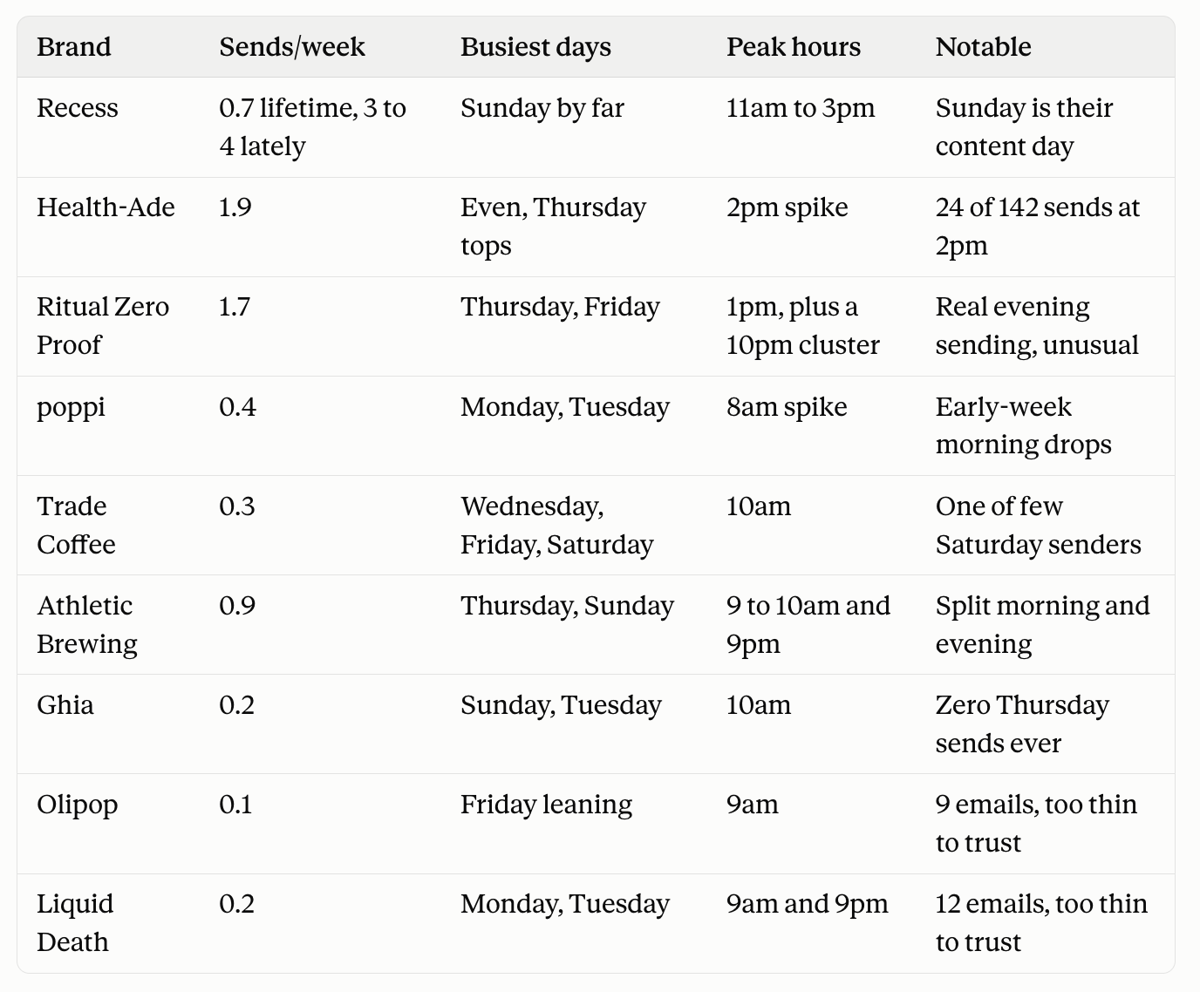
Most of these brands send highly visual, image-only emails, and most aren’t optimized for dark mode, so there’s room for improvement in how their emails actually read in the inbox. The fundamentals are covered though: all nine send through Klaviyo and all of them pass SPF, DKIM, and DMARC.
How we pulled it together
The dataset is the Email Love library: almost 500,000 marketing emails, growing by more than 1,000 a day. The Email Love MCP makes it queryable from Claude in plain English, which turns it from an inspiration archive into a competitive research tool.
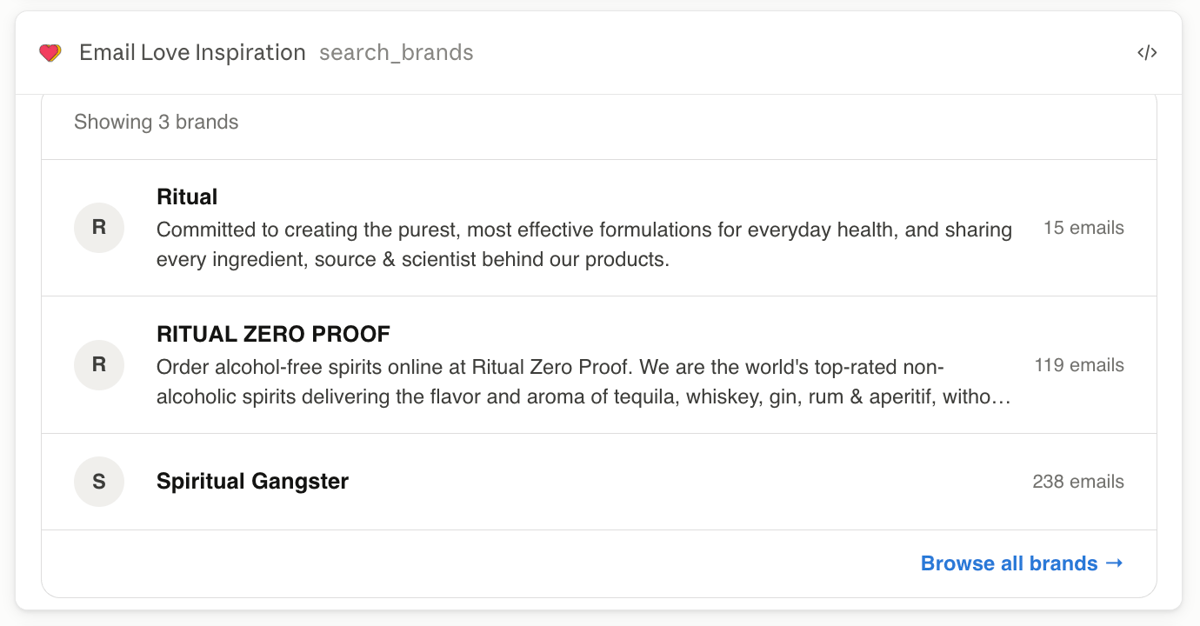
The first thing to check is how much history the library actually has for each brand before you pull anything. Every brand comes back with an email count. In our run, Recess had 264 captured emails, Athletic Brewing had 31, and Olipop had 9. Under about 15 and you’re getting style notes, not strategy. Five or six brands with real coverage beats ten with gaps.
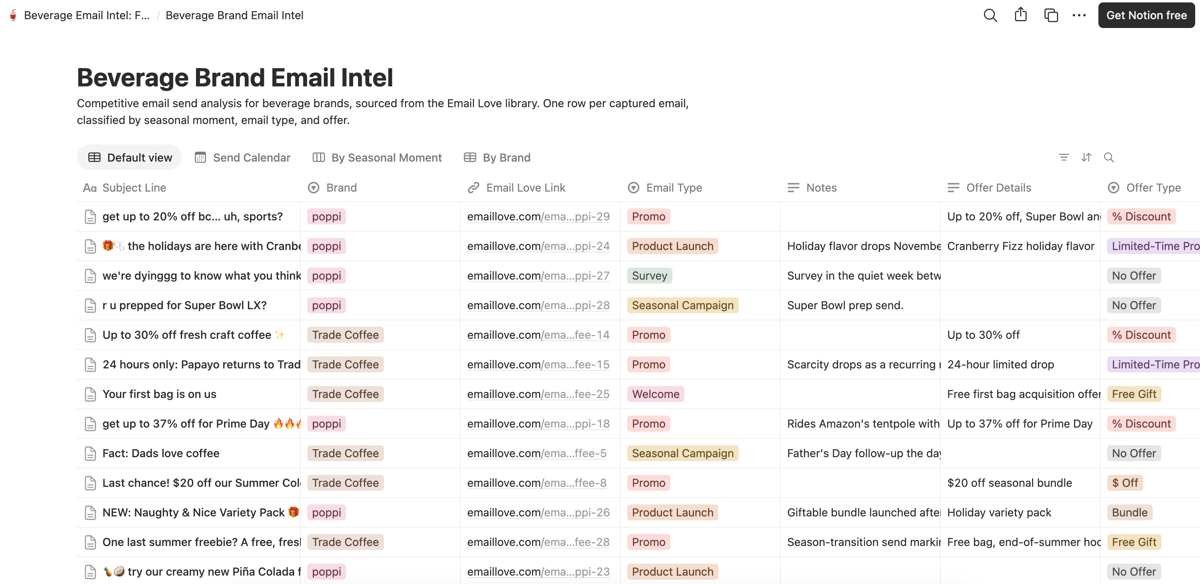
Then pull sends brand by brand and sort everything into a Notion database: one row per email, tagged by brand, date, seasonal moment, email type, and offer. Put a calendar view on it and the whole year is on one screen. From there the calendar mostly writes itself, because each slot gets a date, an offer depth, and a linked example of what the market did in that slot last year.
It’s not a beverage trick
We ran the same exercise for a skincare brand to check that the approach works across verticals. Kiehl’s was at 30 percent sitewide from November 19. Summer Fridays discounted one hero product and kept the rest at full price. Tatcha never named Black Friday in a single captured send. Three big brands in the same category handled Black Friday in three different ways, and if you’re planning against them, that’s worth knowing before you set your own offers. The whole calendar is public if you want to take a look: Glow Theory Lifecycle Calendar. We published it exactly as the skill built it.
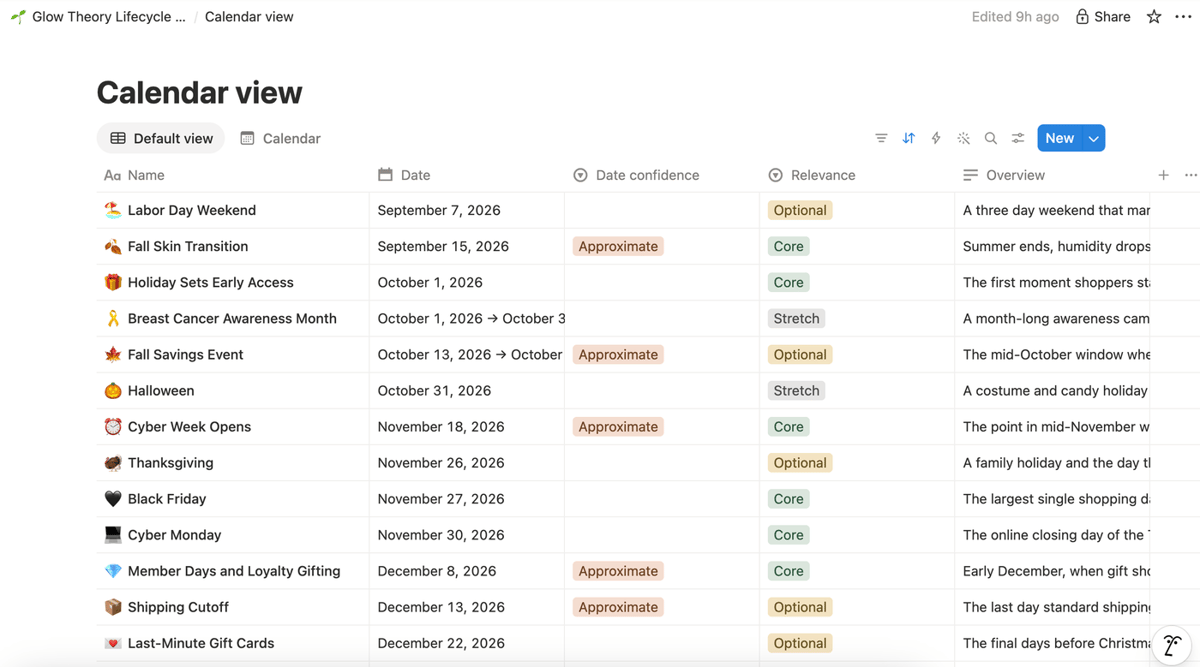
We packaged the workflow as a free Claude skill: competitive-lifecycle-calendar. It builds a ranked year-of-moments calendar in Notion, writes the competitive evidence into every core moment, and summarizes how deep your market discounts and where discounting isn’t done. Structure adapted, with credit, from Luke’s skill.
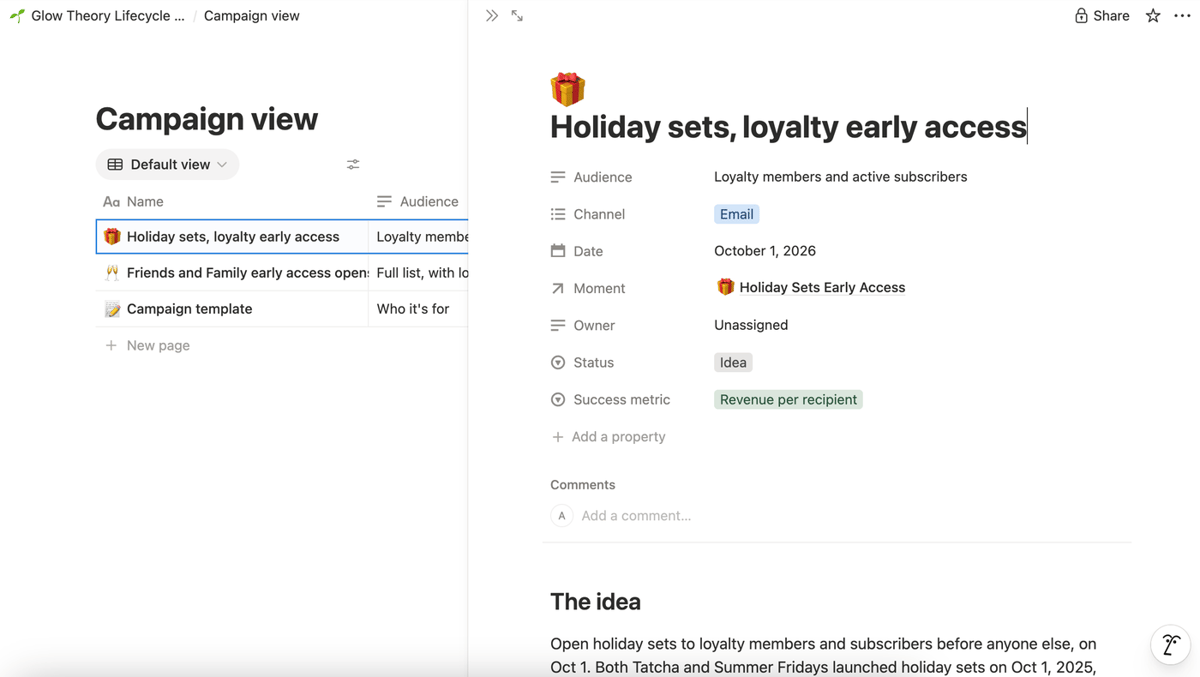
The skill plans campaigns against the moments too. This one opens holiday sets early access on Oct 1 because Tatcha and Summer Fridays both launched holiday sets on Oct 1 last year.
If you’d rather run it by hand, copy this prompt:
I run lifecycle marketing for a [category] brand aimed at [audience]. Using the Email Love MCP, find 5 competitor brands with good coverage in the library, map every seasonal email they sent over the last twelve months with dates, offers, and discount depths, then build me a twelve month send calendar with the evidence behind each slot.
Plan from what happened
Your competitors have already done the planning. Their emails tell you when they start holiday, when they discount, which products they push, how often they send, and what they do when they aren’t selling.
You don’t need to guess what a good calendar looks like. Look at the market, find the patterns, and build yours from the evidence. Connect the MCP, grab the skill or run the prompt, and start planning from what actually happened, not what you remember happening.
Much love,
Andy
Email: [email protected]
Twitter: @emaillove


