
On this page · 5 min read
This week, someone emailed me a question about their Email Love account. I read it. I typed out a reply. I hit send.
Their response? “Is this AI or a real human?”
So I did what any rational person would do. I took a selfie of myself sitting in front of the reply and sent it back as proof.
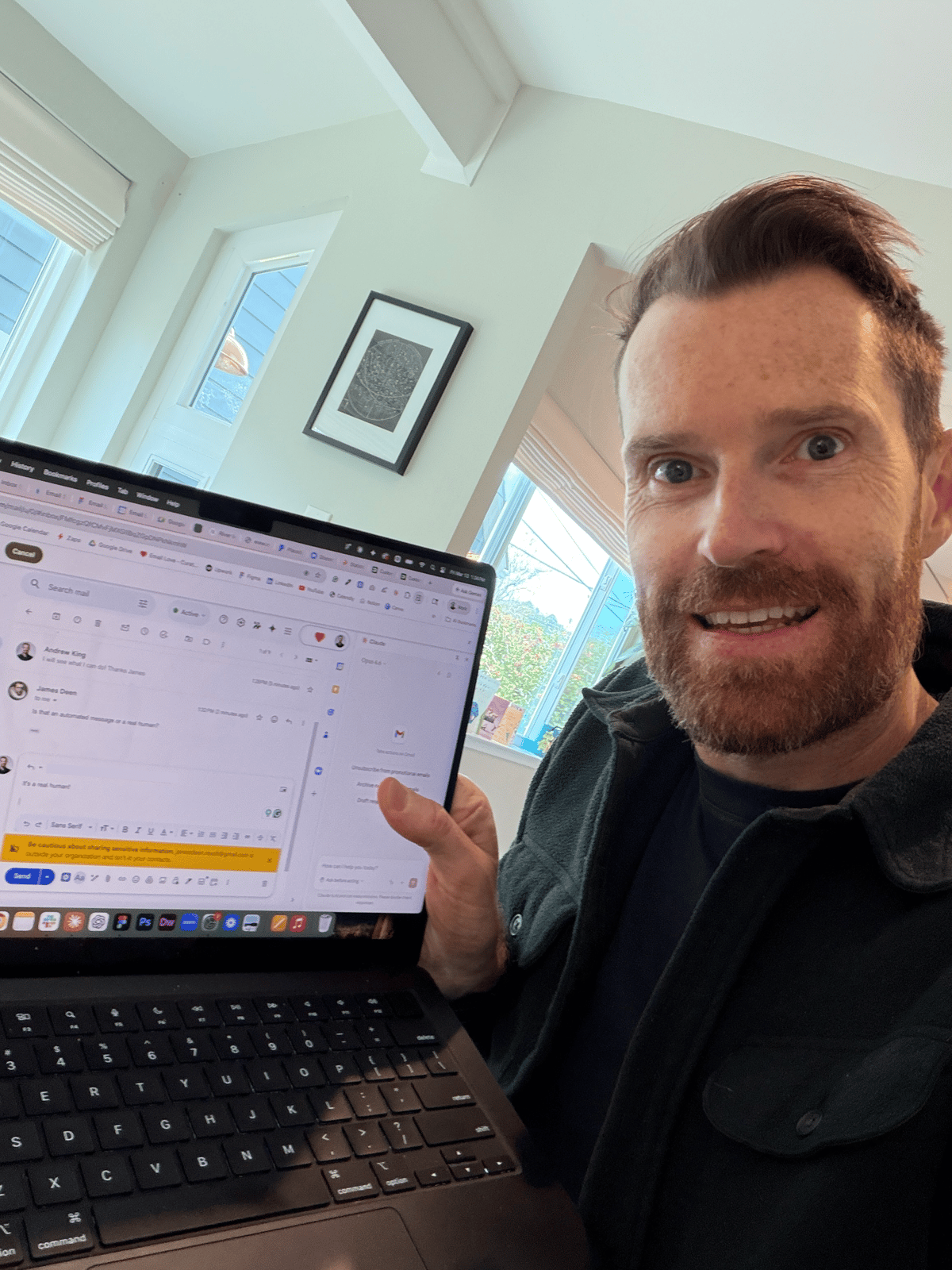
(That’s me, a real human man)
They loved it.
But here’s the thing that stuck with me afterward. We’ve reached a point where a genuine, thoughtful reply from a real person is so unusual that people genuinely can’t tell if they’re talking to a human or a bot. And I think that says something pretty important about the direction we’re heading.
The inbox trust problem
Think about the last time you emailed a company and got a reply that felt like a real person wrote it. Not a template with your first name jammed in. Not a “Thanks for reaching out! We value your feedback!” auto-response. An actual reply from someone who read your message and responded to what you said.
It’s rare. And that rarity has created a weird new problem. When a real human does reply, the default assumption is that it must be AI.
I don’t blame people for thinking that. Most brands have made it pretty clear they’d rather not hear from you. No-reply addresses. Chatbots that send you in circles. Support forms that feel like screaming into the void.
What I learn from actually reading my emails
I reply to a lot of emails personally. Not because I’m trying to be a hero. Because it’s genuinely one of the most useful things I do all week.
Here’s what happens when you actually read and respond to the emails people send you.
You find out what’s confusing about your product. Not what your analytics say is confusing. What’s actually confusing to real people trying to use it right now. There’s a difference.
You hear what people actually want to build. Someone might email asking about a feature we don’t have yet, and that question shapes our roadmap more than any product planning session.
You build relationships that compound over time. That person who got my selfie? They’re going to remember that interaction. They’ll probably tell someone about it. You can’t buy that kind of connection with a drip campaign.
You notice patterns. When three different people email you about the same problem in the same week, that’s a signal. If those emails were being filtered through an AI responder, I’d probably miss it entirely.
Where I actually do use AI for email
I’m not anti-AI in email. I’d be a hypocrite if I said that, given that we’re building AI features into the Figma Plugin right now.
I use AI and Zapier to handle one specific scenario. When someone cancels their Email Love Figma Plugin subscription, an AI-generated message goes out asking for feedback. It’s personalized to their account and usage. It’s specific enough to feel thoughtful.
And it works. I get useful feedback from people who would otherwise just disappear.
The key distinction is what AI is doing in that flow. It’s collecting information, not providing support. It’s asking a question, not answering one. That’s an important difference.
The AI support bot loop (we’ve all been there)
Now let me talk about where AI in email falls apart. Because I have strong feelings about this.
You know the loop. You email a company with a specific problem. The AI bot reads your message, identifies a keyword, and sends you to a support doc that has nothing to do with your actual issue. You reply, explaining that the doc didn’t help. The bot sends you to another doc. Or worse, it just closes the conversation because nobody mapped out that particular edge case.
I’ve been caught in this loop more times than I can count. And every single time, I think: someone at this company decided that saving money on support staff was more important than actually helping their customers.
The root problem isn’t that AI is bad at support. It’s that most companies implement AI support without thinking through all the use cases first. They deploy it, dust off their hands, and move on. The people who fall through the cracks just… fall.
I personally don’t use AI to reply to support emails or write support responses for this exact reason. The edge cases are where trust is built or destroyed. And AI hasn’t earned that trust yet.
When to automate vs. when to show up
If you’re thinking about where AI fits in your own email workflow, here’s the simple framework I use.
When someone is asking for help, that’s a human conversation. Support, troubleshooting, anything where someone is frustrated or confused. A real person should be on the other end of that. If you absolutely can’t do that, make it dead simple to escalate to a human. Not three clicks and a dropdown menu. One click. “Talk to a person.” Done.
When you’re collecting feedback or data, AI works great. Post-purchase surveys, cancellation feedback, NPS follow-ups. These are structured interactions with predictable inputs. Let AI handle the outreach. Just make sure a human actually reads the responses.
When it’s high-value or high-stakes, show up personally. A big customer has a question? Reply yourself. Someone’s considering a large contract? Don’t let a bot handle the first impression. The time you invest in these conversations pays back exponentially.
The bigger point
I think the brands that are going to win long-term are the ones using AI to free up time for more human interaction. Not less.
Right now, most companies are using AI to replace human touchpoints. The goal seems to be: how few humans can we involve in talking to our customers? And look, I get the economics. I run a small company. I understand the appeal of automating everything.
But the person who emailed me this week and got a selfie in return? They’re going to be a customer for a long time. Not because of my product. Because they felt like they were talking to someone who actually gave a shit.
That’s not something you can automate.
What about you?
I’m curious where you land on this. Are you using AI to reply to customer emails? Has it worked well or created more problems? Have you been stuck in the AI support bot loop yourself?
I’d love to hear your experience. And yes, if you reply, a real human will read it. I might even send a selfie to prove it.
Much love,
Andy

Andy has spent two decades building email programs for brands and agencies, and now co-runs Email Love: the inspiration gallery of 577,000+ emails and the Figma plugin that lets teams design, build, and export production-ready email without leaving their design file. He writes about email design systems, production workflow, and where the industry is heading.

Customer.io delivers more impact from every message–unifying data, messaging, and AI into one platform so every customer interaction gets smarter over time. We help teams build personalized campaigns across email, SMS, push, in-app, and webhooks, using their own first-party data to reach the right people with the right message at the right moment. AI is built into the platform to remove the grunt work, letting marketers focus on strategy, not setup. Over 9,000 brands trust us to power their messaging.